
The arena on the bay
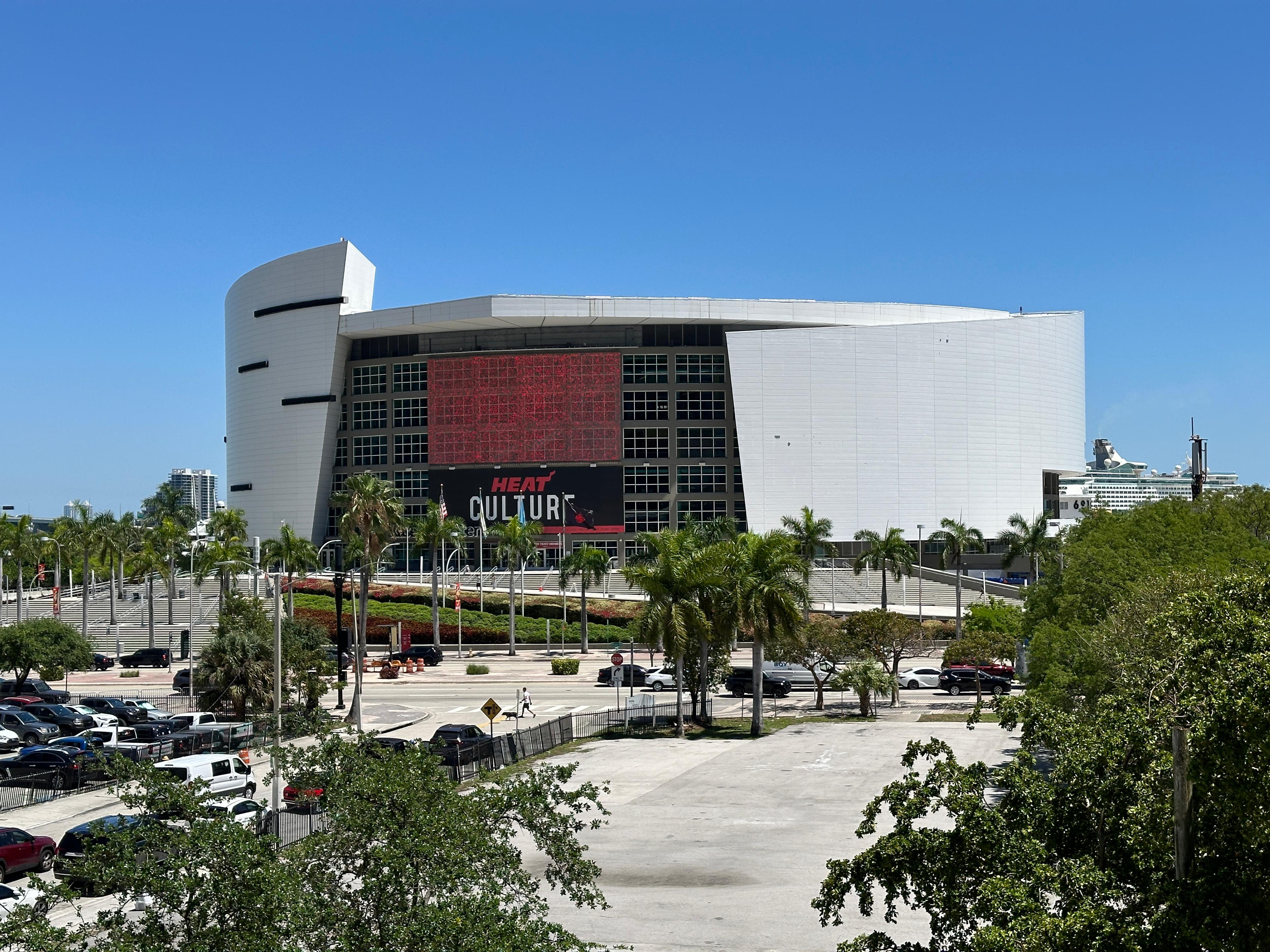
There are not many NBA arenas you reach by waterfront promenade. Kaseya Center stands at 601 Biscayne Boulevard, at the downtown edge of Biscayne Bay, with its broad entrance plaza facing the water and the cruise ships of PortMiami in the distance. To the south is Bayfront Park; a short walk north along the bay is Maurice A. Ferré Park, home to the Pérez Art Museum Miami and the Frost Museum of Science. The arena anchors a stretch of downtown that Miami built for looking outward — museums, parks, and a basketball arena in a row along the water.
It is a working building first and a landmark second. The Miami Heat have played here since January 2000, and the arena's calendar runs on their season from October through April, then flips to the biggest concert tours, Latin music awards, boxing, UFC cards, and family shows. It seats 19,600 for basketball, with 2,105 club seats, 80 luxury suites, and 76 private boxes, and it can be reconfigured for concerts from about 5,000 seats in its intimate theater setup to more than 20,000 for a full arena show. Inside the same complex is the Waterfront Theater, the largest indoor theater in Florida, seating between 3,000 and 5,800 — a room within the room, used for concerts, worship events, family shows, and awards ceremonies.
For a visitor, the first thing to understand is that this is not a museum with opening hours. It opens for events. You do not wander in on a Tuesday afternoon to look around; you come for a game or a show, and the building rewards you for arriving early — the plaza, the bay, and the downtown skyline are part of the ticket.
From Miami Arena to the bayfront
The arena exists because the Heat nearly left. In 1997, the team's owners — then playing in the eight-year-old, publicly financed Miami Arena, a few blocks west — threatened to move the franchise to Broward County unless Miami-Dade County gave them the $38 million bayfront parcel for a new arena. The county agreed, on terms that gave it 40 percent of the arena's annual profits above $14 million. Construction began on February 6, 1998, and the new building rose on the bay in under two years.
It was designed by Arquitectonica, the Miami firm, with 360 Architecture (then Heinlein Schrock Stearns). The design team included George Heinlein, Cristian Petschen, Reinaldo Borges, and Lance Simon; Parsons Brinckerhoff managed the project, Thornton Tomasetti engineered the structure, and Morse-Diesel, Odebrecht, and Facchina built it. The construction cost was $213 million. The arena opened as the American Airlines Arena on December 31, 1999 — a New Year's Eve concert by Gloria Estefan was the first event — and two days later, on January 2, 2000, the Heat played their first game in the new building, beating the Orlando Magic 111–103.
The old Miami Arena, the Heat's first home, was demolished in 2008. The bayfront building has now been the team's home for more than a quarter of a century, and it has outlasted the naming deal that gave it its first name, the crypto exchange that gave it its second, and the interim name that followed.
Arquitectonica's waterfront arena
Arquitectonica's design is unmistakably of its moment: a big, pale, sculptural box on the water, with a rounded corner tower, a tall gridded facade, and a wide red panel at its center, set behind trees and a broad plaza. It does not imitate the Mediterranean Revival or Art Deco buildings Miami is known for; it is a late-1990s arena that wears its engineering plainly, and its best angle is from the bay, where the whole white mass sits against the downtown towers.
The building has two signatures that date to its opening. The first is on the roof: as part of its sponsorship deal, American Airlines had a giant aircraft painted atop the arena, with the airline's logo in the center — a design meant to be read from airplanes taking off and landing at Miami International Airport, where American has a hub. The arena's luxury skyboxes were called "Flagship Lounges," borrowing the name of American's premium-class airport lounges, and until the renaming the building used the airline's 1967–2013 logo. The second signature hangs over the court: the scoreboard, designed by the artist Christopher Janney and installed in 1998 as part of the original construction. Drawing on the forms of underwater anemones, it changes colors depending on the atmosphere in the building — a piece of public art that is also the room's centerpiece, and a quiet nod to the bay outside the doors. Fans shortened the original name to "Triple-A" or "A3," and the nickname stuck through every renaming that followed.
Inside, the building is more than a basketball bowl. The Waterfront Theater, carved into the arena complex, is the largest indoor theater in Florida; it hosted the 2020 NFL Honors ceremony, broadcast nationally on the eve of the Super Bowl in Miami. The arena also has a regulation NHL-size ice rink, though it has never hosted hockey — the Florida Panthers play in Sunrise — and the rink instead serves ice shows such as Disney on Ice.
Three banners: the Heat's championship years
The reason the building matters to Miami is the basketball played in it. The Heat have hosted NBA Finals games here in 2006, 2011, 2012, 2013, 2014, and 2023, and three championship banners hang from its rafters.
The first title came in 2006, when the Heat met the Dallas Mavericks in the Finals — a series between two franchises making their first Finals appearance, in two arenas that both carried the American Airlines name, which is why people called it the "American Airlines series." The Heat clinched the championship in Dallas, but the Finals games in Miami announced the building as a championship stage. The rematch came in 2011, and that time Dallas won in Miami.
The back-to-back titles of 2012 and 2013 were won at home, and they are the building's defining nights. In 2012, the Heat beat the Oklahoma City Thunder in five games, clinching the championship on the Biscayne Bay court. In 2013, against the San Antonio Spurs, the Heat trailed the series three games to two coming home — and won Games 6 and 7 in Miami to defend the title, Game 6 saved by Ray Allen's corner three-pointer in the final seconds, one of the most famous shots in NBA history. The Spurs took the 2014 rematch. The Heat returned to the Finals in 2023, by then under the building's current name, and lost to the Denver Nuggets.
Those three championships belong to the Pat Riley era, and the building now says so on its floor: in October 2024, the court was dedicated as the Pat Riley Court at Kaseya Center, honoring the coach and executive who led the Heat to all three titles and helped bring LeBron James and Chris Bosh to Miami in 2010. The Heat are the building's permanent tenants — the arena's only NBA tenant since it opened, joined in its first years by the Miami Sol of the WNBA, who played here from 2000 to 2002 — and since 2015 the arena has also hosted the annual Hoophall Miami Invitational, a college basketball showcase.
More than basketball
Between basketball seasons, the arena is South Florida's biggest concert room, and its stage history reads like a survey of popular music: Gloria Estefan opened it, and since then it has hosted U2, Madonna, Taylor Swift, Shakira, Coldplay, Lady Gaga, Adele, Cher, Celine Dion, Tina Turner, Mariah Carey, Janet Jackson, Justin Timberlake, Katy Perry, Ariana Grande, Billie Eilish, Dua Lipa, Rihanna, Maroon 5, and the Latin stars who treat Miami as a homecoming: Jennifer Lopez, Marc Anthony, Ricardo Arjona, and RBD, among many others.
It is also, fittingly for Miami, the home of Latin music's biggest nights. The arena has hosted the annual Premio Lo Nuestro awards since 2001, and the Latin Grammy Awards in 2003, 2020, and again on November 14, 2024. The MTV Video Music Awards came here in 2004 and 2005. The 2004 and 2005 VMAs, the For Darfur benefit concert, and the Sensation dance event all filled the same bowl where the Heat play.
The fight calendar is just as long. The arena hosted the Royal Rumble in 2006, Survivor Series in 2007 and 2010, and Hell in a Cell in 2013, and Brock Lesnar made his famous return to WWE here on April 2, 2012. In mixed martial arts, it hosted the first UFC event ever held in Florida — UFC 42 on April 25, 2003 — and the promotion came back after twenty years for UFC 287 in April 2023, then again for UFC 299 in March 2024 and UFC 314 in April 2025. The circus closed here, too: in January 2017, the Ringling Bros. and Barnum & Bailey Circus announced its closing after its shows at the arena. And in a sign of how thoroughly the building has entered Miami's self-image, the Sahara Arena in the video game Grand Theft Auto VI — set in a fictionalized Miami — is based on the Kaseya Center.
Four names in four years
No arena in America has changed its name quite the way this one did. It opened as the American Airlines Arena in 1999, and the airline held the naming rights for more than twenty years — until September 10, 2019, when American announced it would not renew. The name stayed on the building while a new sponsor was sought, and the court decals were finally removed before the 2020–21 season.
In March 2021, the cryptocurrency exchange FTX bought the naming rights for $135 million over 19 years; the NBA approved the deal in early April, and the building became FTX Arena in June 2021. Nineteen months later, FTX collapsed. The exchange filed for bankruptcy on November 11, 2022, and the naming agreement was terminated effective January 2023. For three months the building was officially the Miami-Dade Arena, its facade bare, while the county looked for a new sponsor. In April 2023, Miami-based software company Kaseya signed a 17-year, $117.4 million naming agreement, and the building became the Kaseya Center. Under the deal, the county receives the majority of the naming-rights revenue; the Heat receive $2 million a year.
The churn is part of the story now — a building that has been, in order, an airline's billboard, a crypto exchange's monument, a county's placeholder, and a hometown software company's namesake, without ever moving an inch. Miami-Dade County still owns the arena, and Basketball Properties Ltd. operates it. Whatever the name on the facade, the address has never changed: 601 Biscayne Boulevard, on the bay.
How to visit
The Kaseya Center is an event venue, not a museum — it opens for ticketed events, so there are no regular visiting hours. Check kaseyacenter.com for the current calendar of Heat games, concerts, and shows, and buy tickets through the arena's official channels. The Heat season runs October through April; the concert calendar fills the rest of the year.
Getting there without a car is easy, and it is the best way to arrive. Take the Metrorail to Government Center and transfer — free — to the Metromover's Omni Loop, which stops at Freedom Tower and Park West stations, both a short walk from the arena. The Historic Overtown/Lyric Theatre Metrorail station is also within walking distance, and Brightline's MiamiCentral station is nearby. If you drive, the arena has 939 on-site parking spaces, reserved for premium-seat holders during Heat games. Miami International Airport is about eight miles west.
Arrive early and use the setting. Walk the plaza before the doors open, look back at the downtown skyline from the bay side, and pair the visit with the waterfront around it — Bayfront Park to the south, the Pérez Art Museum Miami and the Frost Museum of Science a short walk north in Maurice A. Ferré Park. The arena is the loudest building on this stretch of the bay, and on a game night, when the scoreboard glows and the plaza fills, it is the center of downtown Miami.
Key Facts
- Kaseya Center is at 601 Biscayne Boulevard, Miami, FL 33132, on Biscayne Bay in downtown Miami. Coordinates: 25.78139, -80.18806.
- The arena opened as the American Airlines Arena on December 31, 1999, inaugurated with a concert by Gloria Estefan; construction cost $213 million. Groundbreaking was February 6, 1998. It replaced the Miami Arena as the home of the Miami Heat.
- The arena was designed by Arquitectonica and 360 Architecture (formerly Heinlein Schrock Stearns); the design team included George Heinlein, Cristian Petschen, Reinaldo Borges, and Lance Simon. Project manager was Parsons Brinckerhoff; structural engineer Thornton Tomasetti; general contractor Morse-Diesel/Odebrecht/Facchina. Owner: Miami-Dade County. Operator: Basketball Properties Ltd.
- The Miami Heat played their first game in the arena on January 2, 2000, defeating the Orlando Magic 111–103. The Heat have been tenants since 2000; the Miami Sol of the WNBA played here from 2000 to 2002.
- Basketball capacity is 19,600 (the arena's own text also gives 19,500 in some sources); concert capacity ranges from 5,000 to 20,021 depending on configuration; hockey capacity 14,447. The arena has 2,105 club seats, 80 luxury suites, and 76 private boxes, and 939 parking spaces.
- The Waterfront Theater inside the arena complex seats 3,000 to 5,800 and is the largest indoor theater in Florida. It hosted the 2020 NFL Honors on February 1, 2020.
- The arena's scoreboard was designed by artist Christopher Janney and installed in 1998 as part of the original construction; drawing on underwater anemone forms, it changes colors depending on the atmosphere in the building.
- As part of the original sponsorship, American Airlines had a giant aircraft painted atop the arena's roof, with the airline's logo in the center, visible from airplanes using Miami International Airport. The luxury skyboxes were called "Flagship Lounges." Fans nicknamed the building "Triple-A" or "A3."
- The Heat hosted NBA Finals games at the arena in 2006, 2011, 2012, 2013, 2014, and 2023, winning championships in 2006 (clinched in Dallas), 2012 (clinched at home over Oklahoma City in five games), and 2013 (won Games 6 and 7 at home over San Antonio, including Ray Allen's game-tying three-pointer in Game 6). The court was dedicated as the Pat Riley Court at Kaseya Center in October 2024.
- Naming history: American Airlines Arena, 1999–2021 (American announced on September 10, 2019 that it would not renew); FTX Arena, June 2021–January 2023 ($135 million, 19-year deal signed March 2021; terminated after FTX's bankruptcy on November 11, 2022); Miami-Dade Arena, January–April 2023 (interim name); Kaseya Center since April 2023 (17-year, $117.4 million agreement with Miami-based software company Kaseya; the county receives the majority of the naming revenue and the Heat $2 million annually).
- The arena has hosted the Premio Lo Nuestro Latin music awards annually since 2001; the Latin Grammy Awards in 2003, 2020, and 2024; the MTV Video Music Awards in 2004 and 2005; the Royal Rumble (2006), Survivor Series (2007, 2010), and Hell in a Cell (2013); UFC 42 on April 25, 2003 (the first UFC event in Florida), UFC 287 in April 2023, UFC 299 in March 2024, and UFC 314 in April 2025; and the final Ringling Bros. and Barnum & Bailey Circus shows in January 2017, after which the circus's closing was announced.
- The arena has hosted the annual Hoophall Miami Invitational college basketball showcase since 2015. The Sahara Arena in the video game Grand Theft Auto VI is based on the Kaseya Center.
- Transit: Metrorail to Government Center, free transfer to the Metromover Omni Loop to Freedom Tower and Park West stations; Historic Overtown/Lyric Theatre Metrorail station and Brightline's MiamiCentral station are nearby. Miami International Airport is about eight miles west.
Location Photography