A House Named for Something That Clings to a Hull
Walk down the winding trail through the hardwood hammock off Main Highway in Coconut Grove — a path Ralph Middleton Munroe cut barely wide enough for one buggy, so the old forest would survive around it — and the trees open onto a lawn, a wide-porched house, and Biscayne Bay glittering beyond. This is The Barnacle Historic State Park: five bayfront acres holding the oldest house in Miami-Dade County still standing in its original location. Munroe built the house in 1891, five years before Miami was incorporated, in the era Florida State Parks calls the Era of the Bay, when every trip to this coast began and ended by sail. He named it The Barnacle, presumably, the National Register nomination suggests, because its form resembled one — a broad octagonal central room clinging to its pilings above the shore. The house is now the Munroe House Museum, furnished much as the family left it, and the park around it remains one of the last remnants of the original Miami hammock. In a county that reinvents its waterfront every generation, The Barnacle simply refused to move.
The Commodore Comes to the Bay
Ralph Middleton Munroe first visited South Florida in 1877, on vacation from New York. On a later trip he brought his wife, who suffered from tuberculosis, hoping the climate would cure her; it did not, and she died and was buried in Coconut Grove. Munroe kept returning, and in 1886 he bought 40 acres of bayfront land for $400 in cash plus one of his sailboats, the Kingfish, valued at another $400. He built his boathouse in 1887 and lived on its upper floor while the main house rose. In the spring of that year he organized Biscayne Bay's first regatta, and when local sailors formed the Biscayne Bay Yacht Club in 1887, they elected Munroe their Commodore — a title he held for 22 years, and the one Miami kept using for the rest of his life. He remarried in the mid-1890s — Jessie Wirth, with whom he raised a daughter, Patty, and a son, Wirth, in the house — and built a life that mixed yacht design, salvage work, photography, natural history and civic founding. The Barnacle was its headquarters: part home, part boatyard office, part clubhouse for a settlement that had no city yet.
A Boatbuilder Builds a House — Then Lifts It
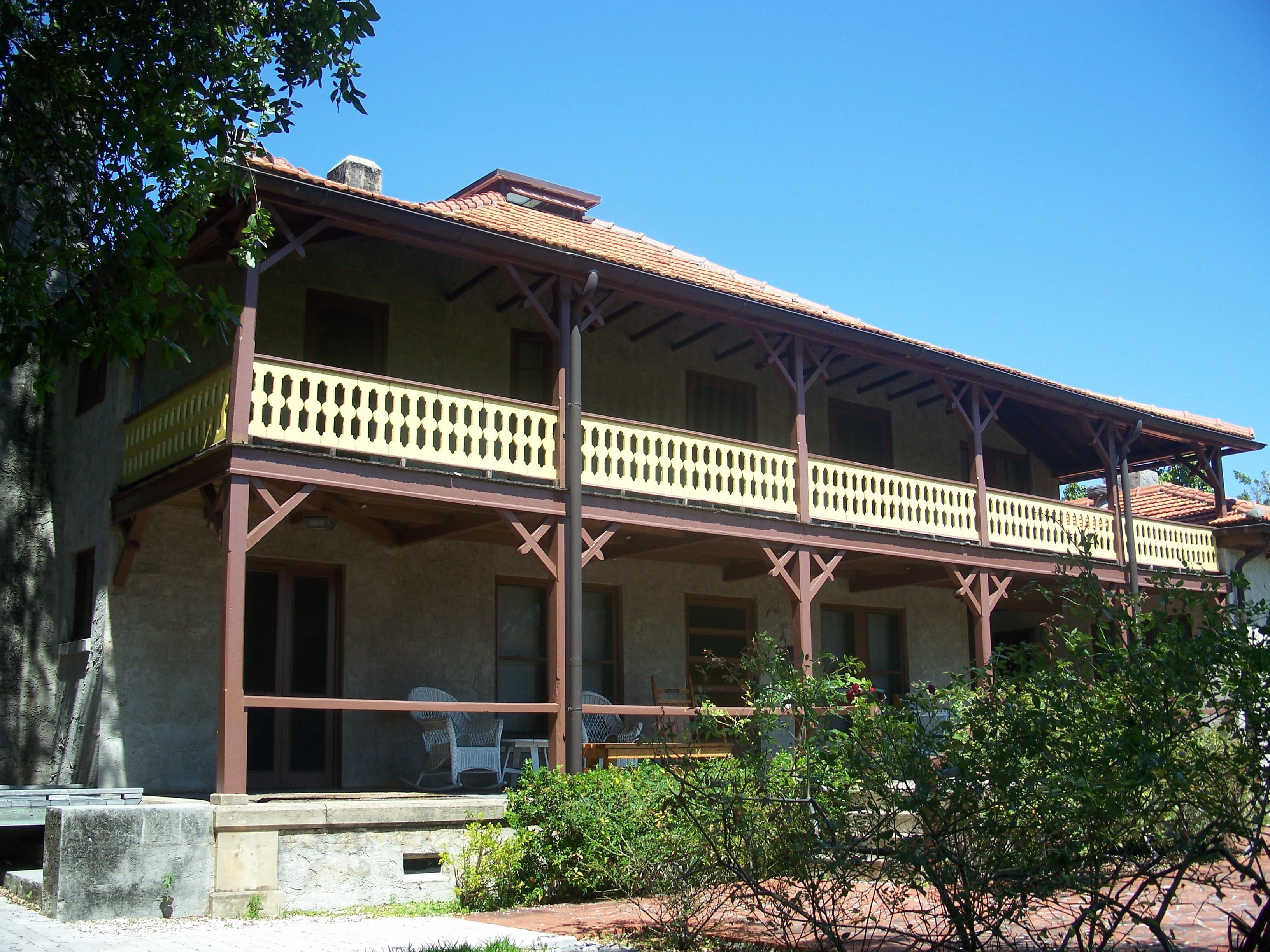
Munroe designed houses the way he designed boats: for wind, water and shallow ground. The Barnacle went up in 1891 as a one-story bungalow raised on wooden pilings, its octagonal central room and wide porches arranged to pull the bay breeze through and to let storm water pass beneath. The design worked. The house survived the Great Miami Hurricane of 1926 — which destroyed the original boathouse, later rebuilt along the same lines — and Hurricane Andrew in 1992, each time with only minor damage, while more conventional buildings around it failed. The house's strangest chapter came in peacetime. By 1908 the family needed more room, so Munroe had the entire structure lifted and a new first story built underneath it — which is why, as Florida State Parks points out, the second floor of The Barnacle is older than the first. A library followed in the early 1910s, electricity and indoor bathrooms after that, and porch enclosures in 1928 gave the house its present form. On the grounds stand the other survivors: the reconstructed Commodore's Boathouse, first meeting place of the Biscayne Bay Yacht Club's founders, and the 1927 Carriage House, where Munroe and his wife lived during the house's last major renovation.
Fifty-Six Yachts and Two Replicas in the Water
Munroe's real life's work floated. Over his lifetime he drew plans for 56 different yachts, specializing in shallow-draft designs — sharpies and proas — that could work Biscayne Bay's skinny water, where channels were few and sandbars were everywhere. In the Era of the Bay, that was not a hobbyist's skill; boats were the area's only real transportation, and a good designer was infrastructure. The park keeps that legacy in the water: replicas of two Munroe designs lie at the site, the Egret, a 28-foot sharpie ketch he designed in 1886, and the Flying Proa of 1898. One original did not survive. The Micco, among the last of Munroe's boats and already 101 years old, was displayed at the park until Hurricane Andrew reduced it to fragments in 1992 — the same storm the house rode out with barely a mark. Munroe died on August 20, 1933, at 82. His family kept the house for another forty years, through his widow Jessie's death in 1940 and his son Wirth's tenure, until 1973, when his descendants sold the surviving five acres of the original forty to the State of Florida. The Barnacle had outlived the Era of the Bay, the railroad age that ended it in 1896, and the city that grew up to surround it.
Five Acres of Old Florida, Kept on Purpose
What the state bought in 1973 was more than a house. Because Munroe cleared only his narrow buggy trail, the park preserves a mature tropical hardwood hammock — one of the last remnants of the forest that once covered this coast — where herons, pelicans, kingfishers and migrating songbirds still work the line between woods and bay. The grounds remain deliberately unmanicured by Miami standards: a lawn for picnics and the park's frequent outdoor concerts, rocking chairs on the porch, sailboats crossing the view exactly as they did in Munroe's photographs — he was an accomplished photographer, and his images of early Coconut Grove are a historical record in themselves. The house interior, seen by guided tour only, still holds many original furnishings, and its passive-cooling design is the lesson of the visit: no air-conditioning was ever the point, because the octagon, the porches and the pilings were the system. The Barnacle is on the National Register of Historic Places, and its cultural afterlife keeps growing — in 1988 the house even played a Caribbean hideaway in the Miami Vice finale "Deliver Us From Evil." But its real significance is simpler. Stand on that porch and you are standing where Miami began: not the railroad city of 1896, but the sailing settlement before it, preserved by a man who loved the hammock too much to cut it down.
Key Facts
- The Barnacle was built in 1891 by Ralph Middleton Munroe at 3485 Main Highway, Coconut Grove; it is the oldest house in Miami-Dade County still standing in its original location and is on the National Register of Historic Places.
- Munroe bought 40 bayfront acres in 1886 for $400 plus his sailboat Kingfish (valued at $400). He built the boathouse in 1887 and lived upstairs in it until the main house was completed.
- The house began as a one-story bungalow on wooden pilings with an octagonal central room; in 1908 the whole structure was raised and a new first floor built beneath it, so the second floor is older than the first.
- Munroe was founder and first Commodore of the Biscayne Bay Yacht Club (a title he held 22 years) and designed 56 yachts in his lifetime; replicas of his Egret (1886) and Flying Proa (1898) are kept at the park.
- The house survived the 1926 Great Miami Hurricane and 1992's Hurricane Andrew with only minor damage; Andrew destroyed his 101-year-old boat Micco. The Munroe family sold the remaining 5 acres to the State of Florida in 1973, creating the state park.
Visitor Details
Address: 3485 Main Highway, Miami, FL 33133
Transit: Served by the Miami Metrorail at the Douglas Road and Coconut Grove stations, with a walk or Miami trolley/bus connection to Main Highway in Coconut Grove. Per Florida State Parks, there is no motor vehicle entry and no parking in the park itself except for visitors with disabilities; use the public lot near the Coconut Grove Playhouse or street parking in the neighborhood.
Hours/Admission: Per floridastateparks.org, park grounds are open Thursday through Monday, 9 am–5 pm, and the park is closed every Tuesday and Wednesday, on Christmas Day and on New Year's Day. Pedestrian and bicycle admission is $2 per person (ages 5 and under free). The historic house interior is by guided tour only — tours at 10 am, 11:30 am, 1 pm and 2:30 pm; the house tour is $3 for ages 13 and up, $1 for ages 6–12, free for ages 5 and under. Check floridastateparks.org for current hours and fees before you go.
Best timing: Arrive for the 10 am house tour, before the heat builds, then take the hammock trail and the bayfront lawn while the morning light is on the water. Allow one to two hours. Leashed dogs are welcome on the grounds but not inside the historic house.
Location Photography