12:30 p.m., January 15, 1919
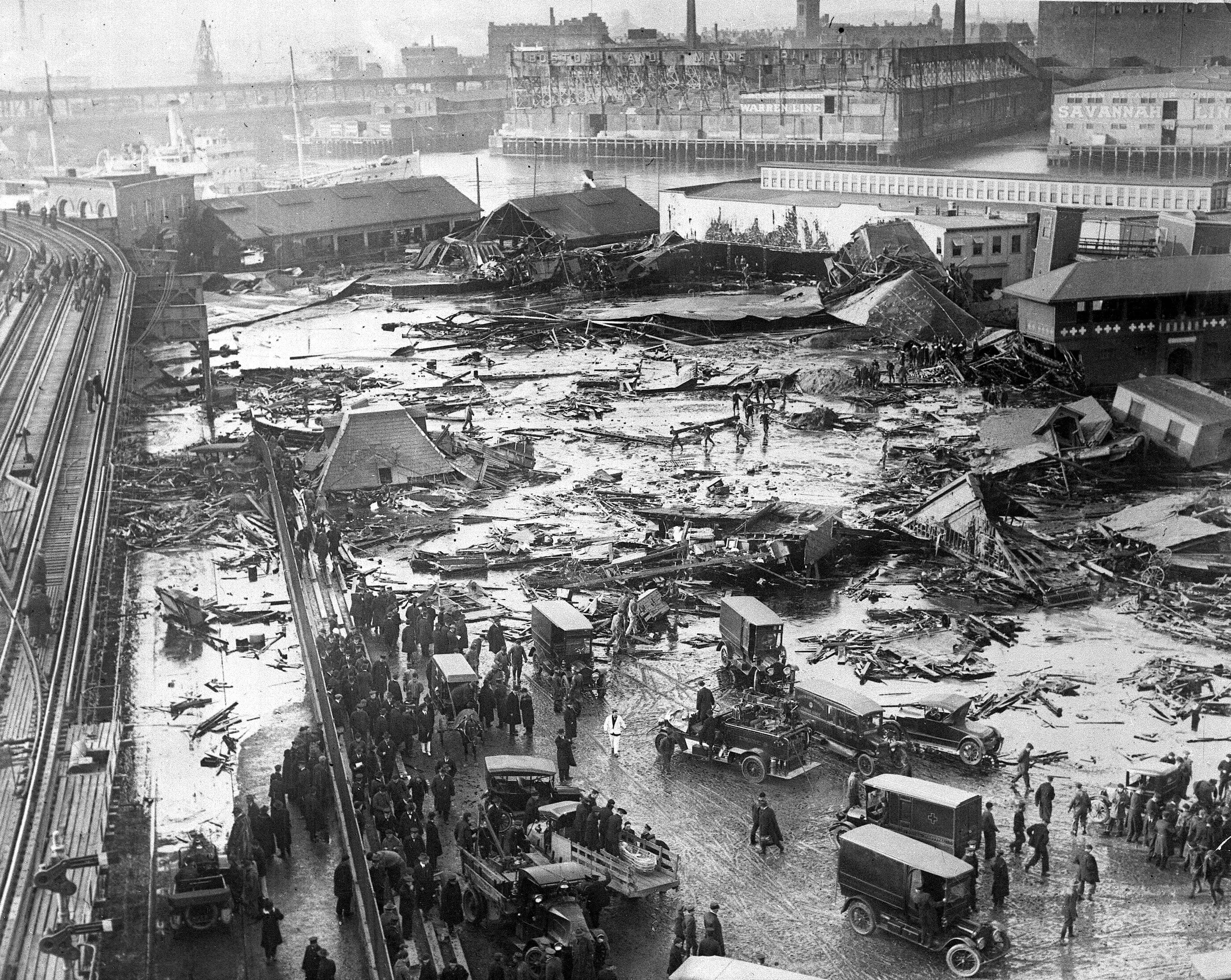
It was lunchtime on an unusually warm January day. Factory workers and children were out on Commercial Street when the rivets of the great molasses tank began to fail. Witnesses described a sound like machine-gun fire as thousands of rivets sheared. The 50-foot steel cylinder at 529 Commercial Street — full to near capacity — split open and collapsed. What came out was 2.3 million gallons of molasses, weighing roughly 13,000 tons. It did not ooze. It surged through the streets as a wall of syrup moving at an estimated 35 miles per hour — a speed a 2016 Harvard fluid-dynamics study later judged credible. The wave crushed freight cars, tore the Engine 31 firehouse off its foundation, and smashed the Boston Elevated Railway's Atlantic Avenue structure so violently that a train was nearly lifted from the tracks. Buildings crumpled; several blocks were flooded two to three feet deep. People and horses caught in it sank deeper the harder they struggled. "Horses died like so many flies on sticky fly-paper," the Boston Post reported the next day. "Human beings — men and women — suffered likewise."
The Tank That Should Never Have Stood
The tank belonged to the Purity Distilling Company, which stored molasses offloaded from ships before piping it to an ethanol plant in Cambridge. In 1919 molasses was serious business: fermented into industrial alcohol, a key munitions ingredient, demand ran high with Prohibition approaching — the 18th Amendment would be ratified the very next day. Purity had been bought by the United States Industrial Alcohol Company (USIA) in 1917. The Hammond Iron Works threw the tank up in a hurry in late 1915 under USIA treasurer Arthur Jell. The contract called for the standard safety test — filling the 50-foot-tall, 90-foot-diameter tank with water to check for leaks. Jell refused: too expensive, too slow. Instead he ordered in six inches of water, just enough to cover the base joint, declared the tank sound, and put it into service. Boston's building department never inspected it — officials classified the tank as a "receptacle," not a building, so the foundation permit was all the paperwork required. From the day it was filled, the tank leaked. Molasses seeped from its seams, and neighborhood children reportedly came with cups and pails to collect the drips. The company's response was to paint the tank brown so the seepage wouldn't show. In the days before the disaster, a fresh load of warm molasses had been pumped in atop colder molasses already inside. Then the temperature, which had sat near 2 degrees earlier in the week, jumped to about 40 degrees on January 15. The molasses expanded, and the thin, brittle steel — a later analysis found it about half as thick as it should have been — gave way.
The Wave
Twenty-one people died. About 150 were injured. The dead included Bridget Clougherty, crushed in her house at 6 Copps Hill Terrace when the wave demolished it, and two ten-year-old children. A dozen or more horses were killed — accounts differ — along with uncounted dogs and cats. Some victims drowned; others died of blunt-force trauma from the debris, or suffocated as the molasses, cooling rapidly in the winter air, thickened around them. Rescuers waded in knee-deep, then waist-deep, and had to be pulled out themselves. The first rescuers were 100-plus cadets from the USS Nantucket, the nautical school ship docked in Boston Harbor. Police, firefighters, and Red Cross nurses followed, setting up a makeshift hospital in an undamaged building. Doctors found victims so completely coated that it was hard to tell the living from the dead. Cleanup took two weeks: 300 workers, some 87,000 man-hours of shoveling and hosing. Fresh water wouldn't cut the sugar, so crews pumped salt water from the harbor, which stayed brown until summer. For decades afterward, residents insisted that on the hottest summer days, the sweet smell of molasses rose again from the old bricks — "a distinctive, unmistakable atmosphere of Boston," as journalist Edwards Park put it.
The Trial That Changed How America Builds
Within hours, USIA's lawyers had a theory: Italian anarchists had bombed the tank. It was 1919, the Red Scare was building, and the North End was heavily Italian — blaming saboteurs was convenient. The company fought the victims in court for six years. What followed became one of the first major class-action lawsuits in Massachusetts history, with 119 residents filing claims. Court-appointed auditor Hugh W. Ogden's report, issued April 28, 1925, demolished the company's case: no bomb. The tank had failed from structural defects — steel too thin, rivets flawed, no competent engineering oversight — and the company was liable. USIA ultimately paid about $628,000 in damages and settlements (contemporary reports range from $600,000 to $628,000), with families of the dead receiving roughly $7,000 each. The case set a lasting precedent: Massachusetts and then other states moved to require structural plans signed off by licensed architects and engineers — the paperwork Jell's tank had never needed.
The Park, the Plaque, and the Smell
USIA never rebuilt the tank. The lot became a yard for the Boston Elevated Railway, and eventually a city-owned recreation complex: Langone Park, with its Little League diamond, playground, and bocce courts, and the larger Puopolo Park immediately to the east. For the 2019 centenary, ground-penetrating radar pinpointed the tank's original footprint — its concrete base still lies about 20 inches beneath the baseball diamond — and attendees formed a human circle along the tank's edge while the 21 names of the dead were read aloud. There is no grand monument. At the entrance to Puopolo Park stands a small plaque placed by the Bostonian Society, titled "Boston Molasses Flood": "On January 15, 1919, a molasses tank at 529 Commercial Street exploded under pressure, killing 21 people. A 40-foot wave of molasses buckled the elevated railroad tracks, crushed buildings and inundated the neighborhood. Structural defects in the tank combined with unseasonably warm temperatures contributed to the disaster." (Wave-height estimates vary widely across sources, from about 8 feet to the plaque's 40; the 35-mph speed is the more consistently reported figure.) After nearby construction finished in 2021, the city added a larger historical marker with text and photographs — but the little plaque remains the essential stop: easy to miss, mounted low on a wall by the sidewalk, steps from where the tank stood. Stand there on a hot afternoon, look toward the harbor past the bocce courts, and try to picture it: a 50-foot steel cylinder looming over the tenements, the dull roar, and then the street itself running brown and sweet and lethal. The North End rebuilt, the laws changed, and the smell — if the old-timers are to be believed — never entirely left.
Key Facts
- January 15, 1919, ~12:30 p.m.: a Purity Distilling Company molasses tank at 529 Commercial Street burst in Boston's North End.
- 2.3 million gallons of molasses; wave estimated at 35 mph; 21 people killed, about 150 injured.
- Tank built hurriedly in 1915; leaked from the start; tested with only six inches of water; brown paint hid the seepage.
- Six-year legal battle — one of Massachusetts' first class-action suits — ended in 1925 with the company found liable; led to licensed-engineer requirements for structural plans.
Location Photography

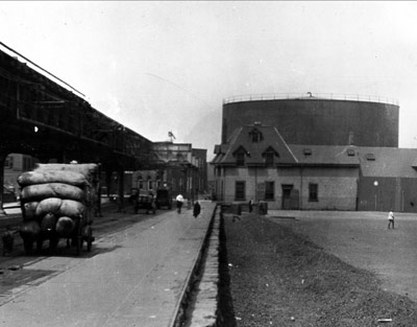

Photo Credits
Hero photo: Boston Public Library, Public Domain, via Wikimedia Commons.
Photo: Unknown photographer, Public Domain, via Wikimedia Commons.
Photo: The Bostonian Society, Public Domain, via Wikimedia Commons.
Photo: MLHalsey, CC BY-SA 3.0, via Wikimedia Commons.