
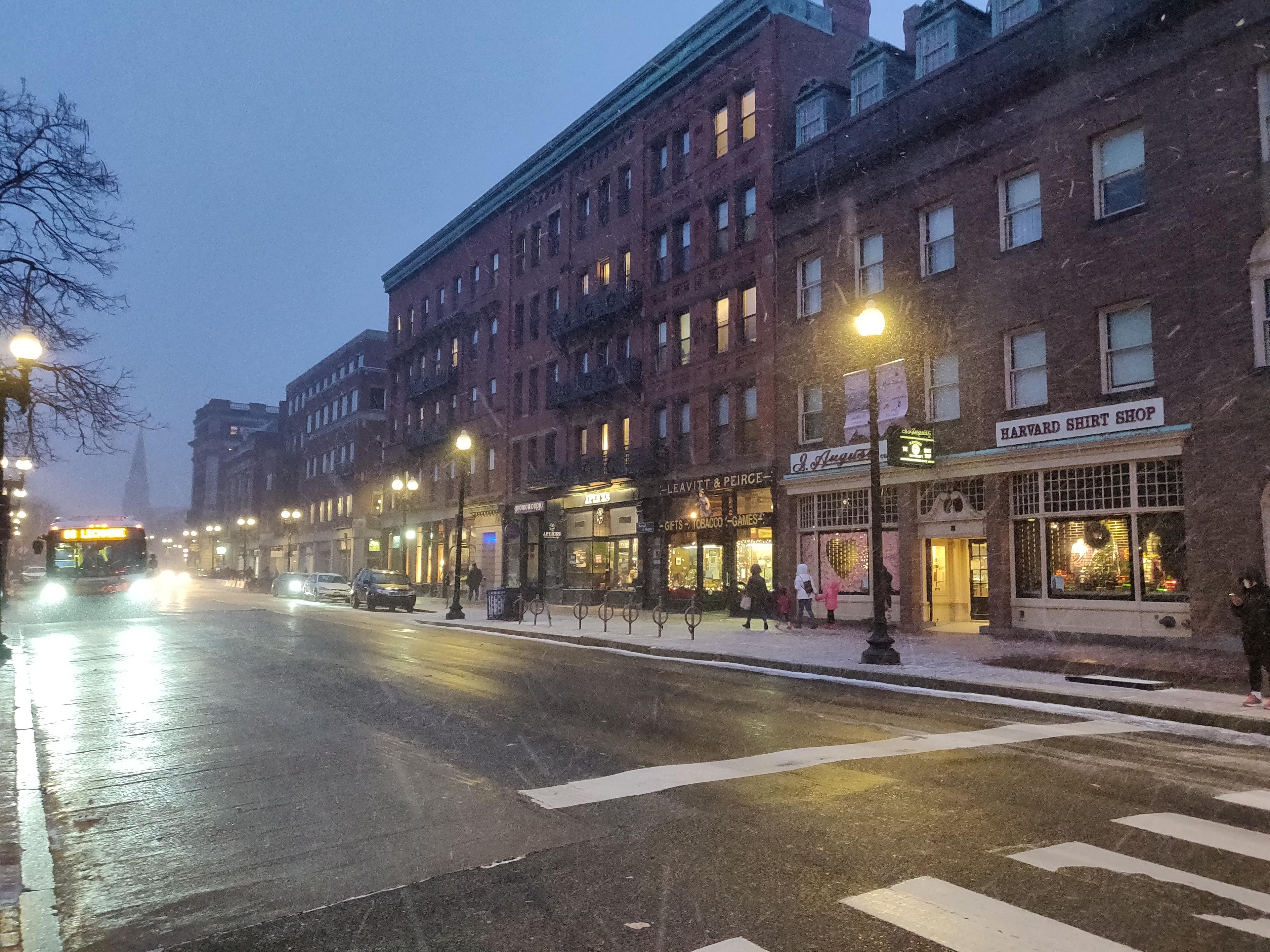
The square that isn't a square
Harvard Square is not a square. It is a triangle — a knot of streets where Massachusetts Avenue, Brattle Street, and John F. Kennedy Street meet at the northwest corner of Harvard Yard, in Cambridge, Massachusetts, just across the Charles River from Boston. There is no fence around it and no admission charge to enter it; it is a public crossroads, and that is the whole point. What makes it a place, rather than an intersection, is everything that has gathered at that knot over nearly four hundred years: the university on one side, the shops and theaters on the others, and in the middle a small brick kiosk, a stretch of brick pavement, and a crowd that never quite disperses.
Stand in the middle of it on a weekday afternoon and the Square performs its daily inventory. Students cut through on their way between Harvard Yard and the river. A bus pulls out of the Harvard station on Massachusetts Avenue. Somebody plays music near the kiosk — a violin, an erhu, a guitar — because somebody has always played music here. Tour groups gather by the gates of Harvard Yard to hear about the statue inside. The Coop's red-brick bulk anchors one corner, the bookshops and cafes fill the rest, and the whole scene has the particular Cambridge quality of feeling both centuries old and entirely of this moment. It is, by a wide margin, the most famous three acres in New England that belong to nobody in particular.
The Square's fame is slightly misleading. Visitors come for Harvard, and Harvard is right there — the Yard's gates open directly onto the Square. But the Square is not the university. It is the town that grew up beside the university, and it has always had its own life, its own arguments, and its own cast of characters, some of whom the university would rather forget. That tension — gown and town, scholars and buskers, the oldest college in America and the diner that fed it at 3 a.m. — is what this article is about.
Newtowne: the capital that moved
Harvard Square began before Harvard did. The settlement was founded in 1630 under the name Newtowne, and it was briefly the site of the Massachusetts capital — the seat of the colony's government before Boston took that role permanently. The town was laid out around what is now Harvard Square and Cambridge Common, the broad green just northwest of the Square, and its early streets still follow the paths the first settlers walked.
In 1636 the Great and General Court of the Massachusetts Bay Colony voted to found a college at Newtowne — the institution that would become Harvard University, the oldest institution of higher education in the United States. It was originally called the New College, and its mission was to train clergy. It received its famous name on March 13, 1639, for John Harvard, a young Puritan minister and religious exile from England who had graduated from Emmanuel College, Cambridge, and who died of tuberculosis on September 14, 1638, after living on American soil just thirteen months. He was thirty years old. He left half of his estate and his library of more than 400 books to the new college, and the college took his name.
The town took the college's name too: Newtowne became Cambridge, after the English university town, and the crossroads beside the college became Harvard Square. Cambridge Common, across Massachusetts Avenue from the Square, is where, on July 3, 1775, George Washington took command of the Continental Army during the American Revolution — the green is still there, still open, and still the Square's front lawn in all but name.
The college next door and the statue of three lies
You cannot write about the Square without Harvard Yard, because the Yard is its eastern wall. Through the gates — the brick and iron openings along Massachusetts Avenue and JFK Street — lie the Yard's elms, dormitories, and chapels, including University Hall, where the American Folklore Society was founded in 1888 by the ballad collector and Harvard professor Francis James Child. That small fact matters more than it looks: the scholarly study of folk song began in the Yard, and seventy years later the folk revival would be sung into existence a few hundred yards away, in a coffeehouse on Mount Auburn Street.
Just inside the Yard's main gate stands the Square's most photographed object, and its most unreliable one: the John Harvard Statue. The bronze was sculpted by Daniel Chester French — the same sculptor who would later carve the seated Lincoln in Washington — and unveiled on October 15, 1884, paid for by the Boston philanthropist Samuel James Bridge. It was first sited in front of Memorial Hall and moved to its present place in the Yard in 1924. Within a month of its unveiling it had been coated with tar, the first in a long series of student pranks.
It is nicknamed the Statue of Three Lies, because the inscription on its base gets three things wrong. First, the likeness is not John Harvard at all: no portrait of him survives, so French modeled the head on Sherman Hoar, a Harvard graduate of the class of 1882, and the body on a cash-strapped Oxford graduate who posed for pay. Second, John Harvard was not the founder of the university; he was its first major benefactor, and the college was founded by a vote of the Massachusetts General Court. Third, the statue's date is wrong: Harvard was founded in 1636, not 1638. Tour guides recite the three lies to every group that stops at the statue, and visitors rub the statue's left shoe for luck — a tradition that has polished the bronze toe to a shine. The statue is a perfect emblem of the Square itself: famous, beloved, and wrong in instructive ways.
Harvard's other great neighbor at the Square's edge is its museum row, a short walk north on Oxford Street: the Harvard Museum of Natural History, home of the celebrated Glass Flowers — the Ware Collection of Blaschka Glass Models of Plants, exquisitely detailed glass botanical models made by the father-and-son team of Leopold and Rudolf Blaschka — and the Peabody Museum of Archaeology and Ethnology, founded in 1866. They belong to the university, not the Square, but every visitor to the Square ends up in them sooner or later, and they are part of why the neighborhood feels like a campus that never quite ends.
The kiosk at the center of everything
If the Square has a single landmark, it is the small brick building at its center: the Harvard Square Subway Kiosk. It was built in 1927–1928 for the Boston Elevated Railway to replace the original 1912 subway station headhouse, designed by the firm of Blackall, Clapp & Whittemore to a concept by MIT civil engineering professor Charles B. Breed — thin piers of alternating waterstruck brick and limestone, a thin roof, and a transparent covering over the stairs down to the platforms. The Cambridge subway had reached Harvard Square in 1912, and the kiosk was the station's front door. The Cambridge Historical Commission nominated it to the National Register of Historic Places in 1977, and the listing was approved in January 1978, saving it from demolition during the Red Line extension works of the late 1970s and early 1980s. The station itself was rebuilt in that period, and in 1983 the kiosk was reconstructed a short distance from its original site and adapted as a newsstand.
The newsstand was Out of Town News, and it is impossible to overstate what it meant to the Square. Founded in 1955 by Sheldon Cohen — known as the "unofficial mayor of Harvard Square" — it stocked leading newspapers, magazines, and periodicals from around the nation and around the world, at a time when that was the only way to read them. Its regular customers included the economist John Kenneth Galbraith and the chef Julia Child, and Robert Frost once stopped at the stand to ask directions on his way to a poetry reading. In 1984 Out of Town News moved into the kiosk itself, and for thirty-five years the little brick building with its curved roof was the Square's information desk, meeting point, and symbol — the place where, as the Historical Commission's landmark report put it, Students for a Democratic Society chanted antiwar slogans, wartime news was dispensed, and in peacetime street people leaned against its walls to exchange counterculture word-of-mouth.
Out of Town News closed on October 31, 2019. The kiosk stood empty for a time, then was renovated, and on May 30, 2025 it reopened as the Cambridge KiOSK, operated by the local nonprofit CultureHouse as a public space. The curved roof and brick piers are unchanged. What changed is the use: the building that once sold the world's newspapers now hosts the Square's public life directly, and the city designated Harvard Square itself a conservation district in 2000, a recognition that the whole knot of streets, not just its buildings, is worth protecting.
Club 47 and the folk revival
The Square's claim on American music history rests on a coffeehouse the size of a living room. Club 47 opened in 1958 at 47 Mount Auburn Street as a jazz coffeehouse, founded by Joyce Kalina and Paula Kelly. The folk music revival of the late 1950s and early 1960s had two centers in America — Greenwich Village in New York and Harvard Square in Cambridge — and Club 47 was the heart of the Cambridge scene.
The story is told so often in the Square that it has become a local legend, but the outline is documented. A seventeen-year-old Boston University student named Joan Baez, barefoot and long-haired, showed up at the jazz coffeehouse, got herself on stage, and convinced the manager to give her a regular Sunday-afternoon gig. She quit school to focus on music, built a following at the club, and by 1959 was performing at the Newport Folk Festival; in 1962 Time magazine put her on its cover. Bob Dylan, unable to get himself booked, played between acts for free, because he wanted to be able to say he had performed at the one venue that mattered in the folk world. He learned songs in Cambridge too: he said he learned his 1962 song "Baby, Let Me Follow You Down" from the artist Eric von Schmidt, whose studio was at 44 Brattle Street.
The club moved to nearby Palmer Street in 1963 — the managers persuaded the city to designate 47 Palmer Street, the only address on the street — and it closed in 1968 as rock displaced folk. It reopened in 1969 as Passim, renamed Club Passim in 1994, and it still hosts folk shows, music classes, and a vegetarian restaurant on Palmer Street today. The roll call of those who played the room runs from Joni Mitchell, Judy Collins, and Pete Seeger to Taj Mahal, Tom Rush, Jim Kweskin, and the Charles River Valley Boys, and the club's fiftieth anniversary was celebrated with a "hoot" recorded at the Brattle Theatre in 2008. The folk revival did not only happen in Harvard Square, but it is hard to imagine it happening anywhere else: the scholarship of Francis James Child's ballad collection in the Yard, the coffeehouse on Mount Auburn Street, and the audience of students and dropouts who filled it every night were all within a few hundred yards of each other.
The Square's musical life spilled beyond the club. In May 1974 the music critic Jon Landau watched a newcomer named Bruce Springsteen play at the Harvard Square Theatre on Church Street; the following year the theater hosted Bob Dylan's Rolling Thunder Revue, featuring Joan Baez. WHRB, Harvard's radio station, carried the scene on the air with programs like "Hillbilly at Harvard." The Nameless Coffee House on Church Street offered free performances by the likes of Tracy Chapman and Dar Williams. The Square was, for a generation, the place in New England where you went to hear what was coming next.
The Brattle and the Coop: two institutions that never left
Two of the Square's institutions have survived everything the neighborhood has been through, and they sit within a block of each other.
The Brattle Theatre, at 40 Brattle Street, occupies Brattle Hall, built in 1889 for the Cambridge Social Union — established in 1871 — to house its library and meeting spaces beside the much older William Brattle House. The hall was designed by Longfellow, Alden & Harlow, and its theater opened in 1890 as a live performance space, home to the Cambridge Dramatic Club and, for a time, a ballet school, lectures, and dances. In 1948 it was bought by the Harvard Veterans' Theatre Workshop, which renamed itself the Brattle Theatre Company. In 1953 the owner Bryant Haliday, back from studies in France and inspired by French cinema, converted it into an art film house with his friend Cyrus Harvey, importing a rear-projection system from a cruise ship so audiences could still sit in the balcony. The first film shown was the German film The Captain from Kopenick. In 1955 Haliday and Harvey founded Janus Films, which went on to distribute foreign films across the nation, and Haliday established a Brattle Shakespeare Festival the same year.
The Brattle has been a repertory cinema ever since — the place where Ingmar Bergman and Federico Fellini first reached American audiences, where the annual Valentine's Day Casablanca screening draws its faithful, and where the "Bogie Cult" was born. It went dark for a time in the 1980s, filed for bankruptcy in 1986, and was bought by new owners in 1987 who restored it as an independent repertory cinema. The nonprofit Brattle Film Foundation has operated it since 2001. Brattle Hall was listed on the National Register of Historic Places in 1982 and included in an expansion of the Harvard Square Historic District in 1988. It is, by any measure, the most durable movie house in New England.
Across the Square stands the Harvard Coop — formally the Harvard/MIT Cooperative Society. It was founded in March 1882 by Charles H. Kip, a Harvard junior of the class of 1883, who was troubled by the prices Square merchants charged students for books and for wood and coal to heat their rooms. Kip and four classmates enlisted about 400 Harvard-affiliated people to invest two dollars each, and opened the store at 13 Harvard Row. In its first year it did nearly $14,000 in sales and, by one early history's reckoning, saved its members $4,500 through sharply reduced prices. In 1924 it moved into its current home, a four-story red-brick Colonial Revival building designed by Perry, Shaw & Hepburn, across the street from the subway headhouse. MIT invited the Coop to open a branch after the Institute moved from Boston to Cambridge in 1916, and the cooperative has served both campuses ever since. The membership fee set in 1882 — one dollar a year — was still one dollar more than a century later, and the Coop remains the oldest college retail cooperative in the country.
Between them, the Brattle and the Coop tell the Square's story in miniature: a theater and a store, both founded by people who wanted something the market wasn't providing, both still standing on the same corners more than a century later.
The Pit, the protests, and the counterculture
By the late 1960s Harvard Square had become something its founders would not have recognized: the center of Cambridge's counterculture. The folk revival had drawn musicians, and the musicians had drawn a scene — hippies, hustlers, happenings, and street culture spreading around the Square. Beginning in 1968, as Mo Lotman wrote in his 2009 book Harvard Square: An Illustrated History Since 1950, Cambridge Common "was transformed every warm Sunday afternoon into a bohemian free-for-all, with drum circles, bead-sellers, tranced-out dancers, and a ton of pot." In 1970 it culminated in massive protests against the war in Vietnam: on April 15, 1970, hundreds of protesters battled police and trashed banks and storefronts in the Square.
The physical emblem of that era was the Pit — a sunken plaza beside the subway headhouse, constructed in 1982, that became the gathering place for punks, skateboarders, runaways, and unhoused young people from across New England. It was unorganized by design: a place for impromptu gatherings, outdoor book sales, spontaneous concerts, and lounging, the in-your-face antithesis of the Square's commercial ambitions. For forty years it was the Square's most contested few hundred square feet — loved as the last uncommercial public space in the neighborhood, resented as an obstacle where buses turned and pedestrians squeezed past.
In 2022 the city moved to demolish the Pit and rebuild the area as a beautified plaza, part of a long-term plan to rejuvenate the core of the Square. Advocates circulated a petition to designate the Pit a landmark, calling the proposed design a "characterless commercially focused plaza that you might find in any suburban American mall." The Cambridge Historical Commission decided against landmark status in August 2022, and the Pit's fate was sealed. Its loss is still argued about in the Square, and the argument is really about the Square itself: whether a place famous for its bohemian past can keep any of it once the rents catch up.
Gentrification and the Tasty
The argument about the Pit was the latest round of an older one. Harvard Square has been gentrifying, in waves, since at least the 1920s, when one of the first franchise businesses in the Square arrived after Wythe & Co., an independently run grocer at 6 John F. Kennedy Street, closed after fifty years because of an unaffordable rent increase. The pattern repeated for a century: small, inexpensive, owner-operated places — diners, bookshops, record stores, coffeehouses — priced out, and chains moving in behind them.
The symbol of the loss, for a generation of Square veterans, was the Tasty. The Tasty Sandwich Shop was a one-room diner, estimated at thirty feet long and seven feet wide, with sixteen stools along a yellow linoleum counter; on busy nights sixty to eighty people crowded inside. It stood for eighty-one years in the heart of the Square, a twenty-four-hour mecca where students, workers, and locals mixed in a way few other places in Cambridge allowed. Its building's owner, Cambridge Savings Bank, saw the rising value of the land as the chain-store crawl moved through the Square, and despite protests from the Harvard Square Defense Fund — joined by Click and Clack, the brothers who hosted NPR's Car Talk — the Tasty shut its doors for good in 1997. To this day, old Square hands cite it as the perfect symbol of the perils of gentrification.
The Square that replaced it is wealthier, cleaner, and more polished — and, its defenders say, still itself. The Harvard Book Store has been independently owned and operated since 1932. Club Passim still books folk music on Palmer Street. Bartley's Burger Cottage has been packing them in since 1960. The Brattle still shows repertory film. What is gone is the grunge: the cheap diners, the used book and record shops, the coffeehouses where a seventeen-year-old could talk her way onto a stage. What remains is the street plan, the brick, the kiosk, and the crowd — and the crowd, on a good afternoon, still makes the place feel like itself.
The river and the walk south
The Square's other direction is south, down John F. Kennedy Street toward the Charles River. It is a short walk, and it is the walk every Harvard student has made for generations: past the shops and the subway entrance, past the river houses, to the water. The Charles is the Square's southern horizon, and the walk down to it is the natural end of any visit — the place where the noise of Massachusetts Avenue gives way to the river, the boathouses, and the skyline of Boston beyond.
It is worth making the walk precisely because the Square is so dense. Harvard Square packs four centuries of American history into a few blocks: a colonial capital, the oldest university in the country, a folk revival, a counterculture, and a gentrification debate that is still running. The river is where you go to get some air and to see the whole thing from a little distance — and to understand that the Square, for all its fame, is a neighborhood, and neighborhoods are lived in, not just visited.
How to visit
Harvard Square sits at the intersection of Massachusetts Avenue, Brattle Street, and John F. Kennedy Street in Cambridge, Massachusetts, at the northwest corner of Harvard Yard — reach it by MBTA Red Line to Harvard station, whose headhouse is the historic kiosk at the center of the Square, or by bus along Massachusetts Avenue. The Square itself is public streets and sidewalks, free and open at all hours. Allow two to three hours for a proper visit: the kiosk and the plaza, the gates of Harvard Yard and the John Harvard Statue, a look inside the Coop, a film or a show at the Brattle or Club Passim, and the walk down JFK Street to the Charles. The museums on Oxford Street — the Harvard Museum of Natural History and the Peabody Museum — are a short walk north and are well worth the detour. No fixed prices, fees, or opening hours for the theaters, clubs, shops, or museums are stated in this article, since none was verified against an official source in this run: check the venues' official sites before visiting for current prices, hours, and schedules.
Key Facts
- Harvard Square is the triangular intersection of Massachusetts Avenue, Brattle Street, and John F. Kennedy Street in Cambridge, Massachusetts, at the northwest corner of Harvard Yard, just across the Charles River from Boston. Coordinates: 42.3736, -71.1189.
- The settlement was founded in 1630 as Newtowne and was briefly the site of the Massachusetts capital. Harvard College was founded by a vote of the Great and General Court of the Massachusetts Bay Colony in 1636 — the oldest institution of higher education in the United States — and was named for John Harvard on March 13, 1639. John Harvard died of tuberculosis on September 14, 1638, aged thirty, leaving half his estate and his library of more than 400 books to the college. Cambridge Common, beside the Square, is where George Washington took command of the Continental Army on July 3, 1775.
- The John Harvard Statue in Harvard Yard was sculpted by Daniel Chester French and unveiled on October 15, 1884, paid for by philanthropist Samuel James Bridge. It was first sited in front of Memorial Hall and moved to the Yard in 1924. It is the Statue of Three Lies: the likeness is not John Harvard (the head was modeled on Sherman Hoar, class of 1882), he was not the founder (he was the first major benefactor), and the college was founded in 1636, not 1638.
- The American Folklore Society was founded in Harvard Yard's University Hall in 1888 by the ballad collector and Harvard professor Francis James Child.
- The Harvard Square Subway Kiosk was built in 1927–1928 for the Boston Elevated Railway, designed by Blackall, Clapp & Whittemore to a concept by MIT professor Charles B. Breed, replacing the original 1912 station headhouse. It was listed on the National Register of Historic Places in January 1978, reconstructed a short distance from its original site in 1983, and adapted as a newsstand. Harvard Square was designated a conservation district by the City of Cambridge in 2000.
- Out of Town News was founded in 1955 by Sheldon Cohen, the "unofficial mayor of Harvard Square," stocking newspapers, magazines, and periodicals from around the world. Its regulars included John Kenneth Galbraith and Julia Child. It moved into the kiosk in 1984 and closed on October 31, 2019. The kiosk reopened on May 30, 2025 as the Cambridge KiOSK, operated by the nonprofit CultureHouse.
- Club 47 opened in 1958 at 47 Mount Auburn Street as a jazz coffeehouse founded by Joyce Kalina and Paula Kelly. Joan Baez, then seventeen, won a regular Sunday-afternoon gig there and went on to the 1959 Newport Folk Festival and a 1962 Time magazine cover; Bob Dylan played between acts for free. The club moved to Palmer Street in 1963, closed in 1968, reopened in 1969 as Passim, and is now Club Passim. Its performers included Joni Mitchell, Judy Collins, Pete Seeger, Taj Mahal, Tom Rush, and Jim Kweskin.
- The Brattle Theatre occupies Brattle Hall, built in 1889 for the Cambridge Social Union (established 1871) to a design by Longfellow, Alden & Harlow; the theater opened in 1890. It became a movie house in 1953 under Bryant Haliday and Cyrus Harvey, who founded Janus Films in 1955. The nonprofit Brattle Film Foundation has operated it since 2001. Brattle Hall was listed on the National Register of Historic Places in 1982.
- The Harvard Coop (Harvard/MIT Cooperative Society) was founded in March 1882 by Charles H. Kip, class of 1883, with about 400 members investing two dollars each; it opened at 13 Harvard Row and did nearly $14,000 in sales in its first year. It moved in 1924 to its current four-story Colonial Revival building by Perry, Shaw & Hepburn. MIT invited the Coop to open a branch after moving to Cambridge in 1916.
- The Pit, a sunken plaza beside the subway headhouse, was constructed in 1982 and became the gathering place for the Square's punk and street youth. In 2022 the city moved to demolish it; a petition to designate it a landmark failed when the Cambridge Historical Commission decided against landmark status in August 2022.
- On April 15, 1970, hundreds of protesters against the war in Vietnam battled police and damaged banks and storefronts in the Square. From 1968, Cambridge Common hosted bohemian Sunday gatherings with drum circles and bead-sellers.
- The Tasty Sandwich Shop, a one-room diner about thirty feet long and seven feet wide with sixteen stools, stood in the Square for eighty-one years and closed in 1997 despite protests from the Harvard Square Defense Fund. The Harvard Book Store has been independently owned and operated since 1932; Bartley's Burger Cottage has been serving the Square since 1960.
- The Harvard Museum of Natural History on Oxford Street is home to the Glass Flowers, the Ware Collection of Blaschka Glass Models of Plants by Leopold and Rudolf Blaschka; the Peabody Museum of Archaeology and Ethnology was founded in 1866. In May 1974 Bruce Springsteen played the Harvard Square Theatre on Church Street; the following year the theater hosted Bob Dylan's Rolling Thunder Revue with Joan Baez.
Gallery