A two-acre city of the dead
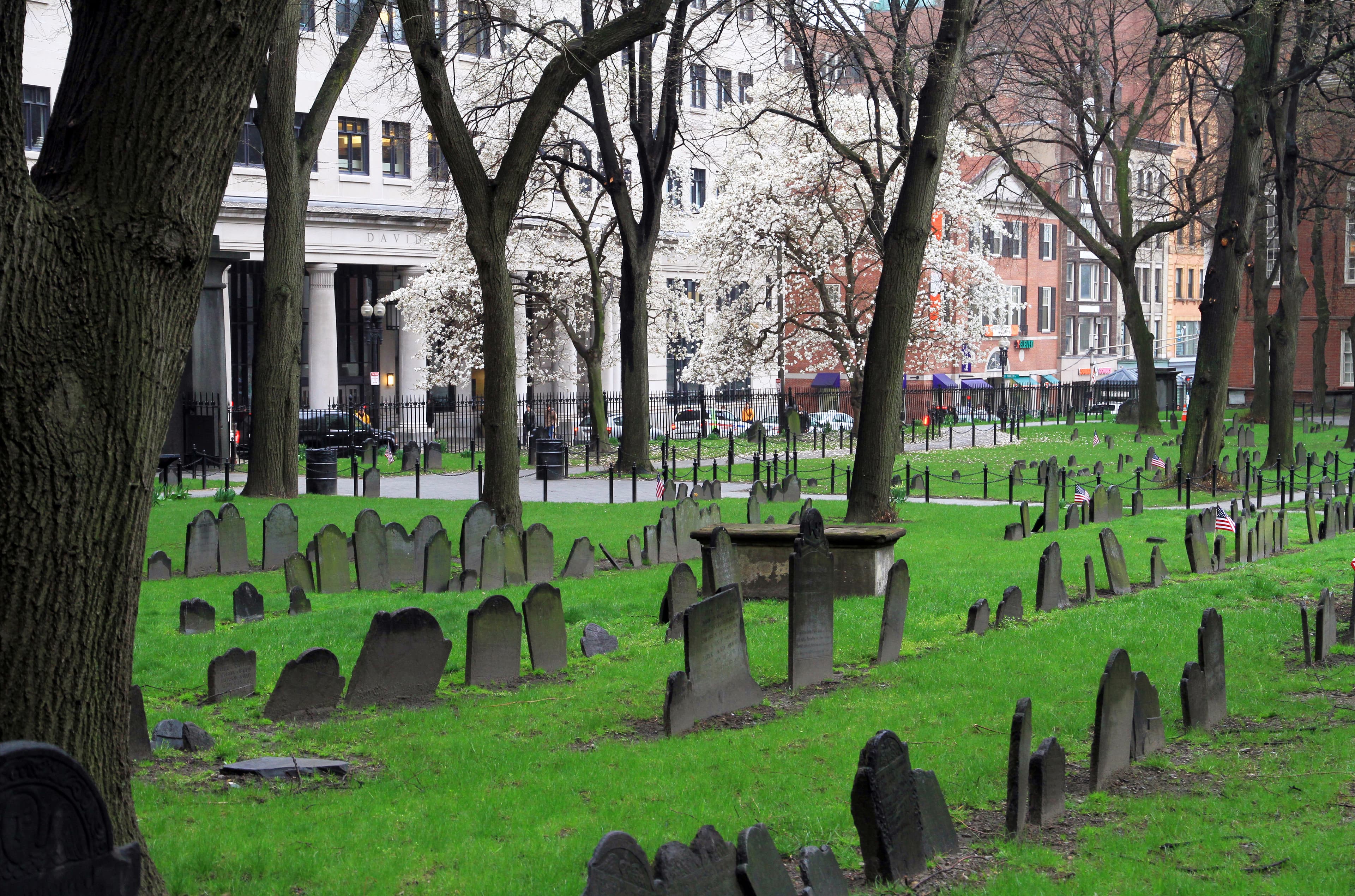
Step through the iron gate on Tremont Street, just downhill from Park Street Church, and the noise of downtown Boston falls away by a degree or two — not to silence, exactly, because the city is right there, buses on Tremont Street and office workers cutting across the Common, but to a different register. Inside the fence, the ground is thick with stones: some 2,345 grave markers standing in long, straight rows, with mature trees overhead and narrow paths threading between them. Historians estimate that as many as 5,000 people are buried here, and some counts run higher still, because the markers are only part of the story. Beneath the lawns lie tombs — more than two hundred of them around the edges of the ground — holding whole families, and many of the stones no longer stand over the bodies they name. In the nineteenth century the markers were rearranged into neat rows, partly for tidiness and partly so that the new lawn mowers could pass between them, and a stone moved for a mower is a stone separated from its grave. To walk the Granary is therefore to walk a place that is at once a cemetery, a museum of early American stone carving, and a puzzle: the names are real, the stones are real, and the exact correspondence between the two is, in more cases than visitors expect, a matter of record-keeping rather than certainty.
That is part of what makes the place so compelling, and part of what makes it so easy to misunderstand. The Granary Burying Ground, founded in 1660, is Boston's third-oldest cemetery, and it is one of the sixteen stops on Boston's Freedom Trail, the red-brick line that runs two and a half miles from Boston Common to the Bunker Hill Monument in Charlestown. It sits between Boston Common and King's Chapel on the trail, and it is, by the Freedom Trail Foundation's account, Boston's and the Northeast's most visited historic burying ground, drawing more than a million visitors a year. People come for the famous names, and the famous names are here in unusual concentration: three signers of the Declaration of Independence, the most famous midnight rider in American history, the five victims of the Boston Massacre, governors and mayors and ministers and merchants, and, at the center of the ground, a granite obelisk for the parents of Benjamin Franklin — who was born in Boston but is not buried here. They also come, whether they know it in advance or not, for the stones themselves: the winged skulls and soul effigies of Puritan carvers, the most eloquent art that a culture suspicious of religious imagery ever produced, carved into slate that has survived three and a half centuries of New England weather.
This article is a guide to the ground as it is: what is buried here, what the stones say and do not say, which beloved stories are legend rather than fact, and how to read a place where the dead outnumber their markers by more than two to one.
Why Boston needed a third burying ground
Boston in 1660 was thirty years old, a Puritan town of a few thousand people clustered around a harbor and a common, and it was already running out of room for its dead. The town's first cemetery, King's Chapel Burying Ground, a block to the east on Tremont Street, had been set aside in 1630 and was filling up. The town's answer was to set aside part of what was then Boston Common — the Common then encompassed the whole block — for a new burying place. For its first decades the new ground was known simply as the South Burying Ground, or the New Burying Ground, to distinguish it from the old one. It took its present name only in 1737, when a granary — a building for storing grain, with a capacity the Freedom Trail reckons at some 12,000 bushels — was built on the lot next door, on the site where Park Street Church now stands. The granary is long gone. The name stayed.
The ground grew as Boston grew. In May 1717 the town voted to enlarge it by taking part of the highway on its eastern side, now Tremont Street; the enlargement was carried out in 1720, when fifteen new tombs were created and assigned to Boston families. The southwest portion of the original block had already been taken, two years after the cemetery was established, for public buildings — the granary itself and a house of correction — and the north portion was used for housing. What remained, roughly two acres in a trapezoid shape, is the ground visitors see today: bounded by Tremont Street on the west, with Park Street Church at its northwest corner, the Boston Athenæum behind it to the east, and Suffolk University Law School across the street.
The earliest dated marker in the ground is the headstone for Andrew Neil and family, dated 1666 — six years after the ground was founded. The second-oldest memorial lies near the Franklin obelisk: John Wakefield, who died aged fifty-two in June 1667. The seven-year gap between the ground's founding and its oldest surviving memorials is not fully explained; stones weather, stones break, stones are moved, and the earliest burials may have been marked in wood that did not survive. The oldest stone of all is sometimes given as that of the Neal children, carved by the craftsman known as the Charlestown Carver, dating to 1666. Either way, the ground's first generation is present in the stones only thinly, and the density of the surviving markers rises steeply through the eighteenth century, when Boston's population — and its mortality — grew.
For its first century and more, the ground was not the shaded, tree-filled place it is now. Eleven large European elms fronted it on Tremont Street, planted in 1762 by Major Adino Paddock and John Ballard; by 1856 they had reached ten feet in circumference, and the walk beneath them was known as Paddock's Mall. The rest of the grounds, by contemporary accounts, were devoid of trees. The first major planting of the interior came in 1830, when a number of trees were set out around the grounds — the same year, notably, that an attempt was made to rename the place Franklin Cemetery, in honor of Benjamin Franklin's family. The attempt failed, and the old name, with all its grain-store ordinariness, survived.
Burials at the Granary ceased in 1880, after concerns about overcrowding and public health raised by local physicians — the same pressures that were closing old urban churchyards all over America in favor of the new garden cemeteries like Mount Auburn in Cambridge. The ground then passed into its long second life as a historic site, maintained today by the City of Boston's Historic Burying Grounds Initiative, which manages sixteen burying grounds across the city. A preservation project completed in 2016, supported by a Freedom Trail Foundation Preservation Fund grant, restored the cast-iron ornamental fence and repaired and cleaned the granite wall and the entrance gate, all dating to 1840; the work won a Massachusetts Historical Commission preservation award. In May 2011 the city had announced a refurbishment project to widen paths and add observation areas, funded jointly by the Freedom Trail Foundation and the city. The ground is not a ruin and it is not a reconstruction. It is a working historic site, tended, repaired, and still accumulating meaning.
The gate: Egypt on Tremont Street
The first thing most visitors see is not a gravestone but a gate, and it is a strange and wonderful thing to find on a Boston street: an Egyptian Revival gateway, built in 1840, of granite pylons with battered — inward-sloping — sides and a heavy iron fence, designed by the Boston architect Isaiah Rogers. Rogers, born in 1800 and dead in 1869, was one of the most successful architects of his generation, the designer of Boston's Tremont House, the first hotel with indoor plumbing, and of the Astor House in New York; in 1863 he was appointed Supervising Architect of the United States. For the Granary he produced a gateway in the Egyptian manner — a style then fashionable for cemeteries, because Egypt offered the Western imagination its oldest and grandest imagery of death and permanence — and he designed an identical gateway for the Touro Cemetery in Newport, Rhode Island, a few years later. The fence cost $5,000, half paid by the city and half by public subscription, which is to say that Bostonians of 1840 taxed themselves and passed the hat to give their ancestors a grander door.
The gate matters for more than its looks. It marks the moment when the Granary stopped being merely a crowded town burying place and became a monument — when Boston began to curate its own past. The Egyptian style, with its associations of endurance and mystery, was a deliberate choice for a ground that already held the founders: it announced that what lay inside was not just old but sacred to the republic. Stand at the gate and look in, and the composition still works as Rogers intended: the central path running straight into the ground, the obelisk rising in the middle distance, the rows of stones falling away on either side. It is worth pausing here before going in, because the gate is also the best place to understand the ground's peculiar relationship with the street. From the sidewalk on Tremont Street, through the iron fence, you can see and read many of the most famous markers without entering at all — which is how generations of visitors, including those in a hurry on the Freedom Trail, have paid their respects. The ground rewards going in, but it does not hide from the street.
The signers: Adams, Hancock, and Paine
Samuel Adams (1722–1803) is the organizer, the man John Adams called the most important figure in the Revolution's political management, and the one whose grave is perhaps the most visited in the ground after Revere's. Adams was a brewer's son and a failed businessman who became, through the town meeting, the newspapers, and the committees of correspondence, the Revolution's great mobilizer — the architect of the Boston Tea Party's political aftermath, a delegate to the Continental Congress, and, after independence, the fourth governor of Massachusetts. His marker is modest, as befits a man who died comparatively poor and who had always distrusted display. Visitors leave coins and small tokens on it, a modern habit that the ground's caretakers tolerate and periodically clear. What the stone does not say, but the ground around it does, is how thoroughly Adams belonged to this neighborhood in life: he lived, worked, and politicked within a few blocks of where he is buried, and his Boston was a walking city in which the burying ground, the meeting house, and the town hall were all within sight of one another.
John Hancock (1737–1793) is the showman, and his memorial is the showiest in the ground — a tall obelisk of his own, raised over the Hancock tomb, with his name in large letters. Hancock was the richest man in Massachusetts when the Revolution began, a merchant prince who inherited his uncle's trading house, and his famously large signature on the Declaration — the story goes that he wrote it large so King George could read it without his spectacles — made his name a synonym for a signature itself. He was the first governor of Massachusetts under the state constitution, and the president of the Continental Congress. His tomb, like those of the other great merchant families, is one of the large tombs at the edge of the ground, and his monument's prominence is no accident: Hancock understood the uses of visibility in life, and his survivors understood them in death. The monument is also a useful corrective to the idea that the Granary is uniformly humble. Puritan plainness was a real aesthetic, but wealth found its way into stone even here, and Hancock's obelisk is the ground's grandest gesture.
Robert Treat Paine (1731–1814) is the third signer, and the least remembered of the three, which is itself part of the story. Paine was a lawyer and a judge, a prosecutor of the British soldiers after the Boston Massacre — he argued for the Crown in that trial, a role that required a particular kind of civic courage — and later the first attorney general of Massachusetts. His grave is quieter than his colleagues', and visitors who find it have usually come looking for the complete set. Taken together, the three signers give the Granary something no other American burying ground can quite match: the full arc of the Revolution's Boston leadership, from the street organizer to the merchant prince to the lawyer, all within a few dozen yards of one another, all buried in ground that was already old when they were born.
Paul Revere, and the ride that made him immortal
No grave in the Granary is more visited than Paul Revere's, and none is more instructive about the difference between history and legend. Revere (1735–1818) was a silversmith, an engraver, a bell founder, and a maker of false teeth, a craftsman of the first rank whose silver is now in museums, and a Son of Liberty who rode as a courier for the Boston Committee of Safety. On the night of April 18, 1775, he rode from Boston to Lexington to warn John Hancock and Samuel Adams that British regulars were marching to seize the colonists' military stores at Concord. He did not ride alone — William Dawes rode by another route, and Samuel Prescott joined him and completed the ride to Concord after Revere was captured — and he did not shout "The British are coming!" through the streets, since the colonists he was warning were themselves British subjects and the ride was conducted in secrecy. Henry Wadsworth Longfellow's poem "Paul Revere's Ride," published in 1861, made Revere the sole hero of the night and fixed his name in American memory; the history is more collaborative and more interesting, and the ground is a good place to remember it, because Dawes is buried elsewhere in Boston and Prescott died young, while Revere lived to eighty-three and lies here, a long life's full stop.
Revere's marker is a later memorial rather than his original eighteenth-century stone, and it is one of the most photographed stones in the ground — a tall, clean slab that stands out among the weathered slate around it. A plaque on the fence near the Tremont Street entrance also marks his burial, so that even visitors who do not enter can find him. The attention is understandable: of all the Granary's dead, Revere is the one most Americans meet first, in school, in poetry, and in the popular imagination. But the ground repays visitors who look past the famous stone to the craftsman's context. Revere's Boston was a city of artisans — silversmiths, pewterers, printers, rope makers — and the Granary holds many of them, their trades recorded in the inscriptions and their stones carved by fellow craftsmen. Revere the silversmith and Revere the rider were the same man, and the same hands that engraved the most famous political print of the Revolution, his depiction of the Boston Massacre, also made teapots.
The Boston Massacre victims, and a boy killed eleven days earlier
Near the Tremont Street entrance, in a place of honor just inside the gate, lie the five men killed in the Boston Massacre of March 5, 1770: Crispus Attucks, Samuel Gray, James Caldwell, Samuel Maverick, and Patrick Carr. They were killed when British soldiers, beset by a crowd on King Street, fired into it, and their funeral — a joint funeral procession through Boston — was one of the great public events of the pre-Revolutionary years. Their markers were moved in the nineteenth century into straight lines, like so many others in the ground, and they now stand together near the entrance, a shared monument to a shared death. The trial that followed, in which John Adams defended the soldiers and most were acquitted, is one of the founding stories of the American commitment to the rule of law; the victims' presence here, at the gate, is the ground's reminder that the Revolution had a human cost before it had a name.
Buried with them, in a common grave, is Christopher Seider — sometimes spelled Snider — a boy of about eleven who was killed on February 22, 1770, eleven days before the Massacre, when a customs informer named Ebenezer Richardson fired into a crowd of boys protesting outside his shop. Seider is often called the first casualty of the American Revolution, and the claim has real force: his funeral, like the Massacre victims', was a political demonstration, and his death radicalized Boston in the weeks before the Massacre made radicalization general. Whether he or Attucks deserves the title of "first" is a matter of definition — first death in a crowd confrontation, first martyr's funeral, first name on a list — and the ground, characteristically, does not settle the argument. It simply holds them together, the boy and the five men, at the entrance, where every visitor passes.
Attucks himself deserves a particular note, because his story has been told and retold with varying degrees of accuracy. He was a man of African and Native American descent, a sailor and rope maker who had escaped slavery years earlier, and he was among the first to fall on King Street. He has long been described as the first person killed in the Revolution, and the description is true in the narrow sense that he was the first to die on March 5. His grave here, shared with the other victims, is one of the most important African American burial sites in New England, and it is fitting that it stands at the gate: the Revolution's first public martyrs, including a Black man, at the threshold of the ground where the Revolution's leaders would later be buried.
The Franklin obelisk, and the Franklin who is not here
Rising above the rows near the center of the ground is the obelisk, twenty-five feet of granite, with the name FRANKLIN cut large into its base. It is the most conspicuous monument in the Granary, and it is the source of the ground's most durable misunderstanding. The obelisk does not mark Benjamin Franklin's grave. It marks the tomb of his parents, Josiah Franklin (1657–1745) and Abiah Folger Franklin (1667–1752), and other members of the Franklin family. Benjamin Franklin was born in Boston, on Milk Street, in 1706, and baptized at the Old South Meeting House, but he left Boston as a young man for Philadelphia, lived most of his life there, and died there in 1790. He is buried at Christ Church Burial Ground in Philadelphia, beside his wife Deborah. The Boston obelisk was erected in 1827, of granite from the Bunker Hill Monument quarry, to replace the Franklin family's original gravestones, which had fallen into poor condition, and it was dedicated on June 15, 1827. An attempt in 1830 to rename the whole ground Franklin Cemetery, in the family's honor, failed — Boston, it seems, was not prepared to give up the granary for the philosopher.
The obelisk is nonetheless worth the walk to the center of the ground, for two reasons. First, it is a beautiful object, and its prominence is a deliberate piece of nineteenth-century civic storytelling: Boston claiming Franklin, the most famous Bostonian who ever left, by honoring the parents who stayed. Josiah Franklin was a candle and soap maker from Ecton in Northamptonshire, England; Abiah, his second wife, was born in Nantucket. They had seventeen children, Benjamin the fifteenth, and they are buried here with other Franklins in a family tomb. Second, the obelisk is a landmark for orientation. From it, the whole ground opens out: the gate behind you on Tremont Street, the rows falling away in every direction, the trees, the tombs at the edges. Visitors who find the obelisk have found the center of the Granary, geographically and symbolically — the point from which the ground's two centuries of burials radiate.
The other Bostonians: governors, merchants, ministers, and a judge
The famous names draw the crowds, but the Granary's deeper interest lies in the density of Boston's early leadership buried here, and in the ordinary citizens packed in around them. Eight early governors of Massachusetts are buried in the ground or commemorated here, including John Endecott, the first governor of the Massachusetts Bay Colony, who died in 1665 and whose gravestone was long thought destroyed; evidence has since established conclusively that he was buried in tomb 189 of the Granary, though for years it was erroneously believed he lay in King's Chapel Burying Ground. James Bowdoin, merchant and second governor of the state, lies here, as does Increase Sumner, the fifth governor, and John Phillips, the first mayor of the city of Boston, who died in 1823. Peter Faneuil (1700–1743), the merchant whose gift built Faneuil Hall, the marketplace and meeting hall that became known as the Cradle of Liberty, is buried here in a family tomb. James Otis Jr. (1725–1783), the lawyer whose argument against the writs of assistance in 1761 — his phrase, "taxation without representation is tyranny," became the Revolution's slogan — lies here, marked by a boulder with a plaque near the Park Street Church side of the ground.
The ground also holds the men who made Boston's institutions and, in some cases, its darker history. Samuel Sewall (1652–1730), the judge of the Salem witch trials who later publicly repented his part in them — his apology, read in Boston's South Church in 1697, is one of the earliest public apologies in American history — is buried here. John Smibert (1688–1751), the Scottish-American portrait painter who brought the grand manner to colonial Boston, lies here. Jeremiah Gridley, the lawyer who defended the writs of assistance against Otis, is here too, which is to say that the Granary holds both sides of the argument that began the Revolution. The Reverend Mather Byles, a prominent minister and a loyalist, lies in tomb number two with his family. Edward Rawson, the first secretary of the Massachusetts Bay Colony, is here. So are the Hulls and Quincys of the Hull-Quincy tomb, and Cyprian Southack, cartographer and naval commander, and Benjamin Woodbridge, killed in 1728 in the first duel fought in Boston, on Boston Common, and buried along the fence near Tremont Street. Wendell Phillips, the abolitionist orator, was buried here in 1884 and later reburied at Milton Cemetery in 1886 — a reminder that even burial, in a ground as old as this, is not always final.
This roll call could go on, and that is the point. The Granary is not a cemetery with a few famous graves. It is a cross-section of Boston from 1660 to 1880: governors and rope makers, judges and sailors, merchants and ministers, the enslaved and the free, the loyalist and the patriot, the famous and the forgotten, all in two acres. The stones that survive name only a fraction of the buried. The tombs at the edges hold families whose names are on the stones of the city — its streets, its schools, its halls — and the ground's paths, widened and observed in the recent refurbishments, are designed to let visitors read that cross-section slowly, stone by stone.
Mother Goose: a legend, handled with care
No story told about the Granary is more beloved, or more doubtful, than the story of Mother Goose. The tale, as it is told on tours and in guidebooks, is that Mary Goose (1665–1758) — or, in some versions, her daughter-in-law Elizabeth Vergoose, who died in 1690 — was the original Mother Goose, the old woman who told nursery rhymes to her grandchildren, whose son-in-law, a Boston printer, published them, and whose grave therefore makes the Granary the birthplace of Mother Goose. It is a charming story, and it has been told so often that many visitors arrive expecting it to be true. It is, on the evidence, almost certainly not true, and the Granary is a good place to learn why a charming story is not the same as a true one.
Mary Goose was a real person, and she is really buried here; her gravestone can be seen in the ground. But the Mother Goose stories long predate her, and the name Mother Goose was already familiar in France by 1650, when collected editions of tales told by "ma mère l'Oye" were published — fifteen years before Mary Goose was even born. Charles Perrault's famous collection, Histoires ou contes du temps passé, appeared in 1697, and the first public appearance of Mother Goose stories in the New World came in 1786, when the Boston printer Isaiah Thomas reprinted Robert Samber's English translation of Perrault under the Mother Goose title. The Boston connection is real — Thomas's 1786 edition is a genuine landmark in American children's publishing — but it does not make Mary Goose the author of the rhymes, and the claim that she told them to her grandchildren and that they were printed from her telling has no contemporary evidence behind it. The New York Times was already debunking the Boston Mother Goose myth in 1899, in an article with the splendid title "Mother Goose; Longevity of the Boston Myth." The myth has outlived the debunking by more than a century, which is itself a kind of tribute: Boston loves the story too much to give it up entirely, and the ground, to its credit, does not insist. Guides tell it as a legend, and visitors are free to enjoy it as one. The honest version is this: Mary Goose lies here, the Mother Goose tales are far older than she is, and the connection between them is a piece of Boston folklore, not a fact of literary history. Presenting it any other way would do a disservice to a ground that has enough true wonders without inventing one.
Puritan stone: winged skulls, soul effigies, and the art of a culture that distrusted images
If the famous names are the reason most visitors come, the stones are the reason many of them stay longer than they planned. The Granary holds one of the finest collections of early New England gravestone carving in America, and it is the best place in Boston to learn to read it.
The Puritans who founded Boston distrusted religious imagery in churches — no stained glass saints, no statues, no crucifixes — and they carried that suspicion into their burying grounds, but with a difference. A church was a place of worship, and imagery there risked idolatry. A gravestone was a place of memory, and imagery there was an outlet: the one place where a Puritan community that forbade religious art in its meeting houses allowed itself a visual language, and that language was about death. The result is a body of carving unlike anything else in American art: slate stones, quarried and cut and lettered by hand, carrying a small, intense vocabulary of symbols.
The most famous is the winged skull, the "death's head": a skull, often grinning, with wings spreading from either side of it. On the earliest stones the skull is stark and frightening, a memento mori in the plainest terms — you will die, and your body will decay. On later stones the skull softens into the "soul effigy": a face, sometimes serene, sometimes almost smiling, with wings, representing the soul flying to heaven after death. The shift from death's head to soul effigy, across the late seventeenth and early eighteenth centuries, tracks a shift in Puritan theology itself, from a stern emphasis on damnation toward a gentler hope of salvation, and it can be read stone by stone as you walk the rows. Other motifs recur: the hourglass, for time running out; the crossed bones; the weeping willow, on the latest stones, for mourning in a more sentimental age; the cherub, on stones for children; and, on a few remarkable stones, scenes of the deceased's life or death — a ship, for a sailor lost at sea, like the USS Trumbull depicted on the 1780 grave of Lieutenant Jabez Smith, killed aboard her.
The carvers themselves are part of the story. The Charlestown Carver, whose name is lost but whose hand is recognizable across the Granary's earliest stones, worked in a distinctive style in the 1660s and 1670s. Later carvers — the Boston carvers of the eighteenth century, men like John Foster and his successors — developed workshops, signed their work with initials or not at all, and passed styles from master to apprentice. The stones are not folk art in the sense of amateur work. They are the work of professionals, working in a demanding medium, for clients who cared deeply about what the stone said and how it looked. Slate was chosen because it could be cut finely and lettered crisply, and because it survived: the Granary's slate stones, three centuries on, are often more legible than marble stones half their age, which is why the ground's inscriptions can still be read by visitors without a guidebook's transcription.
A note on reading the stones: the lettering uses the conventions of its time, including the long "s" that looks like an "f," and the Latin and biblical abbreviations of the period. Dates before 1752 use the Old Style calendar, in which the new year began in March, so a stone dated February 1717 may mean what we would call February 1718. The stones also record ages, relationships, and causes of death with a directness that modern markers avoid: children who died in infancy, wives who died in childbirth, sailors lost at sea, victims of smallpox and other epidemics that swept Boston repeatedly. The Historic Burying Grounds Initiative's newsletter has traced smallpox through these grounds, and the stones bear witness to it: clusters of deaths in epidemic years, whole families in a single season. To read the Granary's stones is to read Boston's mortality, year by year, in a way no history book quite reproduces.
The crypt, the lawn mowers, and the ground's second life
The Granary has not finished surprising Boston. In January 2009, a tourist on a self-guided tour fell through the ground into what proved to be a stairway, covered by a piece of slate that had given way with age, leading down into a previously unknown crypt, eight feet by twelve feet, structurally intact. The tourist was not hurt and did not come into contact with any human remains, and the crypt is believed to be the resting place of Jonathan Armitage, a Boston selectman of 1732–1733. The discovery was a reminder, if one were needed, that the ground's two acres hold more than their markers show, and that a burying ground in continuous use for two hundred and twenty years, in a city that rebuilt itself repeatedly around it, will keep some of its secrets.
The nineteenth-century rearrangement of the stones into straight rows is the ground's other great transformation, and it deserves to be understood rather than lamented. The rows were straightened partly for nineteenth-century ideas of order and partly, prosaically, to let the new lawn mowers pass. The result is that the Granary looks tidier than any seventeenth-century burying ground ever did, and that many stones no longer mark the spot where their bodies lie. The ground's managers are candid about this, and it is one reason the Granary is best visited with a guidebook or a guide: the famous graves are marked and findable, but the ground as a whole is a nineteenth-century arrangement of seventeenth- and eighteenth-century stones, and its orderliness is itself a historical artifact. The lawn-mower rows are as much a part of the Granary's story as the winged skulls.
That second life — as a monument, a tourist destination, and a classroom — is now the ground's permanent condition. The Freedom Trail brings more than a million visitors a year past the gate, and the ground is managed for that traffic: paths, observation areas, plaques marking the historically significant dead, and a fence that lets the street see in. The challenge of managing a site like this is to keep it both a cemetery and a public place, and the Granary's managers navigate it with a restraint that visitors may not notice but should appreciate: no new burials, no commercial development, no alteration of the stones beyond conservation, and a steady program of repair. The ground is not frozen. It is tended, and tending is a form of interpretation.
How to visit, and what to see around it
The Granary Burying Ground stands on Tremont Street at Bromfield Street, in downtown Boston, between Boston Common and King's Chapel on the Freedom Trail. The Freedom Trail's red-brick line leads directly to the gate from Boston Common, and the trail continues from the Granary to King's Chapel and the King's Chapel Burying Ground, Boston's oldest cemetery, a block away — the pair makes a natural comparison, the first and third burying grounds, a generation apart. Park Street Church, immediately beside the gate, is itself a Freedom Trail stop, and the Massachusetts State House, with its gilded dome, stands at the top of the hill on Beacon Street, a short walk away. The Omni Parker House hotel, on School Street nearby, is where the Boston cream pie and the Parker House roll were invented, and where generations of Boston politicians ate; it is a fitting place to end a walk that began with the city's founders.
No fixed admission price, fee, or opening hour is stated in this article, since none was verified against an official source in this run. The ground is managed by the City of Boston and is generally open to visitors during the day as part of the Freedom Trail; check the City of Boston's Historic Burying Grounds pages and the Freedom Trail Foundation before visiting for current hours, seasonal closures, and any restoration work that may limit access to parts of the ground. Guided Freedom Trail walks, run by the Freedom Trail Foundation, include the Granary as a regular stop and are the best way to hear the stones' stories told in sequence.
A few practical counsels, learned from the ground itself. Stay on the paths: the stones are fragile, the ground is uneven, and the 2009 crypt is a reminder that the earth here is not to be trifled with. Read the stones at close range but do not touch them more than necessary; slate is durable but the lettering is not inexhaustible, and the oils of a million hands do real damage over time. Look at the fence plaques first if you are short of time — Revere, Adams, Hancock, and the Massacre victims are all marked from the street — and then go in for the obelisk, the soul effigies, and the quieter stones. And remember, as you stand at the gate, that you are standing at the threshold of a place where Boston buried its founders before it knew they were founders, its merchants before it knew they were history, and its children before it knew how to count them. The Granary does not ask for reverence in any sectarian sense. It asks for attention, and it repays it, stone by stone, for as long as you are willing to look.
Location Photography


Key Facts
The Granary Burying Ground, founded in 1660 on Tremont Street in Boston, is the city's third-oldest cemetery, after King's Chapel Burying Ground (1630) and before Copp's Hill; it was created because King's Chapel Burying Ground could no longer hold Boston's growing population.
It was originally part of Boston Common, which then encompassed the whole block, and was known as the South Burying Ground (or New Burying Ground) until 1737, when it took its name from the granary building that stood on the site now occupied by Park Street Church.
The ground holds about 2,345 grave markers, while historians estimate as many as 5,000 people are buried there, with more than 200 tombs around the edges of the ground; some estimates run higher.
Burials ceased in 1880, after concerns about overcrowding and public health raised by local physicians.
The Egyptian Revival gate and iron fence on Tremont Street were designed by architect Isaiah Rogers and built in 1840 at a cost of $5,000, half paid by the city and half by public subscription; Rogers designed an identical gateway for the Touro Cemetery in Newport, Rhode Island.
Three signers of the Declaration of Independence are buried here: Samuel Adams (1722–1803), John Hancock (1737–1793), and Robert Treat Paine (1731–1814).
Paul Revere (1735–1818), silversmith and courier of April 18, 1775, is buried here; his famous ride was a collaborative effort with William Dawes and Samuel Prescott, not the solo ride of Longfellow's poem.
The five victims of the Boston Massacre of March 5, 1770 — Crispus Attucks, Samuel Gray, James Caldwell, Samuel Maverick, and Patrick Carr — are buried near the entrance, in a common grave with Christopher Seider, a boy killed on February 22, 1770, eleven days earlier.
The granite obelisk at the center of the ground, erected in 1827 and dedicated June 15, 1827, marks the tomb of Benjamin Franklin's parents, Josiah Franklin (1657–1745) and Abiah Folger Franklin (1667–1752); Benjamin Franklin himself, born in Boston, is buried at Christ Church Burial Ground in Philadelphia.
The Franklin obelisk is built of granite from the Bunker Hill Monument quarry; an 1830 attempt to rename the ground Franklin Cemetery failed.
Mary Goose (1665–1758) is buried here, but the claim that she was the original Mother Goose is legend, not fact: Mother Goose tales and the name "ma mère l'Oye" predate her birth, with collected editions published in France by 1650, and the first New World Mother Goose edition appeared in Boston in 1786 from printer Isaiah Thomas.
The ground's Puritan gravestone art includes the winged skull or "death's head" and the later "soul effigy" — a winged face representing the soul flying to heaven — along with hourglasses, crossed bones, and willows; the shift from death's head to soul effigy tracks a theological shift toward hope of salvation.
Eleven European elms fronted the ground on Tremont Street, planted in 1762 by Major Adino Paddock and John Ballard; the walk beneath them was known as Paddock's Mall.
In the nineteenth century the headstones were rearranged into straight rows, partly for order and partly to accommodate lawn mowers, so many stones no longer stand directly over the graves they name.
In January 2009 a tourist fell through a slate cover into a previously unknown 8-by-12-foot crypt, believed to be the resting place of Jonathan Armitage, a Boston selectman of 1732–1733; the tourist was unhurt.
The ground is a stop on Boston's Freedom Trail, between Boston Common and King's Chapel, adjacent to Park Street Church, behind the Boston Athenæum, and across from Suffolk University Law School; it is managed by the City of Boston's Historic Burying Grounds Initiative, which oversees sixteen burying grounds.
Other notable burials include Peter Faneuil, benefactor of Faneuil Hall; James Otis Jr.; James Bowdoin; John Endecott, first governor of the Massachusetts Bay Colony (tomb 189); Samuel Sewall, Salem witch trials judge; John Phillips, first mayor of Boston; and John Smibert, portrait painter.
The ground covers about two acres and is described by the Freedom Trail Foundation as Boston's and the Northeast's most visited historic burying ground, with more than a million visitors a year.