
The palace for the people
There is a short list of Boston sights a first-time visitor names without thinking — the Freedom Trail, Fenway Park, the Public Garden, Faneuil Hall — and the Boston Public Library belongs on it, even though it is not a monument or a stadium or a park. It belongs on the list because it is the building that invented the American public library as we know it. Before Boston, libraries in the United States were mostly private, subscription, or academic affairs. Boston's was something new: a large library, paid for by the public, open to everyone, free of charge, where anyone could walk in and borrow a book to take home.
The library was founded in 1848, and it opened to the public in 1854 in two rooms of a former schoolhouse on Mason Street. Its first great benefactor was Joshua Bates, a London merchant banker born in Weymouth, Massachusetts, who in 1852 donated $50,000 for the library's establishment and another $50,000 for the purchase of books — on the condition, in spirit, that its services be free to all. That condition became the building's motto. The library outgrew the schoolhouse within a few years, moved to a building on Boylston Street in 1858, and by the 1880s it needed a real home. The state set aside land in the Back Bay — then still new landfill, built on more than 4,000 wooden pilings driven into the marsh — at Copley Square, across from Trinity Church.
In 1887 the library's trustees hired Charles Follen McKim, of the New York firm McKim, Mead & White, to design the new central library. Construction began in 1888, and the building opened in 1895. When it opened, it was proclaimed a "palace for the people," and the phrase stuck, because McKim meant it literally: he designed a Renaissance palace, in Milford granite, and filled it with sculpture, murals, and marble, on the theory that a public building should be as beautiful as any private one. It worked. The McKim Building became the model for grand public libraries across the country, including the main branch of the New York Public Library, which opened just over a decade later. In 1986 the National Park Service designated it a National Historic Landmark, calling it the first outstanding example of Renaissance Beaux-Arts Classicism in America.
A facade that reads like a Roman inscription
The McKim Building sits on a granite plinth slightly above Copley Square, a nearly square block, 225 feet across the front, three stories high, its walls entirely of light-gray Milford granite. McKim took his model for the facade from the Bibliothèque Sainte-Geneviève in Paris, but he made the design his own: a rusticated first story, then two upper stories of wide arched windows forming a calm, rhythmic arcade, and above them a cornice with copper cresting in the shapes of shells and dolphins, a nod to Boston's maritime ties.
Look closely at the details, because McKim designed the facade to be read. In the spandrels above the arched windows are 33 stone medallions by Domingo Mora, each bearing the colophon, or trade device, of an early printer or bookseller. Above the third story, carved into the entablature on each of the building's three street facades, are monumental inscriptions in the manner of Roman basilicas. On Dartmouth Street, the main elevation, the inscription reads: "The Public Library of the City of Boston — Built by the People and Dedicated to the Advancement of Learning." On Boylston Street: "The Commonwealth Requires the Education of the People as the Safeguard of Order and Liberty." On Blagden Street: "Founded Through the Munificence and Public Spirit of Citizens."
The main entrance is on Dartmouth Street, up broad granite steps flanked by pedestals carrying a pair of seated bronze female figures by Bela Pratt, representing Science and Art. Three archways lead into the building, and above the central archway, carved into the keystone, is the head of the goddess Minerva by Augustus Saint-Gaudens and Domingo Mora — and above that, the three words that are the whole point of the place: "Free to All."
The grand staircase and its lions
Step through the bronze entrance doors — designed by Daniel Chester French, the sculptor of the Lincoln Memorial, and added in 1904, with low-relief allegories of Music and Poetry, Knowledge and Wisdom, and Truth and Romance — and you enter a vestibule and entrance lobby of pink Knoxville marble, mosaic vaults, and a Georgia marble floor inlaid with the signs of the zodiac. Then comes the building's great interior set piece: a 20-foot-wide grand staircase of yellow Siena marble with black veining, rising to an intermediate landing.
Flanking the staircase are two marble lions, each carved by Louis Saint-Gaudens from a single block of Siena marble. They were commissioned by the veterans of the 2nd and 20th Massachusetts regiments, and the names of the battles they fought — Ball's Bluff, Antietam, Gettysburg — are inscribed at the base of each sculpture. Library lore says that rubbing the lions' tails brings luck, and the polished stone suggests generations of visitors have taken the advice. Around the staircase, on the walls and in the stair hall, are murals by Pierre Puvis de Chavannes — his only work outside France. He refused to travel to Boston, so he painted the canvases in Paris and shipped them across the Atlantic. The great panel across from the top of the stairs shows the Spirit of Enlightenment greeting the Muses of Inspiration, with eight further panels standing for philosophy, astronomy, history, chemistry, physics, pastoral poetry, dramatic poetry, and epic poetry.
The staircase is also where you can see one of the building's quiet engineering feats. The McKim Building was one of the first major applications in the United States of the thin tile vaults of the Catalan master builder Rafael Guastavino — low brickwork arches laid in a herringbone pattern, used in the stairs, floors, walls, and ceilings. Seven different types of Guastavino vaulting can be found in the building.
Bates Hall: the great reading room
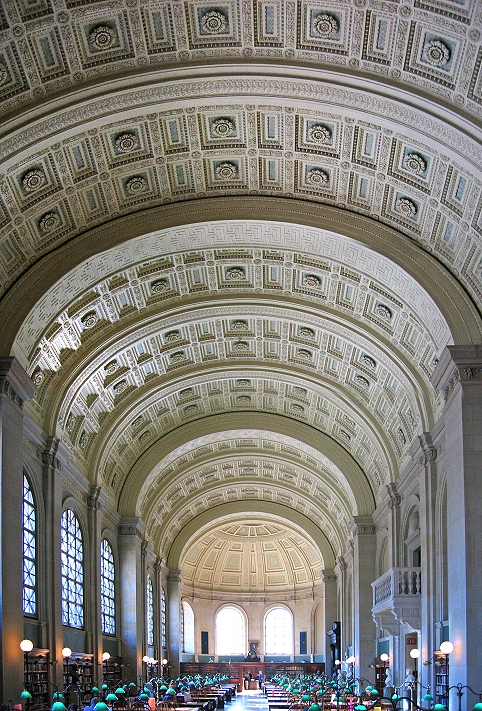
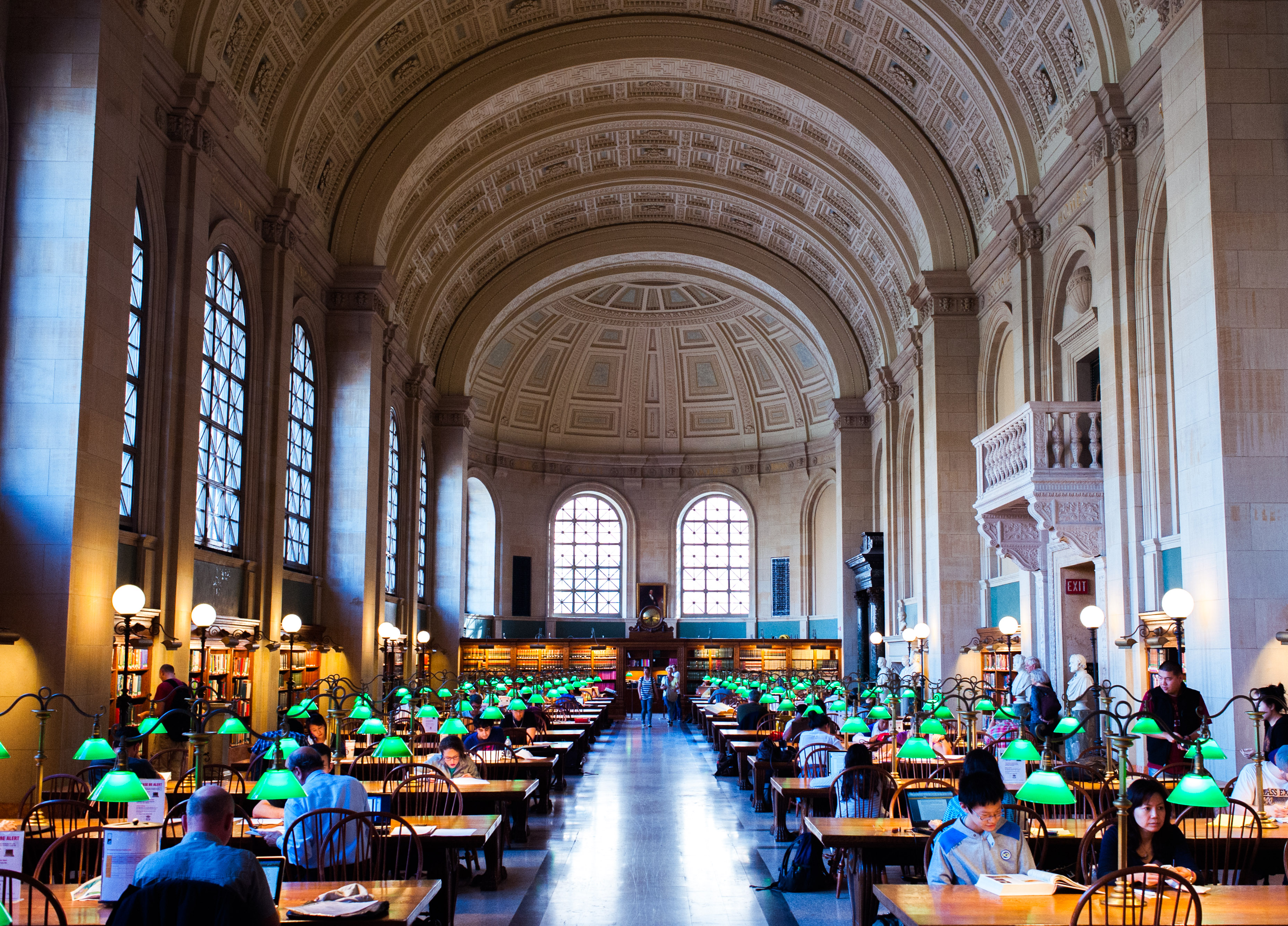
At the top of the stairs, through a small lobby, is the room everyone comes to see. Bates Hall, the library's main reading room, runs the full length of the building's Dartmouth Street elevation on the second floor: 218 feet long, 42 and a half feet wide, and 50 feet high at the crown of its barrel-vaulted, coffered ceiling. It is named for Joshua Bates, the library's first great benefactor, and it is, by common consent, one of the most beautiful rooms in America. A Boston Globe writer once called it one of the city's "secular spots that are sacred," and the description fits: a vast, hushed room, ivory and blue, with English oak bookcases, marble busts of authors and Bostonians along the walls, a frieze of names of artists, scientists, authors, and philosophers near the ceiling, and rows of long wooden tables lit by green-shaded lamps.
Bates Hall was designed for use, not just for admiration. As built it had 33 tables and room for 300 readers; today it seats about 330. The green lamps, the oak tables, and much of the furniture are original or restored to match the room as it looked in 1895, after a major restoration in the 1990s. Readers still work here all day, and visitors are welcome to walk the length of the hall — quietly — and sit for a while. The tall arched windows on the Copley Square side flood the room with daylight, and the semicircular apses at each end give the long room the feel of a Roman basilica. It is the single best free interior in Boston, and it costs nothing to enter.
The courtyard: Rome in the middle of Boston
At the heart of the McKim Building, surrounded on all sides by the library's rooms, is an open-air courtyard measuring 100 by 135 feet, modeled on the courtyard of the sixteenth-century Palazzo della Cancelleria in Rome. It is designed in the manner of a Renaissance cloister: an arcaded gallery with Doric columns of Tuckahoe marble runs around three sides, and in the middle is a small plaza with a square fountain basin. It is the building's lungs — quiet, green, open to the sky — and on a fine day it is one of the most peaceful places in the Back Bay.
The fountain at the courtyard's center holds a copy of Frederick William MacMonnies's Bacchante and Infant Faun, a bronze that has its own dramatic history. McKim himself presented the original statue as a gift to the library, and it was installed in the courtyard in November 1896. Within two weeks it was removed to storage after a public outcry over its nudity and its apparent celebration of drunkenness, and it eventually went to the Metropolitan Museum of Art in New York. In the 1990s the library commissioned a replica, installed in 1999, so the courtyard looks today much as McKim intended it. The courtyard was also part of the multiphase McKim Building restoration that ran from 1991 to 2002, which returned its arcades, fountain, and plantings to their original character.
The murals: Sargent, Abbey, and Puvis de Chavannes
The McKim Building is sometimes called Boston's Sistine Chapel, and the murals are the reason. On the third floor, Sargent Hall is named for the Triumph of Religion mural group that John Singer Sargent painted there between 1895 and 1919 — vast panels of religious history, including the Old Testament scenes on the north wall, that occupied the artist on and off for more than two decades and were never entirely finished to his satisfaction. The hall leads to the library's art room and special libraries, including the Barton Library, the treasure room, and the Wiggin Gallery.
Downstairs, in the book-delivery room off the second-floor corridor, Edwin Austin Abbey's Quest of the Holy Grail runs around the tops of the walls in Pre-Raphaelite style, following the knights' search for the Grail. The delivery room itself is worth a look: checkerboard Verona red and Istrian gray marble floors, an oak desk, and a ceiling with great wooden beams in the style of the library of the Doge's Palace in Venice. And around the grand staircase, as noted, are the Puvis de Chavannes panels — the only murals the French master ever painted outside his own country. The library offers free daily art and architecture tours that take in all three mural cycles, and they are the best way to see rooms that are otherwise easy to walk past.
The Johnson Building and the library today
West of the McKim Building, filling the rest of the block, stands the Johnson Building, the library's second half. Designed by Philip Johnson and opened in 1972, it is a Brutalist building in the same pink granite as the McKim Building, kept deliberately to the same height and cornice line, with slanting lunette windows and a largely windowless upper section. Johnson himself later admitted the building did not come out quite as he intended, and critics have compared it to a mausoleum — but a major renovation completed in 2016, led by William Rawn Associates, opened it up with taller transparent windows, a double-height Boylston Hall, a cafe, and a mezzanine of reading rooms, and it now houses the library's circulating collection and serves as headquarters for the system's 24 branch libraries.
Together the two buildings hold a collection of more than 24 million items, making the Boston Public Library one of the largest public libraries in the country. Its special collections include early editions of Shakespeare, the personal library of President John Adams, the papers of abolitionist William Lloyd Garrison, and the records of colonial Boston. The Central Library draws around 4 million visitors a year. And yet, for all its scale, the McKim Building still works the way Joshua Bates wanted it to: as a free public room, open to anyone, in the middle of the city.
How to visit well
Come in through the Dartmouth Street entrance, the way McKim intended, and give yourself at least an hour — two if you want to linger. Start with the entrance lobby and the grand staircase, say hello to the lions, and follow the Puvis de Chavannes murals up to the second floor. Walk the length of Bates Hall, sit at a table for a few minutes, and then find the courtyard, which is easiest to reach from the first floor. Save the third floor for Sargent Hall and the special libraries, and if a free art and architecture tour is running, take it: the guides tell the stories — the Bacchante scandal, the lions' regiments, the shipped-from-Paris murals — that the walls do not.
Pair the library with Copley Square itself. Across Dartmouth Street is Trinity Church, Henry Hobson Richardson's masterpiece; across the square is the Old South Church; and a few steps away is the Copley MBTA station, the Boylston Street shops, and the Public Garden. The library is the natural anchor of a Back Bay day, and its calm is the perfect counterweight to the avenue's bustle. Step out of Bates Hall into the courtyard, and you will understand what McKim meant by a palace for the people: not a palace that keeps people out, but one built, as the Dartmouth Street inscription says, by the people, and dedicated to the advancement of learning.
Key Facts
The Boston Public Library was founded in 1848 and was the first large free municipal library in the United States, the first public library in the country to lend books, the first to open a branch, and the first to open a children's room.
The library opened to the public in 1854 in two rooms of the former Adams Schoolhouse on Mason Street, and moved to a building at 55 Boylston Street in 1858.
Joshua Bates, a London merchant banker born in Weymouth, Massachusetts, donated $50,000 in 1852 for the library's establishment and another $50,000 for books, on the principle that its services be free to all; Bates Hall is named for him.
The McKim Building in Copley Square was designed by Charles Follen McKim of McKim, Mead & White; construction began in 1888 and the building opened in 1895.
The facade is modeled on the Bibliothèque Sainte-Geneviève in Paris; the central courtyard is modeled on the Palazzo della Cancelleria in Rome.
The building is made of Milford granite and stands on more than 4,000 wooden pilings driven into the Back Bay landfill; it measures 225 feet across the front and 70 feet high to the cornice.
The Dartmouth Street entrance carries the inscription "Free to All" above its central keystone; the three facades carry monumental inscriptions, and 33 medallions by Domingo Mora decorate the window spandrels.
Bates Hall, the second-floor reading room, measures 218 by 42.5 feet and 50 feet high at the crown of its barrel-vaulted, coffered ceiling; it seats about 330 readers today.
The grand staircase is yellow Siena marble; its two lions were carved by Louis Saint-Gaudens from single blocks of Siena marble and commissioned by veterans of the 2nd and 20th Massachusetts regiments.
Murals in the building include John Singer Sargent's Triumph of Religion (1895–1919) in Sargent Hall, Edwin Austin Abbey's Quest of the Holy Grail in the delivery room, and Pierre Puvis de Chavannes's staircase panels, his only work outside France.
The courtyard fountain holds a replica, installed in 1999, of Frederick William MacMonnies's Bacchante and Infant Faun; the original, installed in 1896, was removed after two weeks amid controversy and is now at the Metropolitan Museum of Art.
The building was one of the first major American applications of Rafael Guastavino's thin tile vaults; seven types of Guastavino vaulting appear in it.
The McKim Building was listed on the National Register of Historic Places in 1973 and designated a National Historic Landmark in 1986.
The Philip Johnson addition opened in 1972 and was renovated in 2016; the McKim Building underwent a multiphase restoration from 1991 to 2002.
The Central Library is at 700 Boylston Street, Copley Square, in the Back Bay, and holds a collection of more than 24 million items across the Boston Public Library system.
Visitor Details
Address: Boston Public Library, Central Library (McKim Building), 700 Boylston Street, Boston, MA 02116 (Copley Square, Back Bay)
Transit: Copley station on the MBTA Green Line sits in front of the library's Boylston Street side; several bus routes run along Boylston Street and through Copley Square.
Hours/Admission: The Central Library is a free public library — there is no admission charge to enter, see Bates Hall, or walk the courtyard. Hours, tour times, and any special-exhibition arrangements change from time to time — check the official source at bpl.org before visiting to confirm current hours and free art and architecture tour times.
Best timing: Arrive on a weekday morning for the quietest Bates Hall; allow at least an hour, and two if you join a tour. Visit the courtyard in fine weather, and pair the library with Trinity Church, Old South Church, Copley Square, and the Public Garden, all within a short walk.
Location Photography