The tower you see first
There is a moment, arriving in New York by almost any route from the south or west, when one building takes over the skyline and refuses to give it back. It is not the Empire State Building, and it is not one of the glass slabs of Midtown. It is a tall, tapering tower of blue glass in Lower Manhattan, narrowing as it climbs, its eight triangular faces catching the light differently from every angle, its spire finishing the climb at a height chosen on purpose: 1,776 feet, a deliberate nod to the year of American independence.
That is One World Trade Center, and it is the first thing most first-time visitors should understand about the modern New York skyline. It is the tallest building in the United States and the Western Hemisphere, the main building of the rebuilt World Trade Center complex, and it stands on ground that carries more history, and more grief, than any other sixteen acres in America. To visit it is to do two things at once: to look up at an extraordinary piece of engineering, and to stand in a place where the city was attacked, mourned, and then rebuilt itself in full view of the world.
The tower opened on November 3, 2014. Its observation deck, One World Observatory, opened the following May, on May 29, 2015. Together they draw millions of visitors a year to a corner of Lower Manhattan that, a generation ago, was a construction site behind fences and, before that, a smoking ruin. The speed of that transformation is part of the story. So is the care with which it was done.
The ground beneath the tower
One World Trade Center stands on the northwest corner of the 16-acre World Trade Center site, on the footprint of the original 6 World Trade Center building, bounded by West Street to the west, Vesey Street to the north, Fulton Street to the south, and Washington Street to the east. The original World Trade Center, designed by Minoru Yamasaki, opened in the early 1970s and was anchored by the Twin Towers: the North Tower, 1 World Trade Center, completed in 1972, and the South Tower, 2 World Trade Center, completed in 1973. At 1,368 and 1,362 feet, they were the tallest buildings in the world when they opened, and they became the defining image of the New York skyline within a decade.
On the morning of September 11, 2001, terrorists hijacked four commercial airplanes and flew two of them into the Twin Towers. Both towers collapsed within two hours. A third hijacked plane struck the Pentagon, and a fourth crashed in a field in Pennsylvania after passengers fought back. Nearly 3,000 people were killed in the attacks, including 2,753 at the World Trade Center site itself. The destruction also leveled or gravely damaged the other buildings of the original complex, including 6 World Trade Center, the eight-story customs house on whose site the new tower now stands.
For years afterward, the site was known, simply, as Ground Zero: first a rescue and recovery operation, then a pit, then the largest construction project in the city's modern history. The decision to rebuild on the site, rather than to leave it empty, was argued over for years — in public hearings, in newspaper columns, in families' living rooms. The argument that won was that the city should not surrender its skyline, and that the best memorial to what was lost was a living, working place. One World Trade Center is the physical form of that argument.
Rebuilding: from Freedom Tower to One World Trade Center
The rebuilding began below ground. Construction on utility relocations, footings, and foundations for the new tower started on April 27, 2006, and the first steel columns were set into the foundation that December. The project moved slowly at first, through redesigns, security reviews, and disputes over cost and control between the Port Authority of New York and New Jersey, which owns the site, and the private developers involved. The tower was originally promoted under the name "Freedom Tower," but on March 26, 2009, the Port Authority confirmed that the building's official name would be its legal name: One World Trade Center, the same name as the original North Tower.
The tower passed its milestones in public, and New Yorkers watched it happen. On April 30, 2012, it surpassed the Empire State Building to become the tallest structure in New York City. Its steel frame topped out on August 30, 2012. And on May 10, 2013, workers installed the final component of the spire, bringing the building to its full symbolic height of 1,776 feet. The building opened to its first office tenants on November 3, 2014, thirteen years after the attacks. The publishing company Condé Nast was its anchor tenant, and the Durst Organization co-developed and manages the tower with the Port Authority.
The cost of the tower alone was about $3.9 billion, making it one of the most expensive office buildings ever built. That figure is worth pausing on, because it explains something about the building's character: this was never a routine commercial skyscraper. It was built as a statement, with security and symbolism engineered into every decision, and the budget reflects it.
The architecture: David Childs and the 1,776-foot idea
The tower's architect was David Childs of Skidmore, Owings & Merrill (SOM), working within a master plan for the site by Daniel Libeskind. Childs's design is a study in controlled geometry. The tower rises from a square base of about 200 feet on each side, and as it climbs, its corners are chamfered away until the plan becomes an octagon, and then, near the top, a square again — rotated 45 degrees from the base. The eight faces of the tower are isosceles triangles of glass, and the effect, from the street, is of a crystalline form that seems to shift as you walk around it: solid and monumental from one angle, slender and almost dissolving into the sky from another.
The facade is made of reflective blue glass panels, and the tower's height is broken down into numbers that reward a close look. The roof stands at 1,368 feet — the exact height of the original North Tower, a quiet tribute built into the silhouette. The spire, 408 feet tall, carries the total to 1,776 feet. The top floor is numbered 104, though the building has 94 stories above ground plus five below; the observatory sits at 1,268 feet. There are 73 elevators, including five express elevators that carry observatory visitors from the lobby to the 102nd floor in under a minute.
Security, inevitably, shaped the design as much as aesthetics did. The base of the tower is a 200-foot-tall windowless concrete podium, built to withstand a truck bomb, and the building's core — its elevators, stairwells, and life-safety systems — is encased in extra-thick reinforced concrete. The plaza around the tower is landscaped and open, but vehicle access is controlled, and the building sits back from the street behind bollards and planters that double as street furniture. Childs's achievement was to make all of that fortification read, from the sidewalk, as elegance rather than fear: the tower looks serene, not armored.
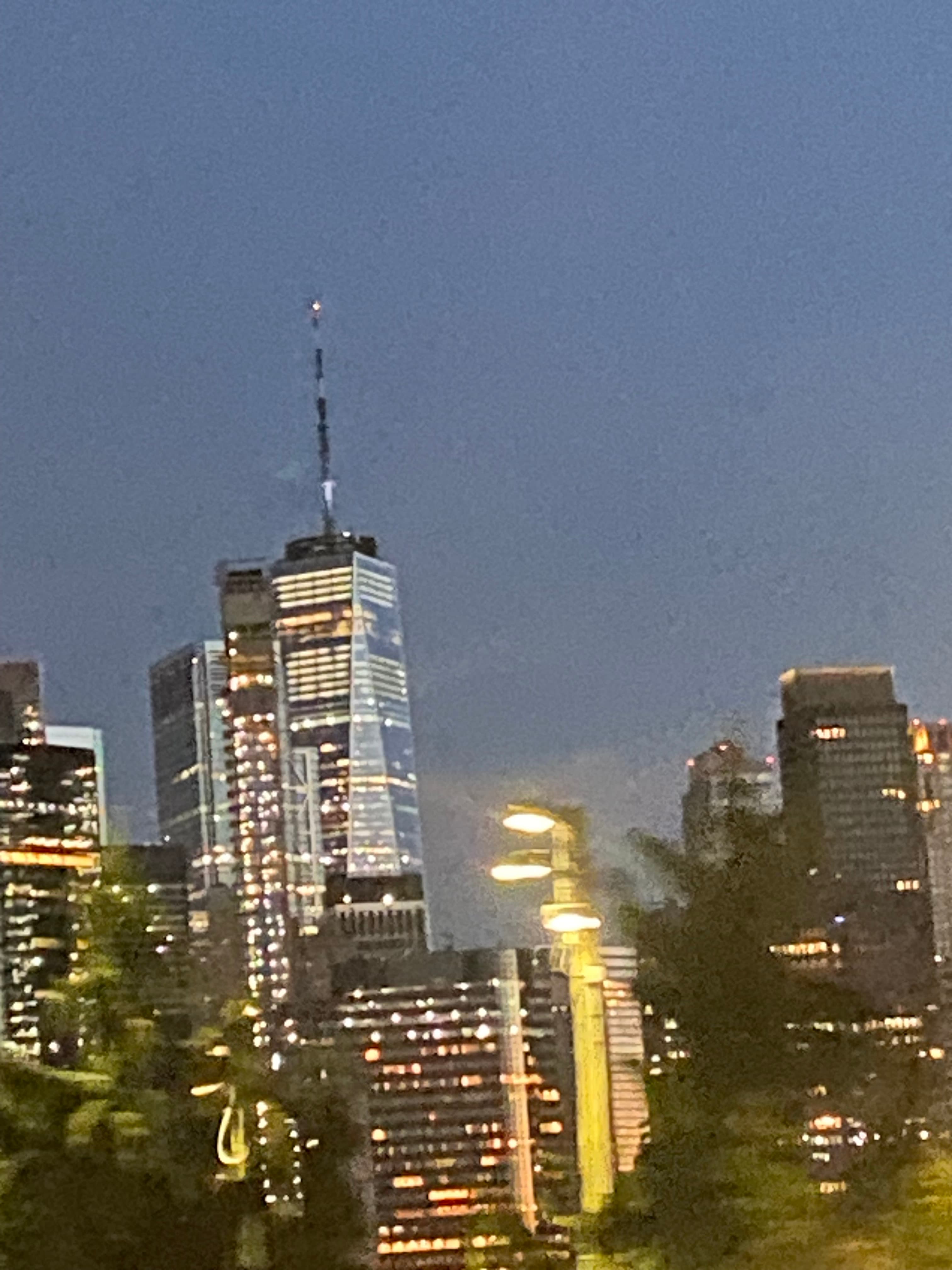
At night, the spire is lit, and its beacon — a powerful light visible for miles — serves as both an aviation warning and a kind of lighthouse for the harbor. On anniversaries and occasions of mourning, the spire is lit in colors chosen for the moment. It is, in the most literal sense, the light at the top of the city.
One World Observatory: the view from the 100th floor
For most visitors, the tower is experienced from the inside, at One World Observatory, which occupies the 100th, 101st, and 102nd floors. The visit is choreographed from the moment you enter. The express elevator ride, under 60 seconds, is itself a show: floor-to-ceiling screens play a time-lapse of New York's skyline growing from the 1500s to the present day as you ascend. At the top, the See Forever Theater presents a short aerial film of the city, and then the screen lifts to reveal the real thing — the observation floor's floor-to-ceiling windows and a panorama that, on a clear day, stretches for 45 miles in every direction.
The main observation level is the 100th floor, with the 101st floor holding a restaurant and bar and the 102nd floor offering an event space and a slightly higher, quieter vantage point. The deck looks out over the harbor and the Statue of Liberty to the south, the Midtown skyline to the north, Brooklyn and the East River to the east, and New Jersey across the Hudson to the west. It is the highest public vantage point in the city, higher than the Empire State Building's observatory and the Top of the Rock, and the difference is felt: from here, Manhattan reads as an island again, the way it does from an airplane window, with the grid, the rivers, and the harbor all laid out at once.
The observatory also runs exhibits on the tower's construction and on the city's neighborhoods, and there are dining options at the top, including a full-service restaurant. It is worth knowing, before you go, that the observatory is a separate ticketed attraction from the rest of the World Trade Center site, and that the memorial plaza and the museum next door are separate experiences with their own admission arrangements. Plan them as three visits in one place, not one visit with three parts.
The memorial at its feet
No account of One World Trade Center is complete without the ground at its feet, because the tower was designed to be seen in conversation with the memorial beside it. Directly south of the tower, on the footprints of the original Twin Towers, sit the two reflecting pools of the National September 11 Memorial: each nearly an acre in size, sunk 30 feet into the ground, with water cascading down their walls into a central void. The names of the 2,983 victims of the 2001 attacks and the 1993 World Trade Center bombing are inscribed in bronze parapets around the pools' edges. The memorial plaza around them is planted with more than 400 swamp white oak trees, including the Survivor Tree, a Callery pear tree that was recovered from the rubble, nursed back to health, and replanted on the plaza.
Beside the pools stands the National September 11 Memorial & Museum, which tells the story of the attacks and their aftermath through artifacts, recorded testimony, and the preserved remnants of the original complex, including the slurry wall that held back the Hudson River during construction of the original towers. The museum is a heavy, necessary experience, and it pairs naturally with the observatory: one takes you up above the city, the other takes you down into its hardest day. Many visitors do both in a single afternoon, and many find the combination — the view, then the memorial, or the memorial, then the view — to be the most complete way to understand what this place is.
Around the tower and the memorial, the rebuilt complex has filled in: the Oculus, Santiago Calatrava's white, wing-like transportation hub, which opened in 2016 and now serves PATH trains and a dozen subway lines beneath a soaring, light-filled hall; the performing arts center, concert halls, offices, and shops that have returned life to streets that were, for a decade, a construction zone. The neighborhood around the tower — the Financial District — is itself worth a walk after your visit: the old stone streets, the Stock Exchange, Trinity Church, and the harbor promenade at Battery Park are all within a short stroll.
Visiting One World Trade Center well
Start at the memorial plaza, not at the observatory. Walk the pools first, find the names, sit under the oaks, and let the scale of the place register before you go up. Then take the observatory elevator and see the city whole from 1,268 feet — the harbor, the bridges, the grid — and you will understand, in a way no photograph conveys, why this tower was built here and why it is this tall. If you have the time and the steadiness for it, finish at the museum, which is the part of the site that asks the most of you and gives the most back.
Come on a clear day if you can choose: the observatory's panorama is the whole point, and haze or low cloud will blunt it. Mornings tend to be quieter than afternoons, and the plaza is at its most peaceful early, before the tour groups arrive. And give the neighborhood its due afterward — walk south to Battery Park and the harbor, or east to the Stone Street Historic District, where the Financial District's oldest taverns and cobblestones survive within sight of the newest tower in America. That contrast, old New York and new, is the point of the whole visit.
One World Trade Center is not, finally, a building you admire the way you admire a beautiful old skyscraper. It is a building you stand beneath and think about: about what was lost here, about what it took to rebuild, and about a city that decided its answer to destruction would be to build the tallest thing in the hemisphere, on the same ground, and to open it to anyone willing to ride an elevator a quarter of a mile into the sky. That is why it belongs on every first-time visitor's list — not just because it is tall, but because it is the story of New York in the 21st century, told in glass and steel.
Key Facts
One World Trade Center is the main building of the rebuilt World Trade Center complex in Lower Manhattan, at 285 Fulton Street, on the northwest corner of the 16-acre site, on the footprint of the original 6 World Trade Center.
It is the tallest building in the United States and the Western Hemisphere: 1,776 feet (541.3 meters) including its spire, a deliberate reference to the year of American independence.
The roof height is 1,368 feet, matching the height of the original North Tower; the spire is 408 feet tall; the top floor is numbered 104; the building has 94 stories above ground plus 5 below, and 73 elevators.
The architect was David Childs of Skidmore, Owings & Merrill, working within Daniel Libeskind's master plan for the site. The developer is the Port Authority of New York and New Jersey, with the Durst Organization.
Construction of foundations began April 27, 2006; the tower surpassed the Empire State Building as New York's tallest structure on April 30, 2012; its steel topped out August 30, 2012; the spire's final component was installed May 10, 2013; the building opened November 3, 2014.
One World Observatory, on the 100th, 101st, and 102nd floors, opened May 29, 2015; its main observation level is the 100th floor, at 1,268 feet, with express elevators reaching the top in under 60 seconds.
The tower was promoted early on as the "Freedom Tower"; on March 26, 2009, the Port Authority confirmed its official name as One World Trade Center, the same name as the original North Tower.
The original Twin Towers were destroyed in the terrorist attacks of September 11, 2001, in which nearly 3,000 people were killed, including 2,753 at the World Trade Center site.
The National September 11 Memorial, directly south of the tower on the Twin Towers' footprints, features two reflecting pools, each nearly an acre, with the names of 2,983 victims inscribed in bronze; the plaza holds more than 400 swamp white oak trees, including the Survivor Tree.
The tower's construction cost was about $3.9 billion, and its base is a 200-foot reinforced-concrete podium designed for blast resistance, with the building's core encased in extra-thick concrete.
The World Trade Center Transportation Hub, the Oculus, designed by Santiago Calatrava, opened in 2016 beside the tower and serves PATH trains and multiple subway lines.
Visitor Details
Address: 285 Fulton St, New York, NY 10007
Transit: PATH trains to World Trade Center station (via the Oculus); subway to WTC Cortlandt (1 train), Fulton Street/Fulton Center (2, 3, 4, 5, A, C, J, Z), and Chambers Street–World Trade Center/Park Place/Cortlandt Street stations
Hours/Admission: Observatory ticket prices and hours change with season and demand, so check the official source at oneworldobservatory.com before visiting. The 9/11 Memorial plaza is free to enter; the 9/11 Memorial & Museum is separately ticketed — check 911memorial.org for current admission and hours.
Best timing: Visit on a clear day if you can choose, and start at the memorial plaza before riding to the observatory. Mornings tend to be quieter than afternoons. Pair the visit with a walk south to Battery Park or east to the Stone Street Historic District.
Location Photography