The palace across from the Capitol
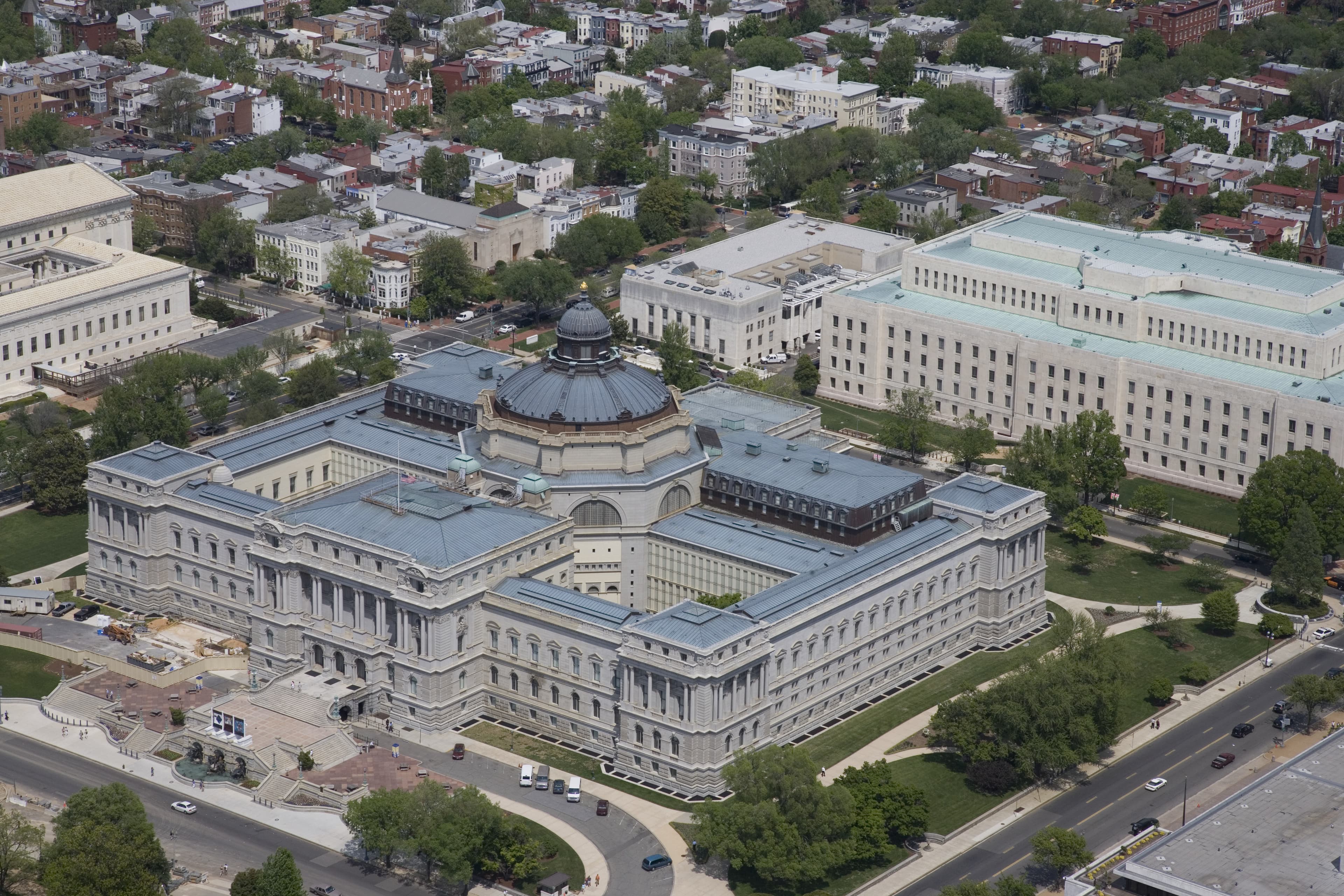
Walk east from the United States Capitol, cross First Street, and you come to a building that looks less like a library than like a palace that has wandered into the middle of American government. That is the Thomas Jefferson Building of the Library of Congress, and it is the single most beautiful public interior in Washington. Its facade is a long, calm Beaux-Arts composition of granite and marble, crowned by a gilded dome; its entrance is guarded by a fountain of Neptune and his sea creatures; and inside, the Great Hall rises in marble, mosaic, and stained glass, as if the whole idea of learning had been given a ballroom.
It is also, and this matters, a working library. The Jefferson Building is the oldest of the Library of Congress's three Capitol Hill buildings, and the ceremonial heart of the largest library in the world — an institution holding roughly 173 million items in more than 470 languages. People come here to see the building, and they should. But the building was designed to make a visitor feel something first and understand something second: that a republic stakes its future on what its citizens know.
The building opened to the public on November 1, 1897, after more than a decade of construction, and it was immediately hailed as a national monument. Writers of the day struggled for superlatives; one called it "likely to long remain unrivaled in this or any other country," and another wrote that he did not expect to see it transcended "until I stand before the judgment seat of God." More than a century later, the praise still holds up. The Jefferson Building is not a backdrop to a Washington visit. For many first-time visitors, it is the visit.
Two fires and a president's library
The Library of Congress began in 1800, when Congress, newly arrived in Washington, set aside money for books its members might need — a reference collection for legislators, housed in the Capitol itself. The original collection was small, a few hundred books and a handful of maps. It did not stay small, and it did not stay safe.
In August 1814, during the War of 1812, British troops burned the Capitol, and the library inside it was destroyed. Congress needed to rebuild, and the man who answered was Thomas Jefferson. The former president offered his own personal library — 6,487 volumes, collected over a lifetime and arranged by subject rather than by size or author, as most libraries of the day were. Jefferson's collection was unusually broad: law and history, yes, but also science, philosophy, poetry, architecture, and books in French, Italian, Spanish, and Greek. Congress bought it in 1815, and Jefferson's library became the foundation of the new Library of Congress. It is why the building now bears his name — formally renamed for him in 1980 — and why a display of Jefferson's books remains one of the building's most moving sights.
Disaster struck again. On Christmas Eve 1851, a fire in the Capitol destroyed about two-thirds of the collection, including two-thirds of Jefferson's original books. The library rebuilt again, this time with a fireproof iron room, and kept growing. Then, in 1870, Congress passed a copyright law requiring that two copies of every work registered for copyright in the United States be deposited with the Library. The flood that followed — books, pamphlets, maps, music, prints, and photographs arriving by the crate — made the old quarters in the Capitol impossible. By the 1880s, everyone agreed: the Library of Congress needed a building of its own.
A building designed as an argument
Congress approved the new building in 1886, and construction ran from 1890 to 1897. The design competition had been won in 1873 by John L. Smithmeyer and Paul J. Pelz; Pelz carried most of the exterior design, and Edward Pearce Casey, who succeeded him, oversaw the interiors and the decorative program, with Bernard Green as superintendent of construction and Thomas Lincoln Casey of the Army Corps of Engineers directing the work. The result was a building modeled, in its ambition and its central block, on the Paris Opera House — a deliberate statement that American civilization could produce public art to rival Europe's, and that a library deserved architecture as grand as any palace or opera house.
That ambition shows everywhere, starting outside. The facade facing the Capitol is a long Beaux-Arts composition of granite, marble, and bronze, its second-floor portico lined with nine busts of great figures chosen by Librarian Ainsworth Rand Spofford: Demosthenes, Ralph Waldo Emerson, Washington Irving, Johann Wolfgang von Goethe, Benjamin Franklin, Thomas Babington Macaulay, Nathaniel Hawthorne, Sir Walter Scott, and Dante Alighieri. Around the first floor, sculpted portrait heads — once described as representing the peoples of the world — serve as keystones over the windows. In front of the west terrace, the Court of Neptune Fountain, sculpted by Roland Hinton Perry with a grotto by Albert Weinert and completed in 1898, sends Neptune, tritons, sea nymphs, and sea horses plunging through the water — a Washington answer to Rome's Trevi Fountain, and the first thing many visitors photograph.
Above it all rises the dome. The copper dome over the Main Reading Room was originally meant to stay low, so as not to compete with the Capitol's dome across the street. Casey and Green thought bigger: they raised it to 195 feet and covered it with 23-carat gold leaf. It was criticized at the time as too showy. It is now one of the great landmarks of the Capitol Hill skyline, catching the light over First Street like a small sun.
The interior decoration was an unprecedented federal commission. More than fifty American painters and sculptors produced works for the building — the first time the United States government had called on a representative body of American artists to embellish a public building. Librarian Spofford set out the program: the progress of civilization, told in allegory, sculpture, and mural, culminating in American culture. The building was, in other words, designed as an argument — that knowledge is the foundation of the republic, and that the republic should house it beautifully.
The Great Hall: marble, mosaic, and electric light
Step through the bronze entrance doors — themselves works of art, with figures representing Imagination, Memory, Truth, and Research by Olin L. Warner, and a central panel on the art of printing by Frederick MacMonnies — and you enter the Great Hall, the building's great ceremonial space. It is two stories of white marble, Corinthian columns, grand staircases, and a vaulted ceiling of stained glass and mosaic, and it stops first-time visitors in their tracks the way a cathedral nave does.
Look up first. The ceiling, long assumed to be decorated with silver leaf, was found during the building's restoration to be gilded with aluminum — a metal more precious than silver in the 1890s, when the building was finished. The choice was deliberate: the Jefferson Building celebrates electricity and modern invention everywhere, and aluminum, the new wonder metal, was part of the message. Bronze female figures on the staircases hold torches of electric light, and a bust of Benjamin Franklin, scientist as well as statesman, stands outside the central window — a reminder that the building opened in the age of the telegraph, the telephone, and the electric motor.
Look at the stairs next. The grand staircases are lined with marble putti — cherubs by sculptor Philip Martiny — each representing an American occupation: a gardener with a spade, an entomologist with a butterfly net, a printer with type, a mechanic with a cogwheel, a student, a hunter, an engineer, a chemist. They are small, charming, and endlessly photogenic, and they carry the building's message in miniature: every kind of work, every kind of knowledge, belongs here.
Then look east, to the far end of the hall, where Elihu Vedder's mosaic of Minerva, Roman goddess of wisdom, gazes down from the second floor. Minerva, shown at peace and holding a scroll, presides over the hall as the building's presiding spirit — wisdom as guardian of civilization. Beneath her, the commemorative arch leading toward the Main Reading Room is crowned with sculptures of students and learning. The floor itself is part of the show: marble inlaid with brass medallions of the sun, the compass points, and the signs of the zodiac. Nothing in the Great Hall is merely decorative. Every surface is trying to tell you why this building exists.
The Main Reading Room and the treasures within
Beyond the Great Hall lies the Main Reading Room, the most famous room in the building and one of the most beautiful library interiors in the world. It is an octagonal chamber rising about 160 feet to the underside of the dome, ringed by eight great marble columns. Each column carries a plaster statue of a female figure representing an aspect of knowledge — Religion, Commerce, History, Art, Philosophy, Poetry, Law, and Science — and each is flanked by bronze portrait statues of men whose lives embodied that field, from Moses and Herodotus to Beethoven and Michelangelo. Above them, the dome's underside carries Edwin Blashfield's murals, including "The Evolution of Civilization," twelve winged figures representing the cultures that contributed to human knowledge: Egypt for written records, Judea for religion, Greece for philosophy, Rome for administration, Islam for physics, the Middle Ages for modern languages, Italy for fine arts, Germany for printing, Spain for discovery, England for literature, France for emancipation, and America for science. At the dome's center, a female figure representing Human Understanding pulls back a veil from her face — the end of ignorance, painted into the ceiling itself.
Visitors today can view the Main Reading Room from an overlook and, at set times, join short walkthroughs onto its floor — a privilege once reserved for credentialed researchers. Check the Library's visit page before you go, because viewing times and access rules change. Even from the overlook, though, the room is overwhelming: the long oak desks radiating from the central desk, the green-shaded reading lamps, the sheer vertical lift of the dome.
Elsewhere in the building, the exhibitions reward a slow wander. The Library's treasures — a Gutenberg Bible, one of the first books printed with movable type; Jefferson's own library, reassembled book by book in a circular display; the rough draft of the Declaration of Independence; Abraham Lincoln's handwritten Gettysburg Address; maps, manuscripts, photographs, and sheet music spanning five centuries — rotate through the building's galleries. The exact displays change as exhibitions turn over, so part of the pleasure of a return visit is finding something new: a first edition, a famous photograph, a piece of sheet music you have hummed without knowing its history.
A working library, not just a monument
It is easy to treat the Jefferson Building as a museum, and it is partly one. But it is also the working heart of an institution that never stops growing. The Library of Congress administers the United States copyright system through the Copyright Office, houses the Congressional Research Service that advises Congress, and preserves the nation's memory in every format — from medieval manuscripts to born-digital recordings. Its collections include the papers of presidents, the photographs of the Depression-era Farm Security Administration, the recordings of the American Folklife Center, and the stories of veterans collected by the Veterans History Project. The building's grandeur is not nostalgia; it is the public face of an institution still doing the job it was built for.
The building also still fills with music. The Elizabeth Sprague Coolidge Auditorium, opened in 1925, has hosted more than 2,000 concerts — classical, jazz, folk, and pop — many of them free and drawing on the Library's extraordinary collections of instruments and manuscripts. On Thursday evenings, the "Live! at the Library" series keeps the building open late, with conversations, music, performances, and workshops in the Great Hall itself. A library that throws open its doors after dark, with a drink in hand and a string quartet playing under Minerva's gaze, is a building that understands its own purpose.
And the building keeps its sense of humor about its own grandeur. The book tunnel that once whisked volumes between the Jefferson Building and the Capitol on an electric conveyor at 600 feet per minute — a sort of pneumatic dream of the future of reading — is gone, sacrificed to the Capitol Visitor Center. The dome that was supposed to stay politely low now outshines everything around it. The building that was meant to be the largest, costliest, and safest library in the world is now simply the most beloved room in Washington.
Visiting the Jefferson Building well
Start outside, on the west side, with the Court of Neptune Fountain — it is at its best in the morning light, and it frames the facade the way the building's architects intended. Study the entrance doors before you rush through them; the bronze figures of Imagination, Memory, Truth, and Research are a complete little essay on what a library is for. Then give the Great Hall the time it demands. Walk it slowly, look up at the ceiling, find the Martiny putti on the staircases, and stand under Minerva's mosaic at the east end. The overlook to the Main Reading Room is the climax of the visit — linger there.
Come with a plan for the practical side, too. The building is a working federal building with airport-style security at the entrance, and entry requires a free timed-entry ticket, reserved in advance or, when available, on the day. Allow at least ninety minutes for the public spaces; two hours if you want to see the exhibitions properly. And pair the visit with its neighbors: the Capitol across the street, the Supreme Court one block east, and the folly and grandeur of the whole Capitol Hill ensemble. The Jefferson Building is the jewel of that ensemble — and, unlike most jewels, it is free, open, and waiting for anyone who walks in with curiosity.
Key Facts
- The Thomas Jefferson Building, originally called the Library of Congress Building, is the oldest of the Library of Congress's three Capitol Hill buildings; it opened to the public on November 1, 1897, after construction from 1890 to 1897, and was renamed for Thomas Jefferson in 1980.
- The building's architects were John L. Smithmeyer and Paul J. Pelz, with Edward Pearce Casey overseeing the interiors and decorative program; Bernard Green was superintendent of construction.
- The Library of Congress was founded in 1800; its original Capitol collection was destroyed when British troops burned the Capitol in August 1814, and Congress bought Thomas Jefferson's personal library of 6,487 volumes in 1815 as its replacement foundation.
- A second fire on Christmas Eve 1851 destroyed about two-thirds of the collection, including two-thirds of Jefferson's original books.
- The Copyright Law of 1870, requiring two copies of every copyrighted American work to be deposited with the Library, flooded the old Capitol quarters and drove the decision to build a dedicated library building, approved by Congress in 1886.
- The dome over the Main Reading Room rises 195 feet and is covered with 23-carat gold leaf, raised above its originally planned lower height by Casey and Green.
- More than fifty American painters and sculptors produced commissioned works for the building, the first time the federal government called on a representative body of American artists to embellish a public building.
- The Great Hall's ceiling decoration, long thought to be silver leaf, was found during restoration to be aluminum leaf — a metal more precious than silver in the 1890s.
- The Great Hall's grand staircases are lined with marble putti by Philip Martiny representing American occupations, including gardener, entomologist, printer, mechanic, student, hunter, engineer, and chemist.
- Elihu Vedder's mosaic of Minerva, Roman goddess of wisdom, presides over the east end of the Great Hall; the Main Reading Room dome carries Edwin Blashfield's "The Evolution of Civilization" murals.
- The Court of Neptune Fountain on the west terrace, sculpted by Roland Hinton Perry with a grotto by Albert Weinert, was completed in 1898.
- The building was designated a National Historic Landmark in 1965.
- The Library of Congress is the largest library in the world, with roughly 173 million items in more than 470 languages, and it administers the U.S. copyright system and houses the Congressional Research Service.
- The Elizabeth Sprague Coolidge Auditorium, opened in October 1925, has hosted more than 2,000 concerts.
Visitor Details
Address: 101 Independence Ave SE, Washington, DC 20540
Transit: Capitol South station (Blue, Orange, and Silver lines) is the closest Metro stop, a short walk from the building; Union Station (Red line) is also nearby
Hours/Admission: Verified against the Library of Congress visit page (loc.gov/visit) in this run: the Thomas Jefferson Building is open to visitors Tuesday through Saturday, 10 a.m. to 5 p.m., with last entry at 4:30 p.m.; it is closed Sundays, Mondays, and select federal holidays, and stays open late on Thursday evenings. Entry requires a free timed-entry ticket — reserve in advance on loc.gov/visit, as hours, ticket rules, and access to individual spaces can change. Visitors pass through airport-style security at the entrance.
Best timing: Morning light for the Court of Neptune Fountain and the west facade; allow at least 90 minutes for the public spaces, and check loc.gov/visit for Main Reading Room viewing and walkthrough times before you go. Pair the visit with the U.S. Capitol across the street and the Supreme Court one block east.
Location Photography