A white marble answer to Fifth Avenue
There is no building in Midtown Manhattan that stops foot traffic quite like St. Patrick's Cathedral. On Fifth Avenue between 50th and 51st Streets, directly across from Rockefeller Center, a white-marble Gothic cathedral rises between the glass towers and flagship stores, its twin spires pointing 330 feet into the Manhattan sky. Step off the shopping avenue and through its bronze doors, and the noise of Midtown falls away into a cool, vaulted quiet that has been there since the nineteenth century.
The cathedral was the vision of Archbishop John Hughes, who in the 1850s decided that New York's fast-growing Catholic population — then largely Irish immigrants — needed a cathedral to match the city's ambition. He hired the firm Renwick & Rodrigue, and the young architect James Renwick Jr. spent three years traveling in Europe studying Gothic cathedrals, taking particular inspiration from the unfinished Cologne Cathedral, before drawing the plans. The cornerstone was laid on August 15, 1858, before a crowd reported at 100,000 people, on what was then a half-rural stretch of Fifth Avenue, north of the city's built-up core.
Building it was an act of collective sacrifice. The American Civil War halted construction in the early 1860s, and when work resumed, the money came overwhelmingly from ordinary parishioners — poor Irish immigrants giving small sums, week after week. A contemporary editorial in the New York World described the cathedral as being constructed "not of the superfluity of wealth, but for the most part out of the offerings of poverty." The cathedral was completed in 1878 and dedicated on May 25, 1879, though the twin spires were not added until 1888, when the funds finally allowed. It was consecrated on October 5, 1910, once all its debts were paid.
Gothic Revival on the grandest scale
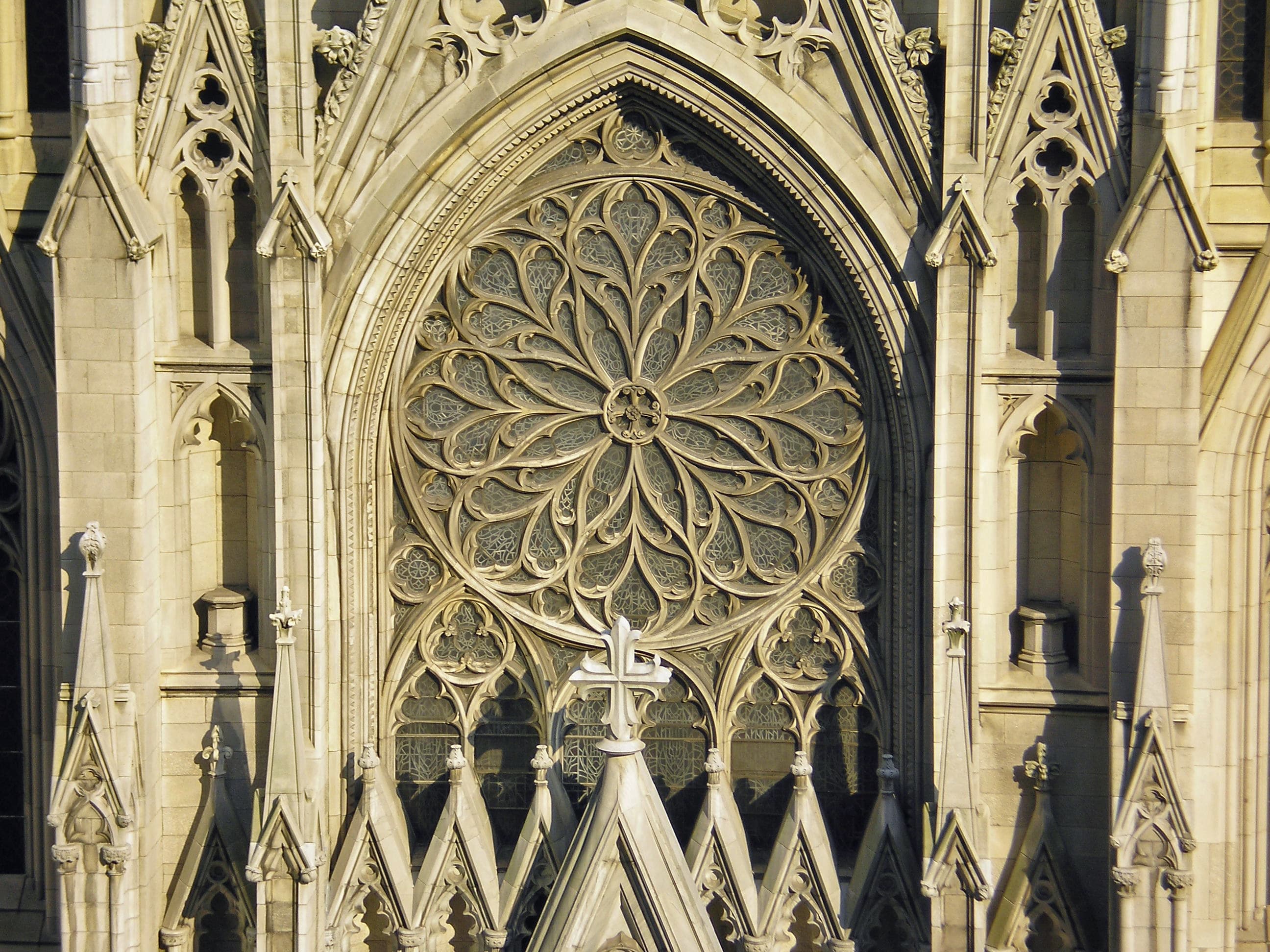
St. Patrick's is the largest Gothic Revival Catholic cathedral in North America, and its dimensions still impress: about 332 feet long, with a transept width of 174 feet, clad in white marble quarried in Massachusetts and New York. The style is Decorated neo-Gothic — pointed arches, ribbed vaulting, and traceried windows — executed with a discipline Renwick learned from the medieval originals. The main entrance on Fifth Avenue is framed by three bronze doors, flanked by the two towers, and crowned by a great rose window that glows over the avenue at dusk.
Inside, the scale is just as deliberate. The nave runs the length of a city block beneath a ribbed vault, flanked by side aisles and chapels, with several dozen stained glass windows casting colored light across the white marble. The northern tower holds nineteen bells, and the interior carries two pipe organs, including the great gallery organ above the main entrance with its five manuals. The high altar sits beneath a bronze baldachin, and behind it, the Lady Chapel — added between 1901 and 1906 to a design by Charles T. Mathews — extends the cathedral east toward Madison Avenue, along with the rectory and the archbishop's residence. The cathedral seats roughly 2,200 to 2,400 people, and on a Sunday it still fills.
Look closely at the details and the building rewards you. The bronze doors themselves are works of art, cast with scenes from the lives of saints. The stained glass, much of it made by celebrated studios in France and America, tells the story of the faith in panels of deep blue and red. The Stations of the Cross, the side altars, and the chapels each carry their own dedications, many of them gifts of immigrant families whose names are carved into the marble — the same families whose pennies built the place.
A cathedral of national moments
St. Patrick's has never been only a parish church. As the seat of the Archbishop of New York, it has been the stage for the city's great public rituals for nearly a century and a half. Popes have prayed here — a plaque inside marks the 1965 visit of Pope Paul VI, and Pope Francis visited during his 2015 trip to New York. The funerals of the famous have filled its nave, from Babe Ruth in 1948, when 75,000 mourners stood in the rain along Fifth Avenue, to governors, mayors, and cultural figures since. It is where New York comes to grieve in public and to celebrate in public, and the building's dignity has a way of rising to both occasions.
Every March 17, the cathedral takes its place at the center of the city's oldest parade. The St. Patrick's Day Parade marches up Fifth Avenue and passes directly in front of the cathedral, where the archbishop traditionally reviews the marchers from the steps — a fitting tribute to the Irish immigrants whose offerings raised the walls. At Christmas, the cathedral is equally central: the Nativity scene, the carols, and the Midnight Mass on Christmas Eve draw crowds that spill onto the avenue, and the building glows against the Rockefeller Center tree across the street.
The cathedral has been cared for as carefully as it was built. It was designated a New York City landmark in 1966 and added to the National Register of Historic Places — and named a National Historic Landmark — in 1976. A major restoration completed in 2015 cleaned the marble, repaired the stained glass, and renewed the interior, returning Renwick's white marble to something close to the brilliance it had when the doors first opened in 1879.
Inside: what to look for
Enter through the Fifth Avenue doors and give your eyes a moment to adjust. The first thing you notice is the height: the vaulted ceiling draws the eye straight up, and the long nave pulls it forward toward the sanctuary. Walk slowly down the center aisle, and look up at the clerestory windows and the ribbed vaulting — this is the Gothic idea at its purest, stone made to feel weightless.
Turn into the side aisles for the chapels. The Lady Chapel, behind the main altar, is quieter and more intimate than the great nave, with its own altar and stained glass. Near it stands a monumental Pietà, larger than Michelangelo's, carved as a memorial. The crypt beneath the cathedral holds the tombs of New York's archbishops and cardinals, a reminder that this is a working seat of a living archdiocese, not a museum. The great rose window above the entrance is best seen from the back of the nave, looking west toward Fifth Avenue, especially in late afternoon when the light comes through it.
Take time with the bronze doors on your way out. They are easy to rush past, but they are among the finest pieces of ecclesiastical metalwork in America, and they frame the moment every visitor remembers: stepping from the marble quiet back into the roar of Fifth Avenue, with the Atlas statue and Rockefeller Center directly across the street.
Visiting St. Patrick's: how to do it well
Come outside of Mass times if you want the building at its quietest, when you can sit in a pew and look around without disturbing a service. Services run throughout the day, and parts of the cathedral may be reserved for worshippers during them — check the Mass schedule before you go if you plan to attend, or if you want to avoid the busiest liturgies. The cathedral is a working church first and a landmark second, and visitors are asked to be quiet and respectful inside, particularly during services.
Pair the visit with the neighborhood. The cathedral sits at the exact center of Midtown's great sights: Rockefeller Center and the Atlas statue are directly across Fifth Avenue, the Top of the Rock observation deck is steps away, and the Fifth Avenue shopping corridor runs in both directions. Come in December and you get the full Midtown Christmas circuit — the tree, the store windows, the ice rink — with the cathedral as its spiritual anchor. Come on St. Patrick's Day and you get the parade, but expect crowds and street closures along the avenue. In any season, the best view of the facade is from across Fifth Avenue, where you can take in both spires at once — the view Renwick intended, and the one that still stops New Yorkers mid-stride.
Key Facts
- St. Patrick's Cathedral was constructed starting in 1858, completed in 1878, and dedicated on May 25, 1879; it was consecrated on October 5, 1910, once its debts were paid.
- It was designed by James Renwick Jr. of the firm Renwick & Rodrigue, in the Gothic Revival (Decorated neo-Gothic) style, inspired in part by Cologne Cathedral.
- The cathedral is the largest Gothic Revival Catholic cathedral in North America, measuring about 332 feet long with a transept width of 174 feet.
- Its twin spires, added in 1888, rise 329.5 feet (about 330 feet) above Fifth Avenue, flanking the bronze entrance doors.
- The cathedral is clad in white marble quarried in Massachusetts and New York, and it seats roughly 2,200 to 2,400 people.
- Construction was halted during the American Civil War and was funded largely by the small offerings of poor Irish immigrant parishioners.
- A Lady Chapel designed by Charles T. Mathews was added between 1901 and 1906, along with the rectory and archbishop's residence facing Madison Avenue.
- The northern tower contains nineteen bells, and the interior has two pipe organs, including the great gallery organ above the main entrance.
- The cathedral was designated a New York City landmark in 1966 and added to the National Register of Historic Places and named a National Historic Landmark on December 8, 1976.
- A major restoration completed in 2015 renewed the marble, stained glass, and interior.
- The cathedral is the seat of the Archbishop of New York; popes including Paul VI (1965) and Francis (2015) have visited, and it has hosted nationally noted funerals including Babe Ruth's in 1948.
- The St. Patrick's Day Parade passes directly in front of the cathedral on Fifth Avenue each March 17.
Visitor Details
Address: Fifth Avenue between 50th and 51st Streets, New York, NY (631 Fifth Avenue)
Transit: 5th Ave/53rd St station (E, M trains) and 47th–50th Sts–Rockefeller Center station (B, D, F, M trains) are both a short walk away
Hours/Admission: The cathedral is an active place of worship with services throughout the day — Mass times, visiting hours, and any tour or special-event arrangements vary, so check the official St. Patrick's Cathedral site before visiting; entry for individual visitors is generally without a ticket outside of special services, and donations toward the cathedral's upkeep are welcome
Best timing: Visit outside of Mass times for the quietest experience; late afternoon light through the rose window is a highlight; December brings the Rockefeller Center tree and Christmas crowds across the avenue, and March 17 brings the St. Patrick's Day Parade past the front steps
Location Photography