The quietest place in New York
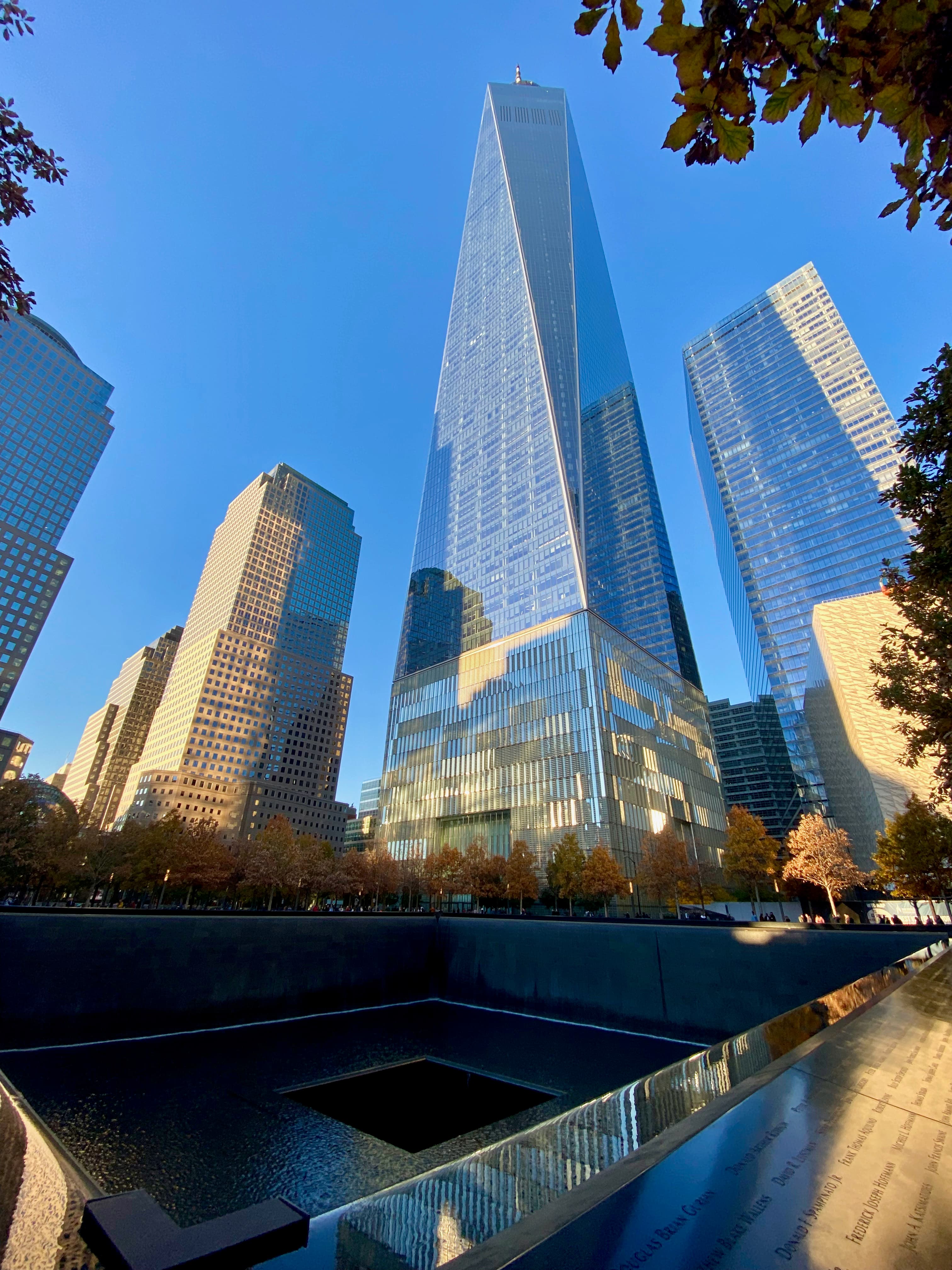
Lower Manhattan is loud. Subway trains rumble underfoot, tourists crowd the sidewalks, and construction never quite stops. Then you step onto the eight-acre plaza of the National September 11 Memorial, and the city seems to lower its voice on its own. The sound that replaces it is water — two vast waterfalls, falling thirty feet down the walls of two square pools, into a dark void at the center of each.
The memorial stands on the site of the original World Trade Center, where the Twin Towers stood until the morning of September 11, 2001. On that day, terrorists hijacked four commercial airliners. Two were flown into the Twin Towers, which collapsed; one struck the Pentagon in Arlington, Virginia; and one, United Airlines Flight 93, crashed in a field near Shanksville, Pennsylvania, after passengers fought back against the hijackers. Nearly 3,000 people were killed that day in New York, at the Pentagon, and in Pennsylvania. The memorial honors them, and also the six people killed in the February 26, 1993 bombing of the World Trade Center.
The memorial opened on September 11, 2011, the tenth anniversary of the attacks. It is now one of the most visited sites in the United States, and for many first-time visitors to New York it is the single most important stop in Lower Manhattan — not a sightseeing attraction in the ordinary sense, but a place of remembrance that asks something different of you than any other landmark in the city.
What the site was
To understand the memorial, you have to picture what stood here before. The original World Trade Center was a seven-building complex anchored by the Twin Towers: the North Tower (1 World Trade Center) and the South Tower (2 World Trade Center). When the North Tower was completed in 1970 and the South Tower in 1971, they were the tallest buildings in the world, and they quickly became the defining image of the New York skyline — the two rectangles every postcard, movie, and skyline photograph leaned on.
The towers were also workplaces. Tens of thousands of people worked in them, and on a normal weekday morning the complex held more people than many American towns. The observation deck on the South Tower, Top of the World, and the Windows on the World restaurant on the North Tower's upper floors were famous destinations in their own right. When the towers fell on September 11, 2001, they took with them not only the people inside but a piece of the city's identity, and the skyline that New Yorkers had taken for granted was gone in a single morning.
For years afterward the site was a construction zone and an open wound, known simply as Ground Zero. The decision about what should rise there — how much should be rebuilt, and how much should be left as remembrance — was argued in public for years. The memorial plaza is the answer that part of the argument reached: sixteen acres of the site were set aside so that the footprints of the towers themselves would never be built over. The two pools sit exactly where the towers stood, so that absence itself is the monument.
The pools and the names
The memorial's design is called "Reflecting Absence." It was created by architect Michael Arad, working with landscape architect Peter Walker, and it was chosen in 2004 from more than 5,000 entries in an international design competition — one of the largest such competitions ever held.
Each pool is nearly an acre in size. Water cascades down all four walls of each square basin and then drops again, into a smaller square void at the center that you cannot see the bottom of. The effect is deliberate and unsettling: the water seems to disappear, endlessly, into a space that has no floor. The sound of the falling water is constant, loud enough to muffle the traffic of the surrounding streets, and it gives the plaza its strange hush. The waterfalls are among the largest manmade waterfalls in North America.
Around the edge of each pool runs a bronze parapet, and cut into that bronze are the names of the dead: 2,983 names in all — 2,977 people killed in the September 11 attacks and six killed in the 1993 bombing. The names are not listed alphabetically. Instead, they are arranged by what the memorial calls "meaningful adjacencies": people who worked together, who were on the same flight, who were in the same company or firehouse, or who were family, are grouped near one another, following requests from nearly 1,200 victims' families. First responders are grouped by their units. If you are looking for a particular name, staff and kiosks on the plaza can tell you which panel it is on.
One quiet tradition has grown up around the names. On the birthday of each victim, memorial staff place a single white rose in the cut letters of that person's name. Visitors who happen to be there on such a day will see a few roses scattered among the bronze panels — a small, startlingly personal detail in a monument built at such scale. If you visit, take the time to read a few names slowly rather than scanning them. That is what the place is for.
The Survivor Tree
In the southwest corner of the plaza, near the South Pool, stands a tree that looks different from the hundreds of swamp white oaks planted in neat rows across the plaza. It is a Callery pear tree, and it is known as the Survivor Tree.
In October 2001, about a month after the attacks, recovery workers found the tree in the rubble at Ground Zero. It was barely alive: its roots were snapped, its branches were broken and burned, and its bark was charred. It was the only tree from the original World Trade Center plaza to survive. The tree was removed from the site and placed in the care of the New York City Department of Parks and Recreation, which nursed it back to health in a Bronx nursery over the following years. In December 2010 it was returned to the memorial site, and it stands there today, its new smooth limbs growing visibly out of its gnarled, scarred trunk — the line between what was damaged and what grew back is plain to see.
The Survivor Tree has become the memorial's second symbol, standing for resilience rather than loss. Since 2013, the memorial has run a Survivor Tree Seedling Program, giving seedlings grown from the tree to communities elsewhere that have endured tragedy of their own. Find the tree, stand under it for a minute, and then look back at the pools: the pairing of the two — the void and the living thing — is the whole argument of the memorial in miniature.
The design competition and the plaza
The competition that produced "Reflecting Absence" began in 2003, when the Lower Manhattan Development Corporation invited designs from around the world. The entries — 5,201 of them, from 63 countries — were judged anonymously, and Arad's entry, submitted when he was a young architect working for the New York City Housing Authority, was selected in January 2004. Walker joined the project to design the landscape around the pools: the grove of more than 400 swamp white oak trees, chosen because the species is native to all three attack sites — New York, Virginia, and Pennsylvania — and the granite plaza that frames the pools.
The plaza is designed to be walked slowly. The trees are planted in rows that form a kind of green roof as they mature, and the ground slopes almost imperceptibly toward the pools. Between the two pools sits the 9/11 Museum, a separate building whose entrance pavilion rises on the plaza; the museum itself is largely underground, built around the bedrock foundations of the original towers. The museum tells the story of the day in full — it is a different, harder visit than the plaza, and many visitors choose to do the plaza first and the museum after, or on a separate day.
One newer part of the plaza deserves attention: the Memorial Glade, dedicated in 2019, which honors the rescue, recovery, and cleanup workers who became sick or died from exposure to toxins at the site in the months after the attacks. Its six stone monoliths stand along the south side of the plaza, inlaid with steel from the original towers, and they are a reminder that the casualty list of September 11 did not stop growing in 2001.
Visiting well
A visit to the 9/11 Memorial is not like a visit to other landmarks, and it helps to arrive with the right expectations. The plaza is an outdoor public space, open to the sky, and it is free to enter. Give it at least an hour — longer if you also plan to visit the museum. Walk the full circuit of both pools, find the Survivor Tree, and sit for a while on one of the benches under the oaks. The memorial is at its most powerful early in the morning, when the plaza is quieter, or in the late afternoon, when the light slants across the water.
It is also a place where other people's grief is present and ongoing. Families of the victims visit regularly, and ceremonies are held here throughout the year. Keep voices low, do not climb on the parapets or wade in the pools, and be mindful about photography — taking pictures is permitted, but posing cheerfully on the bronze parapets is not the spirit of the place. If you are visiting with children, the plaza is a good place to start a conversation about what happened, at whatever level of detail fits their age; the museum, with its graphic material, is better suited to older children and adults.
Afterward, the surrounding neighborhood rewards a walk. St. Paul's Chapel on Broadway, a few blocks north, survived the collapse of the towers despite standing directly across the street, and it served as a relief center for recovery workers in the months after the attacks; its pews still bear the marks of that time. The Oculus, the white-winged transportation hub next to the memorial, and the rebuilt One World Trade Center, rising 1,776 feet beside the plaza, show the other half of the site's story: the city rebuilt, around the space it refused to fill.
Key Facts
- The National September 11 Memorial opened on September 11, 2011, the tenth anniversary of the attacks, on the site of the original World Trade Center in Lower Manhattan.
- The memorial's twin reflecting pools sit in the exact footprints of the North and South Towers, each nearly an acre in size, with waterfalls falling 30 feet into a central void.
- The design, "Reflecting Absence" by architect Michael Arad with landscape architect Peter Walker, was chosen in 2004 from 5,201 entries in an international competition.
- The names of 2,983 victims are inscribed in bronze parapets around the pools: 2,977 killed in the September 11, 2001 attacks and six killed in the 1993 World Trade Center bombing.
- Names are arranged by "meaningful adjacencies" — coworkers, flight passengers, first-responder units, and family members grouped together — following requests from victims' families.
- The Survivor Tree is a Callery pear tree recovered from the rubble in October 2001, nursed back to health by New York City Parks, and returned to the memorial in December 2010.
- More than 400 swamp white oak trees are planted across the eight-acre plaza; the species is native to all three attack sites (New York, Virginia, and Pennsylvania).
- The Memorial Glade, dedicated in 2019, honors rescue, recovery, and cleanup workers who became ill or died from exposure at the site after the attacks.
- On each victim's birthday, memorial staff place a single white rose in the cut letters of that victim's name on the parapet.
- The 9/11 Museum, a separate building on the plaza, is largely underground and built around the bedrock foundations of the original Twin Towers.
Visitor details
Address: 180 Greenwich Street, New York, NY 10007
Transit: The memorial sits in the World Trade Center complex; nearby subway stops include Cortlandt St and Fulton St, and the WTC Cortlandt and World Trade Center stations serve the site — check the MTA for the route nearest your entrance
Hours/Admission: The outdoor Memorial plaza is free to enter; hours and any museum admission vary and change seasonally — check 911memorial.org before visiting for current Memorial hours and Museum admission
Best timing: Early mornings are quietest on the plaza; allow at least an hour for the pools and the Survivor Tree, and plan the Museum as a separate, longer visit; keep voices low and be mindful that families of victims visit throughout the year
Location Photography