The prow that stops you mid-step
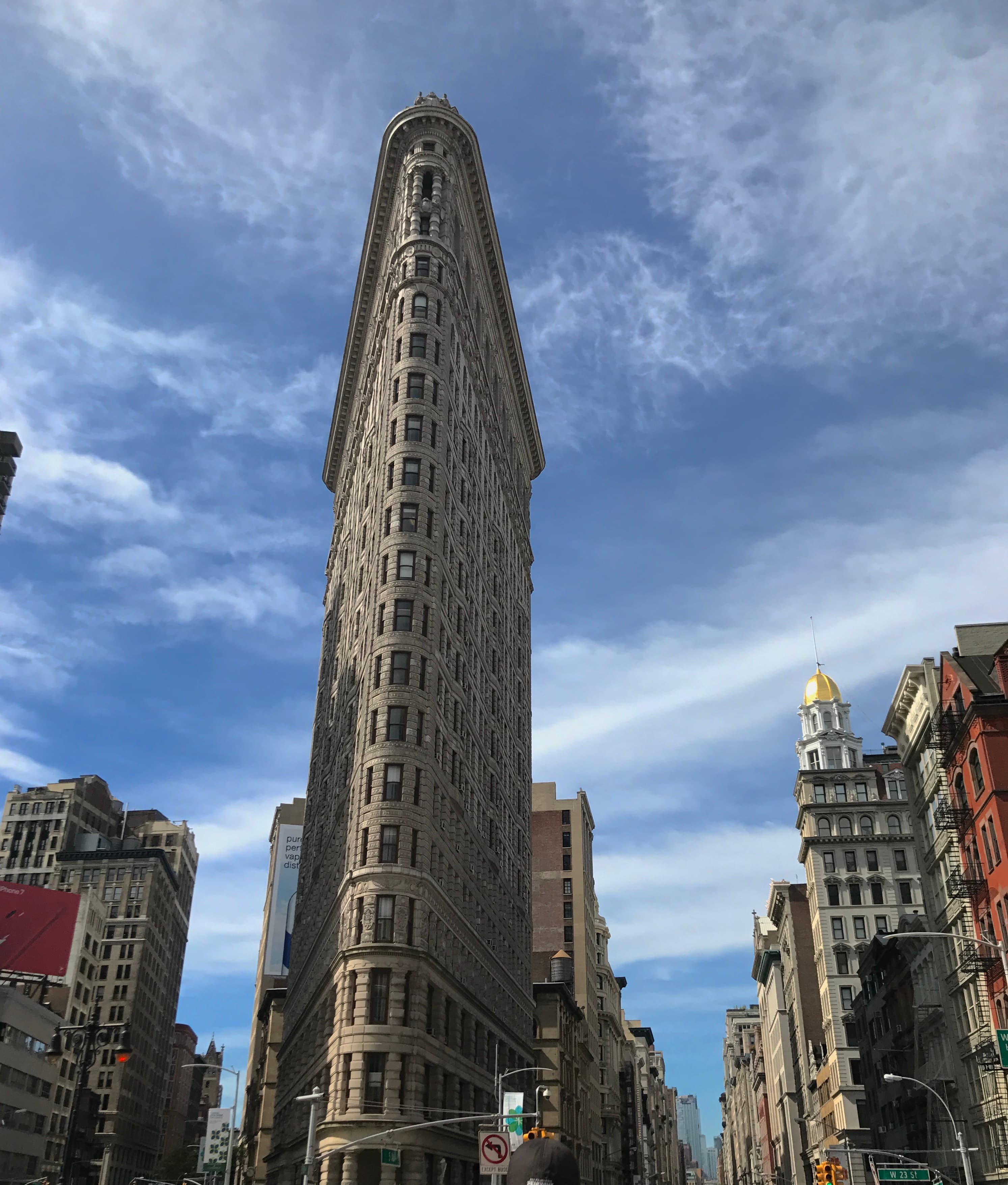
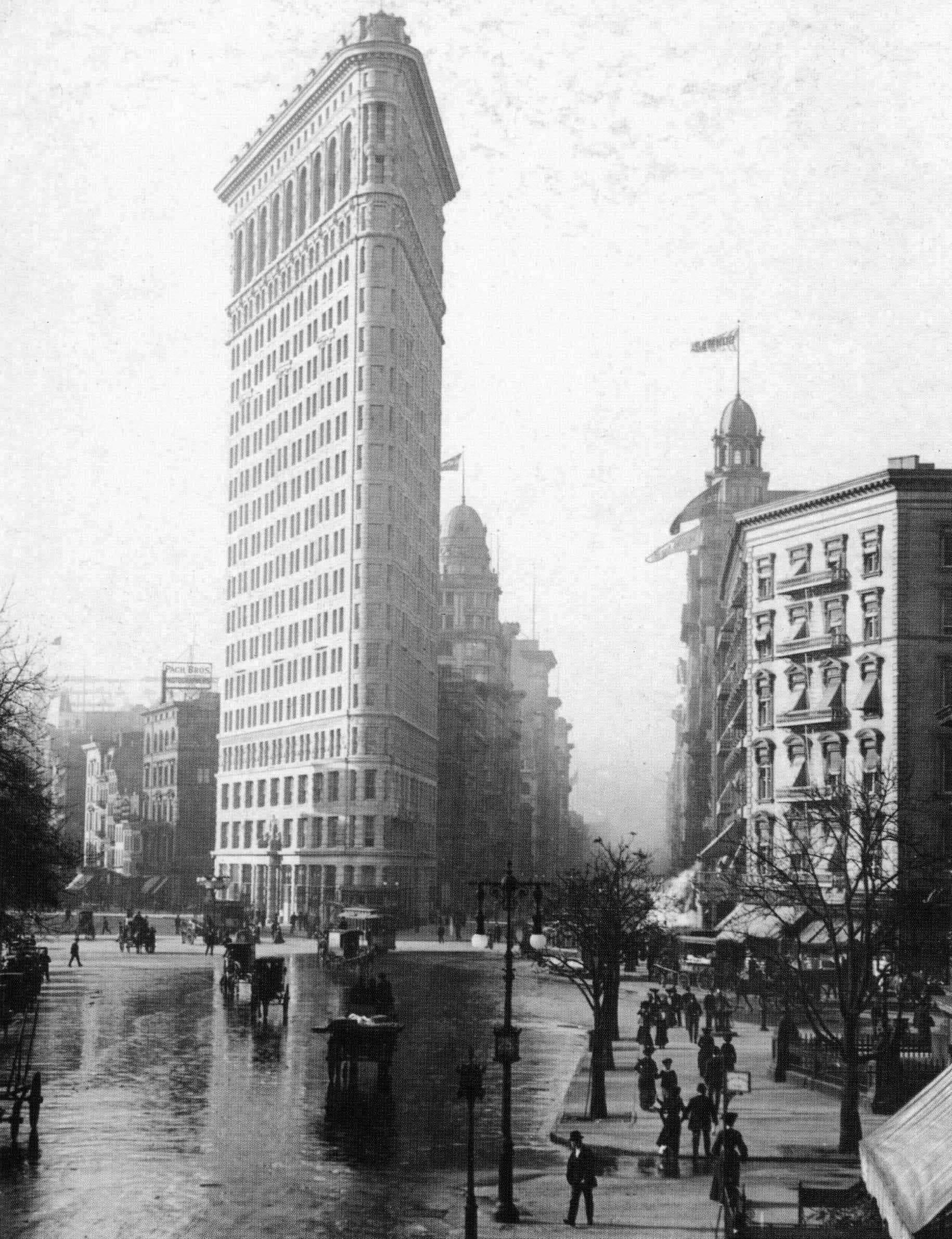
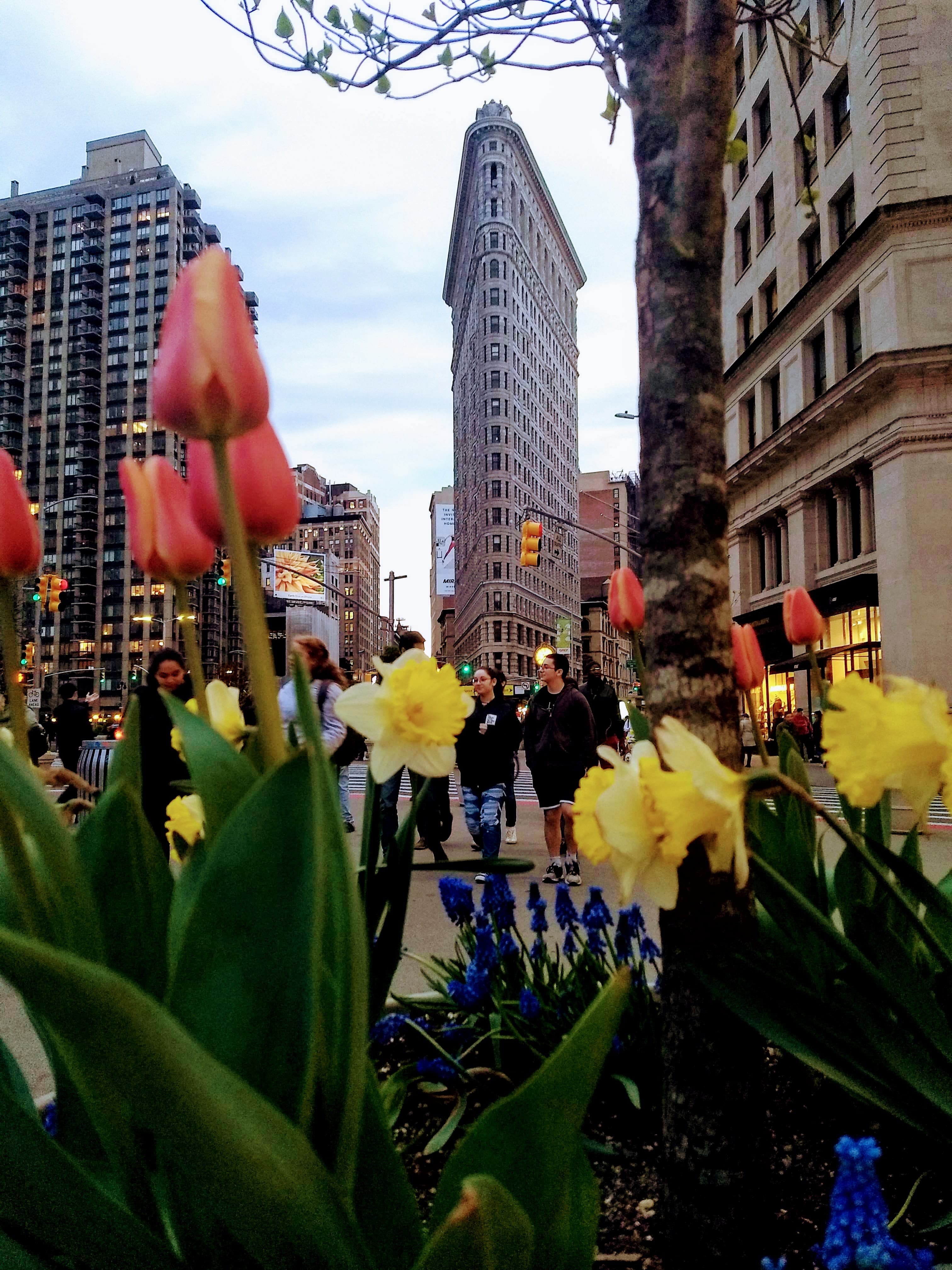
Stand at the north end of Madison Square Park, look south down Fifth Avenue, and the building seems to sharpen as you approach it — a great stone prow cutting through the city like the bow of a ship. That is the Flatiron Building, and it has been stopping pedestrians mid-step since 1902. It is not New York's tallest building, not its oldest, and not even its first skyscraper. It is simply the one everyone recognizes: a triangle of limestone and terra cotta, 22 stories tall, wedged into the plot where Broadway slices diagonally across Fifth Avenue at 23rd Street.
The building's official name was the Fuller Building, after George A. Fuller, founder of the construction company that built it. Nobody ever called it that. The public, the press, and eventually the whole neighborhood took the nickname instead: "Flatiron," for the building's resemblance to a cast-iron clothes iron. The neighborhood around it is still called the Flatiron District, after its signature building — one of the few cases in New York where a single building named the district, rather than the other way around.
What makes the Flatiron remarkable is not just its shape but its position. It anchors the south end of Madison Square and the north end of the Ladies' Mile Historic District, the great shopping corridor of the Gilded Age. It was, on completion, one of the tallest buildings in the city and one of only two skyscrapers north of 14th Street — the other being the Metropolitan Life Insurance Company Tower, one block east. More than a century later, it remains the anchor of the view from Madison Square Park, and the most photographed building in the neighborhood by a wide margin.
A triangle nobody wanted
The Flatiron's shape was forced on it by the street plan. Manhattan's Commissioners' Plan of 1811 laid out a rigid grid of avenues and streets — but Broadway, an older road, refused to conform, cutting diagonally across the grid. Where Broadway crosses Fifth Avenue between 22nd and 23rd Streets, the two streets and the cross streets enclose a triangle: 87 feet wide at its southern back end on 22nd Street, tapering to a point at 23rd Street. Before the building, the plot was already known locally as the "Flat Iron," and for decades it was considered nearly unbuildable — too narrow, too awkward, too exposed to the wind.
The land passed through many hands before Amos Eno bought it in the mid-19th century and held it, renting it out for small commercial uses, while the city grew northward around it. By the turn of the century, the area around Madison Square was the commercial heart of New York, and the triangle's moment had arrived. In 1901, a partnership led by Harry S. Black, head of the George A. Fuller Company — the firm that had pioneered steel-frame skyscraper construction — bought the site and commissioned Chicago architect Daniel Burnham to design a headquarters tower for the company. Burnham, already famous for the White City of the 1893 Chicago World's Fair, gave the job to his firm's design chief, Frederick P. Dinkelberg, and the result was a building that treated its impossible site not as a problem but as the whole idea.
Construction moved at a speed that seems reckless today: the steel skeleton rose through 1901 and 1902, and the building was complete by the summer of 1902. New Yorkers watched the frame climb and argued about it constantly. Critics called it a monstrosity and predicted it would topple in the first strong wind. Sculptor William Ordway Partridge called it "a disgrace to our city." The building did not topple. It did something stranger: it became beloved almost immediately, the way only a building that was supposed to fail can be.
Steel, stone, and terra cotta
The Flatiron was one of the first great steel-framed skyscrapers, and its structure is the reason it exists at all. A masonry building on this footprint could never have reached 285 feet; a steel skeleton could, and did, carrying the load on columns and beams while the walls hung from the frame like a curtain. That engineering freedom let Burnham and Dinkelberg design a facade that behaves like a classical Greek column, in the Beaux-Arts manner: a base of rusticated limestone for the lower three stories, a long shaft of glazed terra cotta above, and an ornate, deeply modeled crown at the top, with a cornice that projects over the street like the brim of a hat.
Look closely at the prow — the narrow northern tip at 23rd Street — and the building's most famous dimension reveals itself: at its narrowest, the prow is only about 6.5 feet wide. That is barely wider than a doorway, holding 22 stories of offices above a ground-floor retail space that New Yorkers nicknamed the "cowcatcher," after the wedge on the front of a locomotive. The rounded prow, the endless rows of windows, and the decorative terra-cotta detailing — cherubs, wreaths, and classical moldings pressed into the facade — reward a slow walk around all three sides. From Fifth Avenue you see the long, elegant flank; from Broadway, the other; from 23rd Street, the prow itself, impossibly thin.
The interior was, in its early years, as much a public place as an office building. The basement held the Flatiron Restaurant, which could seat 1,500 diners, and sightseeing buses brought visitors to eat there and to ride up to the 21st-story observation deck. In 1911 the basement restaurant became the Taverne Louis, a fashionable French restaurant whose owner hired a Black jazz band — Louis Mitchell and his Southern Symphony Quintette — to play dance tunes, introducing ragtime to affluent New Yorkers. Irving Berlin heard the group at the Taverne and urged them to try London, where they became a sensation. The building, in other words, was never just an office tower; from the start it was a stage.
"23 skidoo" and the building that became a photograph
No Flatiron story is complete without "23 skidoo." The phrase — early-20th-century slang for beating a hasty retreat — is said to have been born at the Flatiron's prow, where the building's wedge shape funneled wind down 23rd Street in sudden, violent gusts. The gusts famously lifted women's skirts, drawing crowds of young men to loiter at the corner; police, so the story goes, would shoo them away with the cry "23 skidoo!" Historians debate how much of the tale is true, but the legend stuck to the building the way the nickname did, and it tells you something real: the Flatiron was not a backdrop to New York life, it was a participant in it.
Photographers understood that before anyone else. Alfred Stieglitz photographed the Flatiron in 1903, in snow and rain, and the image became one of the most famous photographs of early-20th-century New York — a moody, atmospheric portrait that treated a commercial building as a work of art. Edward Steichen, Alvin Langdon Coburn, and the painters of the Ashcan School followed, and the Flatiron became the most painted, photographed, and filmed building of its era. A 1902 film by the American Mutoscope and Biograph Company even captured street life around the building in its first months, the camera rising from street level to the roof. The Flatiron did not just appear in the new visual culture of the 20th century; it helped invent it.
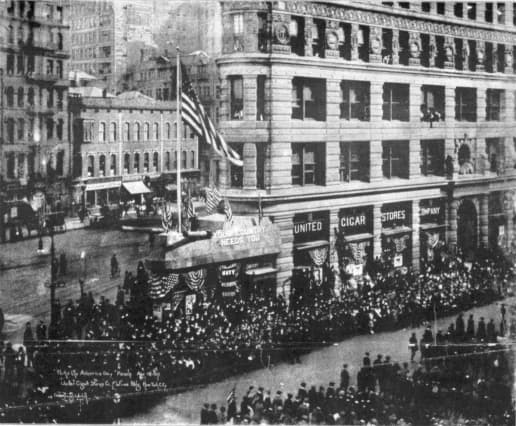
The building's prow kept its role as a public stage. During the pre–World War I "Wake Up America" parade on April 19, 1917, a Navy recruiting station occupied the cowcatcher itself, with the building rising behind it. After World War I, the 165th Infantry Regiment marched past the Flatiron through a Victory Arch in Madison Square, the building standing in the background of the photographs. Through wars, depressions, and the long decline and rebirth of the neighborhood around it, the Flatiron stayed put — the fixed point in a changing skyline.
Landmark, then and now
The Flatiron's official honors came in stages, and each one marked a change in how New York valued its past. It was designated a New York City landmark in 1966, in the first years of the city's landmarks law — a law passed only after the demolition of Pennsylvania Station made the cost of losing great buildings impossible to ignore. It was added to the National Register of Historic Places in 1979 and designated a National Historic Landmark in 1989, the highest federal recognition a building can receive. By then the Flatiron District had been named for it, and the building had outlived every prediction of its failure by nearly nine decades.
The building's later chapters have been less quiet. After more than a century as offices, it changed hands at auction in 2023, and by 2025 renovation scaffolding was up around it again — the latest turn in a long history of reinvention. Through it all, the one constant has been the view: the prow still rises over Madison Square Park, the terra cotta still catches the late-afternoon light, and the building still does what it did in 1902, which is to make people stop and stare.
That is the Flatiron's real achievement. It was built on a plot nobody wanted, in a shape nobody had tried, by a company that bet its headquarters on the idea that a triangle could be beautiful. The bet paid off so completely that the building became the symbol of the city itself — reproduced on postcards, in films, in photographs, and in the minds of everyone who has ever tried to describe New York in a single image.
Visiting the Flatiron: how to see it well
The Flatiron is best seen from the outside, on foot, and slowly. Start in Madison Square Park, across 23rd Street from the prow, where you can take in the whole building with the park's trees in the foreground — the classic view, and the one Stieglitz framed. Then cross to the prow itself and stand at the tip on 23rd Street, where the building narrows to its 6.5-foot point; from here you can appreciate the trick of the design, the way 22 stories balance on a point. Walk the full triangle — down Fifth Avenue on one side, Broadway on the other — to see how the facade changes with the light and how the building's scale shifts from monumental to intimate.
Come in the late afternoon if you can, when the sun rakes across the terra cotta from the west and the facade glows. Come in the evening, too: the building is lit after dark, and the prow against the night sky, with Madison Square Park quiet beside it, is one of the great free sights in Manhattan. Pair the visit with the park itself — its dog run, its food kiosks, and its view of the Metropolitan Life clock tower one block east — and with a walk south down Broadway into the Ladies' Mile, where the cast-iron shopping palaces of the Gilded Age still line the street. The Flatiron rewards the same thing it has always rewarded: standing still, looking up, and taking your time.
Key Facts
- The Flatiron Building, originally the Fuller Building, was completed in 1902 at 175 Fifth Avenue, Manhattan, on the triangular block formed by Fifth Avenue, Broadway, and East 22nd and 23rd Streets.
- It was designed by Daniel Burnham (D.H. Burnham and Company) with Frederick P. Dinkelberg, for the George A. Fuller Company, whose founder it was officially named after.
- The building is 22 stories and 285 feet (87 meters) tall, with a steel skeleton frame — one of the first great steel-framed skyscrapers in New York.
- At its narrowest, the northern prow at 23rd Street is only about 6.5 feet wide; the southern back end on 22nd Street is 87 feet wide.
- The facade is divided like a classical column: a limestone base for the lower three stories, a glazed terra-cotta shaft, and an ornate crown.
- On completion it was one of the tallest buildings in the city and one of only two skyscrapers north of 14th Street, the other being the Metropolitan Life Insurance Company Tower one block east.
- The ground-floor prow space was nicknamed the "cowcatcher"; it housed a Navy recruiting station during the 1917 Wake Up America Day parade.
- The slang phrase "23 skidoo" is traditionally linked to the wind gusts at the building's prow on 23rd Street, though historians debate the details.
- Alfred Stieglitz's 1903 photograph of the Flatiron in snow became one of the most famous images of early-20th-century New York.
- The building was designated a New York City landmark in 1966, added to the National Register of Historic Places in 1979, and designated a National Historic Landmark in 1989.