The place every visitor already knows
You have seen Times Square before you ever set foot in it. It is in the establishing shot of a hundred films, behind the news anchor's desk, in the photograph a friend sends home from their first trip to New York. The reason it photographs so well is also the reason it overwhelms in person: Times Square is not a square at all, but a bowtie — the shape made where Broadway cuts diagonally across Manhattan's grid and crosses Seventh Avenue, between West 42nd and West 47th Streets. Two triangles of pavement, facing each other across the diagonal, hold a crowd, a forest of signs, and the accumulated mythology of more than a century.
That mythology is the point. Times Square is the place New York goes to celebrate, to protest, to gather, and to be seen. It is where the country watched the end of the Second World War in Alfred Eisenstaedt's famous photograph of a sailor kissing a nurse on V-J Day, where ticker-tape parades have passed, and where, every December 31, a crowd that can reach a million people packs the streets to watch a crystal ball descend from a flagpole at One Times Square. It is also, on an ordinary Tuesday in October, simply the busiest pedestrian intersection in America — a place where tourists, theatergoers, street performers, costumed characters, office workers cutting through, and vendors selling everything from pretzels to phone chargers all share the same few acres of pavement.
First-time visitors sometimes arrive braced for disappointment, having heard that Times Square is "just" a tourist trap. It is commercial, certainly, and it is crowded, and nobody who lives in New York goes there without a reason. But that misses what Times Square actually is: a public stage. The lights, the crowds, the theaters, the sheer scale of it — these are not decorations on some other, more authentic New York. They are New York, at its most extroverted, doing what it has done for over a hundred years: putting on a show for whoever happens to be standing there.
Longacre Square: horses, carriages, and a newspaper's gamble
Times Square began life under a different name and a different trade. In the 19th century the area was Longacre Square, named after Long Acre in London, and it was the center of New York's horse and carriage business — carriage makers, stables, and harness shops lined the streets. Broadway already ran through it diagonally, and the elevated trains already rumbled overhead, but the square's character was industrial and practical, not theatrical. The theaters that would define the district were only beginning to move north from the old entertainment districts further downtown.
The change came in 1904, and it came from a newspaper. The New York Times, which had built its new headquarters — the Times Building, at One Times Square — at the southern end of the square, persuaded the city to rename Longacre Square after the paper. Times Square was born in April 1904, and the subway station that opened beneath it that October, as part of the original Interborough Rapid Transit line, carried the new name with it. The paper's owner, Adolph Ochs, wanted a New Year's Eve celebration to publicize the new building, and so on December 31, 1904, the Times sponsored a fireworks display from the roof. The crowds came, the fireworks impressed, and a tradition was looking for a safer encore: the city soon banned the fireworks, so for the following New Year's Eve the paper's electrician devised something else — a lighted ball, lowered from the building's flagpole at midnight.
The first ball drop took place on December 31, 1907, welcoming 1908, and it has happened almost every year since — paused only during the wartime blackouts of 1942 and 1943, when crowds gathered in silence instead, and reshaped in recent years by the pandemic, when the square was closed to the public. The ball itself has been remade many times, growing larger and more elaborate with each generation, and it now sits atop One Times Square year-round, visible in daylight as a geodesic sphere waiting for its one minute of annual fame. The building below it, once a newspaper headquarters, is now almost entirely a shell for signs — a fitting fate for the structure that gave the square its name.
The Theater District grows up around the lights
If the newspaper gave Times Square its name, the theater gave it its soul. As the 20th century opened, Broadway's theaters migrated north into the streets around the square, and the Theater District — roughly from 40th to 54th Streets, between Sixth and Eighth Avenues — became the densest concentration of legitimate theaters in the English-speaking world. The Palace, the Winter Garden, the Majestic, the Lyceum, and dozens of others filled the side streets with marquees, stage doors, and the particular electricity of an audience gathering. The restaurants followed: Sardi's, which opened in 1927, became the caricature-lined canteen where opening-night fortunes were toasted and mourned, and its walls remain a gallery of Broadway history.
The electric signs followed the theaters, and then swallowed them. The first large electric signs appeared in the square in the first decade of the 1900s, and by the 1920s the buildings were competing for attention with ever larger and brighter displays. The famous news "zipper" — the moving electric ticker that wraps around One Times Square — began in 1928, carrying headlines around the building in lights. The signs became the architecture: in Times Square, a building's facade is not a wall but a screen, and the city eventually wrote that fact into law, requiring large illuminated signs on new buildings in the district. The result is the only place in America where brightness is a zoning requirement, and where daylight barely dims the display.
The district's fortunes have risen and fallen with the city. The Depression thinned the theaters, and the decades after the Second World War brought decline: by the 1970s and 1980s, Times Square was synonymous with seediness — adult theaters, arcades, and crime — even as Broadway itself continued to produce hits a few steps from the grime. The cleanup of the 1990s, led by the city and by the Times Square Alliance, the business improvement district founded in 1992, remade the square again: the adult businesses were pushed out, the theaters were restored, family-oriented attractions moved in, and the crowds returned in numbers larger than ever. The transformation is still argued over — what was lost in grit, what was gained in safety — but the square that emerged is the one visitors know today: polished, policed, and packed.
What a first-time visitor sees today
Stand at the center of the bowtie, where Broadway and Seventh Avenue cross at 45th Street, and turn slowly. To the north, Duffy Square holds the red TKTS steps — the glass-and-steel bleacher staircase, opened in 2008, that covers the Theatre Development Fund's discount ticket booth and doubles as the square's best free grandstand. Sit on the steps and the whole square arranges itself in front of you like a theater set: the signs, the crowds, the street performers below. Statues of Father Francis P. Duffy, the celebrated First World War chaplain, and of George M. Cohan, the song-and-dance man who practically invented the Broadway musical, stand in Duffy Square, watching the crowds they would have recognized instantly.
To the south, the pedestrian plazas stretch down Broadway toward 42nd Street — broad expanses of pavement, tables, and chairs where the street was closed to cars in 2009 and made permanent after the experiment proved wildly popular. This is where the square is at its most relaxed: people eat lunch at folding tables, street performers work the edges, and the traffic that once defined the intersection now flows around it. The plazas are the square's living room, and they changed how Times Square feels — from a place you crossed, dodging taxis, to a place you linger.
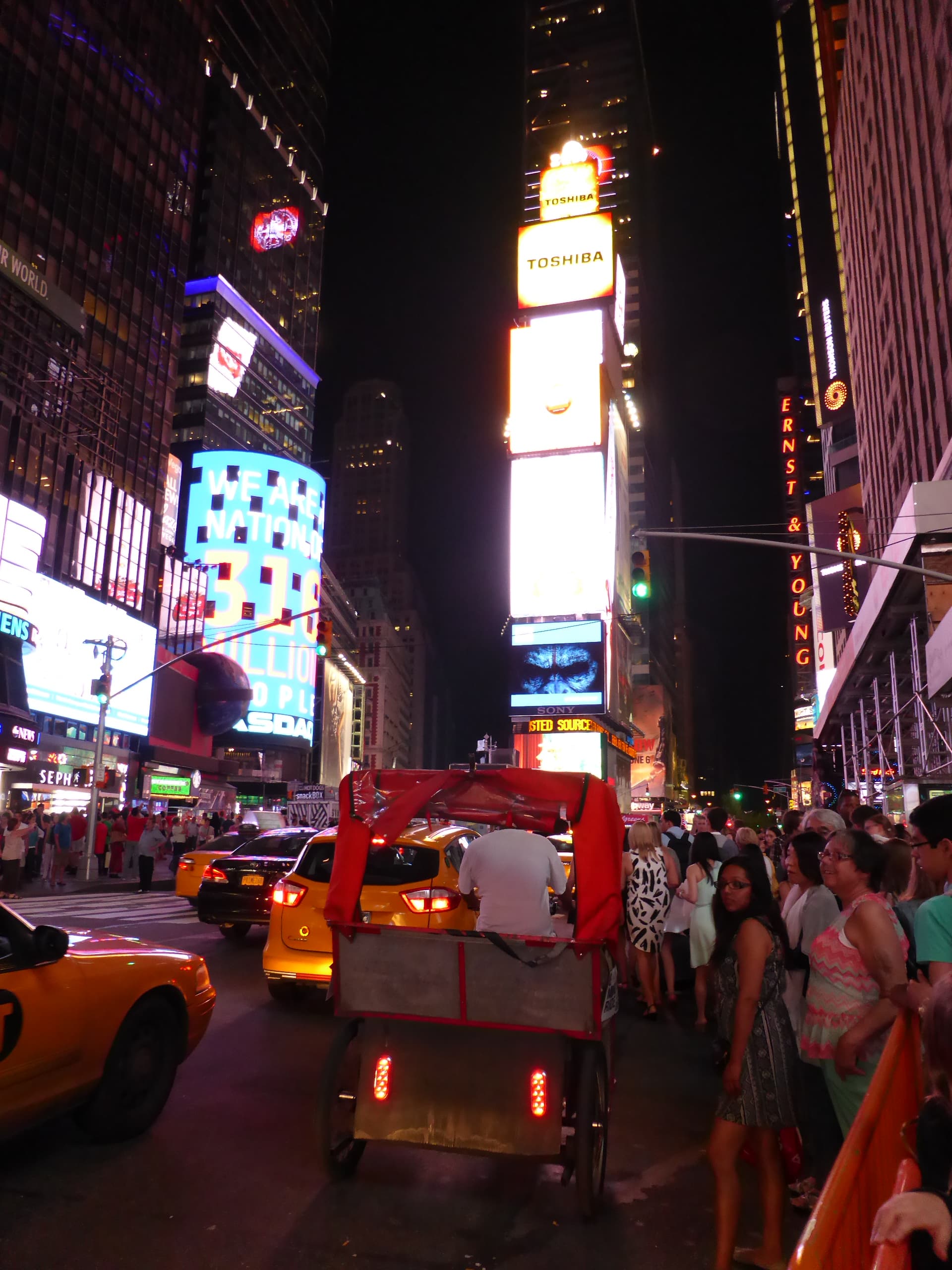
Look up, and the signs do the rest. They change constantly — a new show, a new product, a new record — but the effect is permanent: a daylight-bright canyon of color that makes night feel like afternoon. The NASDAQ tower's screen, the curved Coca-Cola sign, the ever-changing displays on One Times Square itself — these are the landmarks now, as much as any statue. And at street level, the square's supporting cast is always in motion: the Naked Cowboy with his guitar, the costumed characters posing for tips, the vendors, the preachers, the tour guides with their flags held high. It is chaotic, and it is exhausting, and it is also — for about an hour, on a first visit — pure exhilaration.
Beyond the bowtie, the Theater District rewards a short walk in any direction. West on 44th Street is the Shubert Alley, the narrow passage between theaters that has been Broadway's backstage corridor for a century. East on 42nd Street, the restored New Amsterdam Theatre and the Disney store anchor the southern end of the square. North on Broadway, the lights thin out and the Theater District gives way to Columbus Circle and the edge of Central Park. Times Square is best treated as a hub, not a destination in itself: see it, sit in it, photograph it, and then let it spill you into a show, a meal, or a walk up Broadway.
New Year's Eve, and the square's other rituals
No account of Times Square is complete without December 31. The New Year's Eve celebration is the square's defining ritual, and it is worth understanding even if you never attend it. The ball drop is, in truth, a brief event — a minute of descent, a cheer, confetti falling from rooftops — surrounded by hours of waiting in the cold, behind police barricades, with no easy way in or out once you are inside. The crowds arrive in the morning for a midnight moment, and the city manages the event with an enormous security and sanitation operation. It is, by every practical measure, an ordeal — and it is also one of the great communal experiences in American life, watched by hundreds of millions on television around the world.
If you do want to attend in person, plan through the official Times Square Alliance and New York City sources rather than through rumors: entry points, prohibited items, and viewing areas change year to year, and the square's hotels and restaurants offer their own ticketed views for those who prefer warmth to barricades. If you would rather watch the ball without the crush, the broadcast is the better seat — and visiting the square on any other night gives you the lights, the crowds, and the energy without the twelve-hour wait.
The square has other, smaller rituals. The New Year's Eve ball is joined each year by the dropping of confetti inscribed with wishes collected from visitors — a tradition in which anyone can submit a wish, in person or online, to be printed on the confetti that rains down at midnight. On quieter days, the square hosts public art installations, free performances, and the occasional marriage proposal on the TKTS steps. And every day, at every hour, the square performs its oldest ritual: strangers from everywhere on earth, standing shoulder to shoulder, looking up at the same lights, and taking the same photograph.
How to visit, and how to enjoy it
Times Square is not a place that needs a ticket, and that is part of its genius. It is a public intersection, open at all hours, and the best way to see it is simply to walk into it. Come twice if you can: once in daylight, when the crowds are thinner and the architecture — the Paramount Building's stepped crown at 1501 Broadway, the old Times Building itself — is visible behind the signs; and once after dark, when the signs take over and the square becomes the electric canyon of its reputation. Evening is when the theaters let out, the crowds thicken, and the square is at its most itself.
A few practical notes make the visit better. Wear comfortable shoes and expect crowds: the square's sidewalks are among the busiest in the world, and the pedestrian plazas are the place to step out of the flow. Keep bags close and be polite but firm with costumed characters and street vendors — photographs with characters and purchases from carts are transactions, and it is fair to agree on terms before posing or buying. If Broadway tickets are the goal, the TKTS booth in Duffy Square sells same-day discount tickets for many shows, and its red steps are free to sit on whether or not you buy. For a quieter view, the plazas' tables and chairs offer a seat without a purchase, and the surrounding side streets — especially the Restaurant Row stretch of West 46th Street — offer meals a step removed from the square's busiest, priciest tables.
Getting there is easy, which is one reason the square is so crowded: the Times Square–42nd Street station, served by multiple subway lines, sits directly beneath the square, and the Port Authority Bus Terminal is a short walk west on 42nd Street. Several other Midtown stations are within a few blocks. The square is also walkable from Bryant Park and the New York Public Library to the east, from Rockefeller Center to the northeast, and from the Hudson River waterfront to the west. Pair it with one of those neighbors rather than making it the whole day: Times Square is a magnificent hour, or a magnificent evening before a show, and it is best enjoyed as the overture to the rest of Midtown.
Why Times Square endures
Cities do not keep a place like Times Square by accident. It has survived a change of name, a change of industry, a long decline, and a thorough reinvention, because it answers a need that has not changed: the need for a place where the whole city, and the whole world passing through it, can gather and look up at the same thing. The signs will change, the shows will change, the ball will be remade again, and the crowds will keep coming — because Times Square is not really about any single sign, show, or building. It is about the feeling of standing in the middle of the biggest city in America and feeling, for a moment, that you are standing in the middle of everything.
That is why the square belongs on any list of New York's great landmarks, alongside the Statue of Liberty, the Empire State Building, and Central Park. Those places are grander, quieter, and older. Times Square is none of those things. It is louder, brighter, and more crowded than anywhere else in the city — and it is the place where New York's past, present, and future collide in light. Stand in it, look up, and let it do what it has done for more than a century: overwhelm you, just a little, and make you glad you came.
Key Facts
Times Square is the bowtie-shaped intersection where Broadway crosses Seventh Avenue in Midtown Manhattan, roughly between West 42nd and West 47th Streets, in the Theater District.
The area was originally called Longacre Square, after Long Acre in London, and was the center of New York's horse and carriage trade in the 19th century.
The square was renamed Times Square in April 1904 for The New York Times, whose new headquarters, the Times Building at One Times Square, stood at the square's southern end.
The Times Square subway station opened in October 1904 as part of the original Interborough Rapid Transit line.
The first New Year's Eve celebration at the square was a fireworks display sponsored by The New York Times on December 31, 1904; the first ball drop followed on December 31, 1907, welcoming 1908.
The ball drop has been held almost every year since, paused during the wartime blackouts of 1942 and 1943; the ball now sits atop One Times Square year-round.
The moving electric news "zipper" around One Times Square began in 1928.
The Theater District around the square, roughly from 40th to 54th Streets between Sixth and Eighth Avenues, is the densest concentration of Broadway theaters in the city; Sardi's restaurant opened in 1927.
The TKTS discount ticket booth in Duffy Square is backed by a red, glass-and-steel bleacher staircase opened in 2008, which doubles as free public seating overlooking the square.
Broadway through Times Square was closed to cars and converted to pedestrian plazas in 2009, a change later made permanent; the plazas now hold tables and chairs open to the public.
Duffy Square, the northern triangle of the bowtie, holds statues of Father Francis P. Duffy and George M. Cohan, and the TKTS booth.
The Times Square Alliance, the business improvement district for the area, was founded in 1992 and played a central role in the square's 1990s revival.
Times Square's GPS center used for this article is latitude 40.7580, longitude -73.9855.
Visitor Details
Address: Times Square, Broadway and Seventh Avenue between West 42nd and West 47th Streets, New York, NY 10036 (Midtown Manhattan, Theater District)
Transit: Times Square–42nd Street subway station sits directly beneath the square, served by multiple lines; the Port Authority Bus Terminal is a short walk west on 42nd Street. The square is walkable from Bryant Park, Rockefeller Center, and Columbus Circle.
Hours/Admission: Times Square is a public intersection, open at all hours, with no admission to enter. The pedestrian plazas, tables, and chairs are public seating. Broadway show times, TKTS booth hours and availability, and New Year's Eve entry rules change frequently — confirm all three with the official Times Square Alliance / Theatre Development Fund sources before a visit rather than relying on fixed times stated here. No prices, fees, or hours are stated as fact in this article, because they change often and were not verified against an official source in this run.
Best timing: Visit twice if you can — once in daylight, when the crowds are thinner and the buildings behind the signs are visible, and once after dark, when the illuminated signs take over. Evenings, when theaters let out, are the square at its busiest and brightest. For New Year's Eve, plan through official city and Times Square Alliance sources; entry points, prohibited items, and viewing areas change year to year.
Times Square Photography