The glass roof on Broad Street
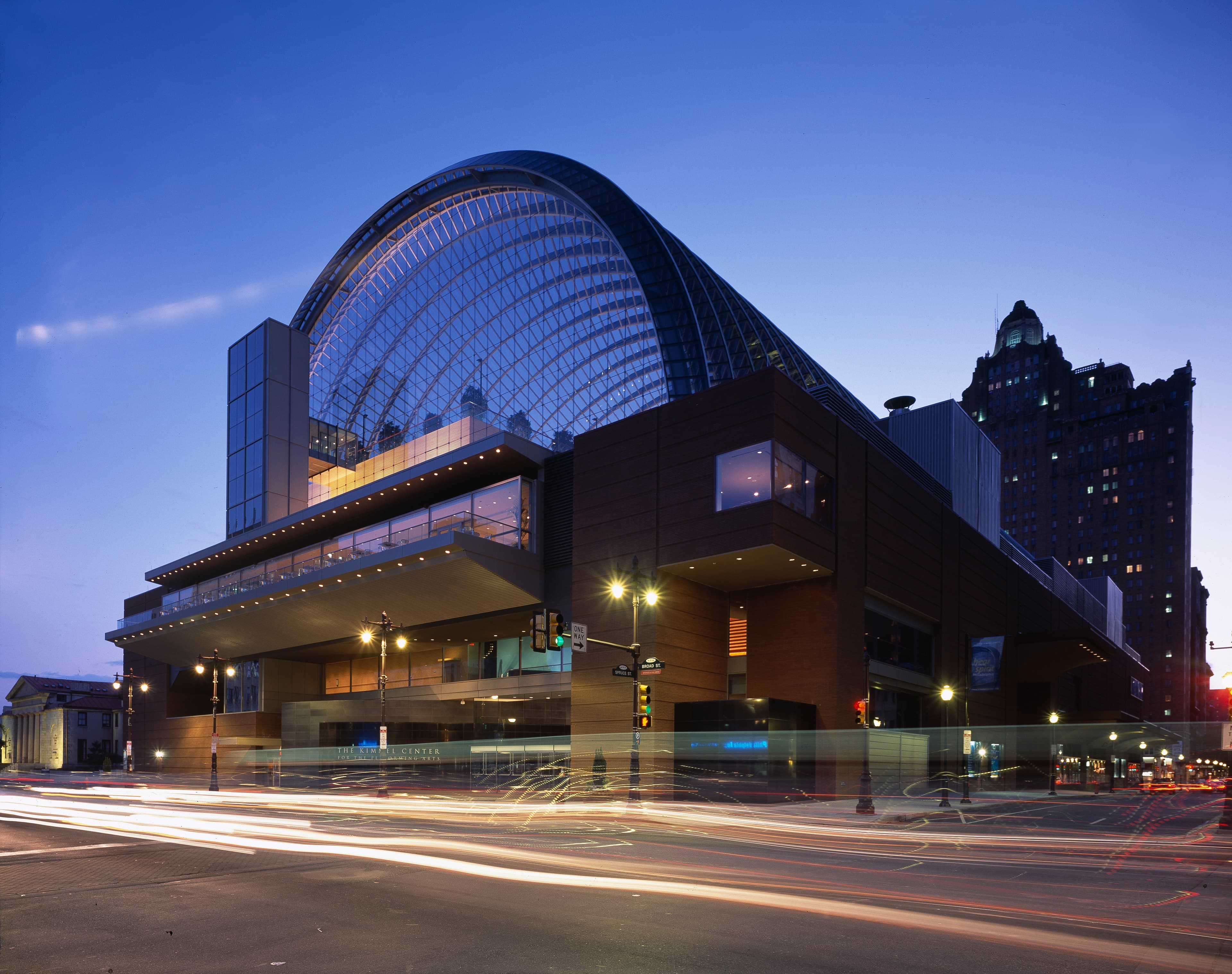
Walk south down Broad Street from City Hall, past the Academy of Music, and the street suddenly opens upward. Above a long brick base, a great barrel vault of glass and steel rises 150 feet into the air — taller than a 15-story building — spanning an entire city block between Broad and Spruce Streets. This is the Kimmel Center for the Performing Arts, and it is the single most recognizable piece of modern architecture in Philadelphia. From the sidewalk it reads as a greenhouse the size of a train shed; from inside, standing in the sunlit public plaza beneath the vault, it reads as something rarer: a concert hall that was designed to be entered by everyone, not just by ticket holders.
The Kimmel Center matters for two reasons, and both are worth a visit. Architecturally, it is Rafael Viñoly's boldest American building — a "building within a building" in which two freestanding theaters sit beneath one enormous glass roof, separated from the street and from each other so that no vibration from a truck on Broad Street ever reaches a pianissimo. Musically, it is the home of The Philadelphia Orchestra, one of America's "Big Five" symphony orchestras, which waited more than a century for a hall built for orchestral sound rather than borrowed from an opera house. The building opened in December 2001, and it has anchored the Avenue of the Arts ever since.
A hall a century in the making
The Philadelphia Orchestra was founded in 1900, and from its first concerts it played at the Academy of Music, the grand 1857 opera house one block north on Broad Street. The Academy was beautiful and beloved, but it was built for opera, not for orchestra: its stage and acoustics served singers first and symphonic sound second. As early as 1908, voices inside the orchestra were calling for a real concert hall, and the orchestra's board formally approved a plan for one in 1986, hoping to finish it in time for the 1991 season. But the project stalled for years over scope and funding, revived after World War II, stalled again, and languished through the 1980s.
What broke the deadlock was a combination of civic ambition and private generosity. In the early 1990s, Mayor Edward G. Rendell made a cultural corridor along South Broad Street — the Avenue of the Arts — the centerpiece of his plan to revive downtown Philadelphia, and the orchestra's need for a hall became the corridor's anchor project. In 1993, Philadelphia-born philanthropist Sidney Kimmel pledged $12 million to the project, with another $3 million to follow in 1998. In 1995, orchestra and community leaders agreed to merge the concert-hall plan with a second project, a venue for the city's smaller performing-arts groups, into a single Regional Performing Arts Center. The merged project was formally created in 1996, construction began in 1998, and in 2000 the building was named for Sidney Kimmel.
The opening came in a rush of celebration in December 2001. A gala preview on December 14 featured André Watts, Denyce Graves, Frederica von Stade, and Sir Elton John; The Philadelphia Orchestra, under Wolfgang Sawallisch, gave its first concert in the new hall on December 15; and the center officially opened, still unfinished in places, on December 16, 2001. The final cost was about $265 million, well over the original budget, and cost overruns and construction delays led to a lawsuit between the center and Viñoly in 2005 that was settled in 2006. But the building was open, the orchestra finally had its hall, and Broad Street had its landmark.
A building within a building
Viñoly's design is best understood from the inside. Rather than one solid mass, the Kimmel Center is three freestanding structures under a single roof: the great concert hall, the smaller Perelman Theater, and the vaulted glass enclosure itself. The two theaters sit on their own isolated structural systems — the whole building rests on coils and layers of vibration-absorbing rubber isolation pads — so that each hall is acoustically sealed from the street, from the plaza, and from each other. Between and around them runs Commonwealth Plaza, a public indoor space modeled on the outdoor plazas of Europe, with cafes and gathering areas that stay open to the public whether or not a performance is on.
Over it all soars the barrel vault: a folded plate-glass roof of 5,808 glass panes, 150 feet high, spanning 350 feet by 174 feet in plan, built without a single interior support column and carried entirely by its side walls. Its glass end walls are engineered to flex with the wind — by as much as 32 inches in extreme gusts — suspended from steel cables held under tension by counterweights weighing between 6 and 12 tons. The building's footprint is 100,075 square feet, with a gross program area of about 429,085 square feet, and its brick side walls rise to roughly the height of the neighboring buildings, keeping the glass giant in scale with the street. Daylight pours through the vault all day, so the plaza changes character from morning to evening, and at night the lit vault glows over Broad Street like a lantern.
The design was controversial from the start — critics called the brick base drab and the entrance unwelcoming — but the interior has won over most skeptics. Step through the doors on an ordinary afternoon and you find what Viñoly intended: a civic room, not a velvet rope. People meet friends, drink coffee, and watch the light move across the glass, and on many days there is a free performance or rehearsal sound drifting from one of the halls.
Marian Anderson Hall: the cello in the glass
The main hall, the reason the building exists, is a 2,500-seat concert hall shaped, in Viñoly's famous conceit, like the inside of a cello. Its curving walls are clad in warm mahogany and makore wood, with no right angles or corners to catch noise, and its curves channel sound the way a cello's body channels the vibration of its strings. Adjustable acoustic panels and a reverberation chamber let the hall be tuned for different kinds of music, and a massive canopy over the stage directs sound energy out to the audience while letting the musicians hear one another without distortion. The hall's sound was debated fiercely in its first years — early reviews were mixed, and Sir Simon Rattle's 2004 remark that "we always knew it was going to be a great hall, and now it is" marked the moment opinion turned — and a program of acoustic refinements between 2009 and 2011, including a new ceiling for the organ chamber and rebuilt stage walls, completed the transformation.
At the back of the stage stands the hall's other great instrument: the Fred J. Cooper Memorial Organ, built by Dobson Pipe Organ Builders. It is the largest mechanical-action pipe organ in an American concert hall, with two consoles, four manuals, 97 ranks, and 124 stops. Hearing it underpin a full orchestra in this room is one of the great Philadelphia musical experiences.
The hall opened as Verizon Hall, named for a $14.5 million contribution from Verizon and the Verizon Foundation. When those naming rights expired at the end of 2023, the hall was rededicated on June 8, 2024, as Marian Anderson Hall, in honor of the legendary contralto, civil-rights icon, and Philadelphia native — the first major concert venue in the world to bear her name, made possible by a $25 million gift from Richard Worley and Leslie Miller. Anderson, born in Philadelphia in 1897, was barred from performing at Constitution Hall in Washington in 1939 because of her race and instead sang to 75,000 people at the Lincoln Memorial; that her name now crowns the hall of her hometown orchestra is a piece of Philadelphia history in itself, and the hall's rededication gala, with Yannick Nézet-Séguin conducting The Philadelphia Orchestra alongside Audra McDonald, Angel Blue, and Marcus Roberts, was one of the city's great musical nights.
The Perelman Theater and the roof garden
The building's second hall is the Perelman Theater, a 650-seat space that is the Kimmel Center's transformer. Its 75-foot-diameter turntable stage can be arranged as a recital hall or as a proscenium theater with a stage, fly-loft, and orchestra pit, so it hosts chamber music, dance, drama, and experimental opera with equal ease. Where Marian Anderson Hall is all curves and warm wood, the Perelman is a crisp, light-wooded cube — a deliberate contrast, the smaller sibling with the more flexible personality. It is the permanent home of the Chamber Orchestra of Philadelphia, the Philadelphia Chamber Music Society, PHILADANCO, and other resident companies, and its intimacy makes it the best place in the building to hear a string quartet or a solo recital up close.
Above the Perelman Theater sits the Dorrance H. Hamilton Roof Garden, a planted terrace with trees overlooking the plaza and Broad Street — a quiet perch above the Avenue of the Arts, and a popular setting for weddings and private events. Below the main halls, the SEI Innovation Studio, a 2,688-square-foot black-box theater, hosts jazz residencies, experimental theater, and the Kimmel Center's education programs, including its youth jazz ensemble and summer arts camp. Together with the Academy of Music and the Miller Theater, which the same organization now manages, the Kimmel Center is home to eight resident companies spanning orchestra, ballet, opera, chamber music, and dance — and since June 2021, The Philadelphia Orchestra and the Kimmel Center have been a single merged organization, performing under the Ensemble Arts Philly banner.
The anchor of the Avenue of the Arts
The Kimmel Center's civic importance is hard to overstate. When it opened, South Broad Street was still shaking off decades of decline, and the bet behind the Avenue of the Arts was that a great hall, surrounded by theaters, restaurants, and streetscape improvements, could pull an entire downtown back to life. Rendell himself later recalled his test for success: a Saturday night at around 10:40 p.m., with ten or fifteen thousand people pouring out of the theaters at once, heading to dinner and clubs. On a good night at the Kimmel Center, that is exactly what Broad Street looks like — crowds spilling from Marian Anderson Hall and the Perelman Theater into Commonwealth Plaza and out onto the Avenue, past the Academy of Music and the Wilma and the Miller, in the city's densest corridor of stages.
That is also why the building rewards a visit even without a ticket. The plaza is open to the public, free tours of the facility are offered regularly, and simply standing beneath the vault — watching the light, listening to the building breathe — is an experience in itself. Pair it with a walk up the Avenue: the Academy of Music one block north, Washington Square and the historic district a short walk east, Rittenhouse Square a short walk west. And if you can, stay for a concert. The Philadelphia Orchestra's subscription concerts, more than 130 a year in its home hall, are the reason this building exists, and hearing them in a hall built for their sound, under a glass roof that glows over Broad Street, is the Kimmel Center at its best: a century-long wait, resolved in wood, glass, and music.
Key Facts
- The Kimmel Center for the Performing Arts is located at 300 South Broad Street at Spruce Street, on the Avenue of the Arts in Center City, Philadelphia, Pennsylvania.
- The Philadelphia Orchestra approved a plan for a new concert hall in 1986; the project languished until Sidney Kimmel pledged $12 million in 1993 (plus $3 million in 1998), and the concert-hall and multi-use venue projects were merged as the Regional Performing Arts Center in 1996. Construction began in 1998.
- The center was named for Sidney Kimmel in 2000. It officially opened, still unfinished in places, on December 16, 2001, after a gala preview on December 14 and The Philadelphia Orchestra's first concert in the hall on December 15, conducted by Wolfgang Sawallisch. The final cost was about $265 million.
- The architect was Rafael Viñoly, and the acoustician was Russell Johnson of Artec Consultants. Cost overruns and construction delays led to a lawsuit against Viñoly in 2005, settled in 2006.
- The building's signature feature is a barrel-vaulted glass roof of 5,808 glass panes, 150 feet high, spanning 350 feet by 174 feet, built without interior support columns and carried by its side walls. The building footprint is 100,075 square feet, with a gross program area of about 429,085 square feet.
- The two theaters are freestanding structures on isolated systems, separated from the street and each other by vibration-absorbing isolation pads; between them runs Commonwealth Plaza, the building's public indoor gathering space.
- Marian Anderson Hall (opened as Verizon Hall) seats 2,500 and is shaped like the inside of a cello, clad in mahogany and makore wood, with adjustable acoustic panels. It contains the Fred J. Cooper Memorial Organ by Dobson Pipe Organ Builders — the largest mechanical-action pipe organ in an American concert hall, with two consoles, four manuals, 97 ranks, and 124 stops.
- Verizon Hall was named for a $14.5 million contribution from Verizon and the Verizon Foundation; the naming rights expired at the end of 2023, and the hall was rededicated as Marian Anderson Hall on June 8, 2024, following a $25 million gift from Richard Worley and Leslie Miller — the first major concert venue in the world named for the Philadelphia-born contralto and civil-rights icon.
- The Perelman Theater seats 650 and has a 75-foot-diameter turntable stage that allows it to serve as a recital hall or a proscenium theater. Above it sits the Dorrance H. Hamilton Roof Garden; below the main halls, the SEI Innovation Studio is a 2,688-square-foot black-box theater.
- The center is home to eight resident companies, including The Philadelphia Orchestra, PHILADANCO, the Chamber Orchestra of Philadelphia, the Philadelphia Chamber Music Society, Opera Philadelphia, and the Philadelphia Ballet. In June 2021, The Philadelphia Orchestra and the Kimmel Center merged into a single organization, now performing under the Ensemble Arts Philly banner, which also manages the Academy of Music and the Miller Theater.
- The Philadelphia Orchestra, founded in 1900 and one of America's ‘Big Five’ orchestras, played at the Academy of Music from its founding until 2001, when it moved to the Kimmel Center.
Visitor Details
Address: Kimmel Center for the Performing Arts, 300 South Broad Street, Philadelphia, PA 19102 (at Spruce Street, on the Avenue of the Arts in Center City)
Transit: Walnut–Locust station (Broad Street Line) is the nearest subway stop; PATCO Speedline serves 12th–13th & Locust and 15th–16th & Locust nearby, and SEPTA bus routes 4, 27, and 32 run along Broad Street.
Hours/Admission: Performance times, tour schedules, and ticket prices change with the season — check kimmelcenter.org before visiting to confirm current hours, tour availability, and ticket prices. Free tours of the facility are offered regularly, and Commonwealth Plaza is open to the public.
Best timing: Arrive before a performance to spend time in Commonwealth Plaza under the glass vault in daylight, or come on a non-performance day for a tour. Pair the visit with a walk up the Avenue of the Arts — the Academy of Music stands one block north — and with Washington Square and Rittenhouse Square nearby. If you attend a Philadelphia Orchestra concert, seats in the center orchestra and first tier give the fullest sense of the cello-shaped hall's sound.
Location Photography