
One of Penn's five squares
Franklin Square is one of the five original open-space parks planned by William Penn when he laid out Philadelphia in 1682. Penn's surveyor, Thomas Holme, drew the city as a grid between the Delaware and Schuylkill rivers, with a square at its center and four more at the corners of the plan: Centre Square, where City Hall stands today; Rittenhouse Square to the southwest; Logan Square to the northwest; Washington Square to the southeast; and, in the northeast, the square then called North East Publick Square — the ground we now know as Franklin Square.
Penn called Philadelphia his "greene countrie towne," and the squares were the green lungs of that idea: open, ordered spaces where settlers could walk, gather, and set a proper example for one another. The land itself was slow to cooperate. The northeast square sat on low, marshy ground at the edge of the young city, between what are now North 6th and 7th Streets and Race Street and the Vine Street Expressway, and for decades it was more an idea on Holme's map than a finished park. It was not formally renamed in honor of Benjamin Franklin until 1825, and it was not made into a landscaped public park until 1837. But it has been public ground — in one form or another — for more than three centuries, longer than almost any other open space in the city.
Stand in the square today and the plan still reads. The paths radiate from a central fountain to the four corners, just as the early nineteenth-century designers intended, and the square's 7.5 acres hold a mix of lawn, mature trees, and paved walks that feels surprisingly calm for a park hemmed in by the Benjamin Franklin Bridge approach, the Vine Street Expressway, and the traffic of 6th Street.
Pasture, powder magazine, and burial ground
For most of the eighteenth century, Franklin Square was a working piece of common land rather than a garden. Early on it was rented out for grazing, and through much of the century it served as a communal pasture and a horse and cattle market. During the Revolutionary War a powder magazine was built in the square's northwest quadrant in 1776 and used until 1790; during the War of 1812 the ground doubled as a drill and parade ground for American soldiers.
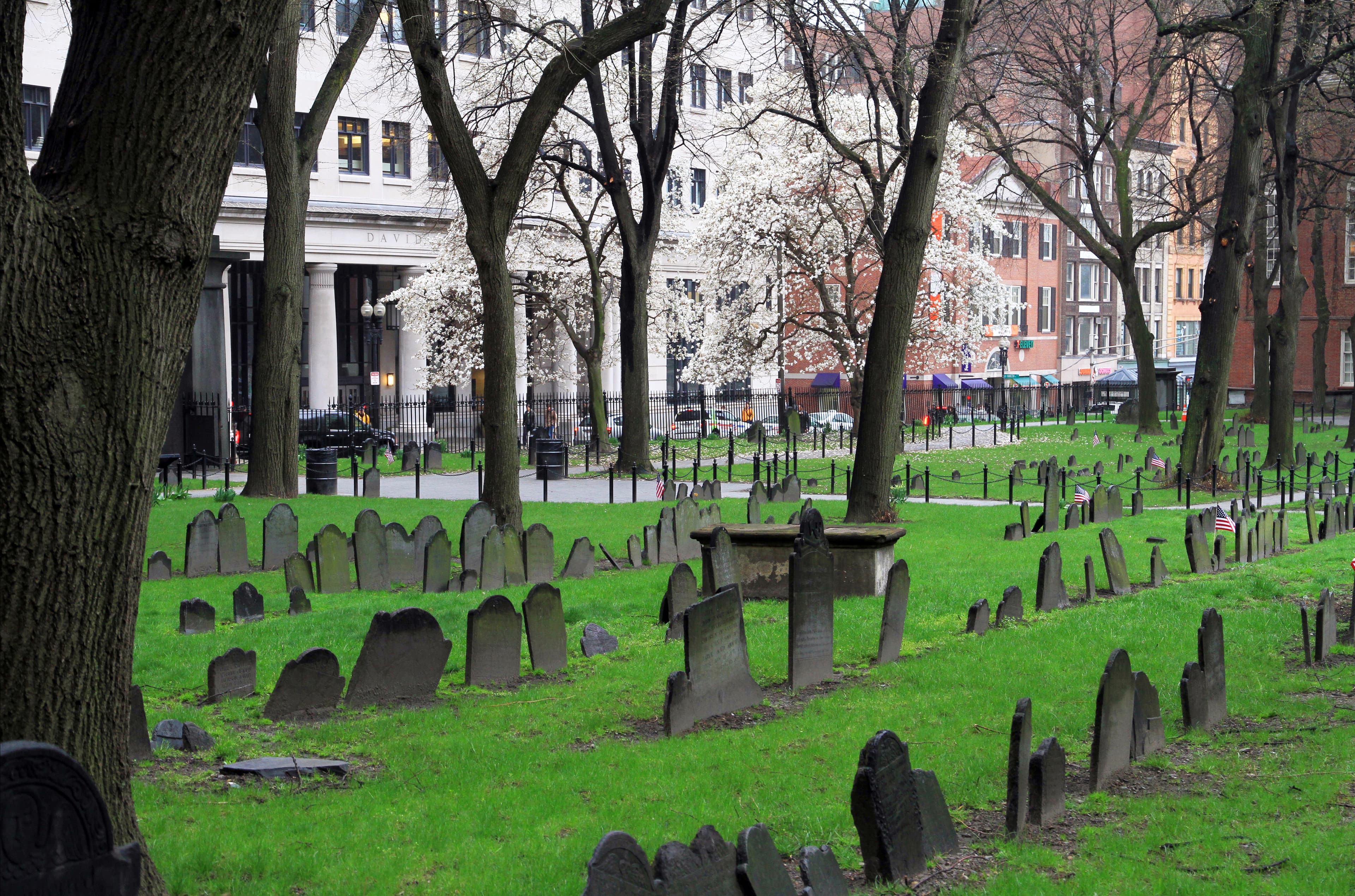
Its longest and most solemn use began in 1741, when William Penn's son Thomas leased a portion of the land to the First German Reformed Church — the congregation founded by German and German-Swiss immigrants in 1727 and known today as Old First Reformed United Church of Christ — for use as a burial ground. The church bought the land outright from Penn's son in 1763, and over the next century the square became the final resting place for more than 3,000 people. The oldest gravestone researchers have identified belonged to Elizabeth Messenger, dated December 14, 1742. Among the dead was Philip Phile, who composed music for the young republic.
The arrangement was contested from the start. Philadelphians who believed the burial ground violated Penn's plan for public green space protested it, and the legal fight dragged on for decades. In 1819 the city required the church to sell the land back, and in 1836 the Supreme Court of Pennsylvania ruled that Penn's sons had never had the right to sell public land to the church in the first place. The city gave the congregation time to remove the bodies and gravestones, and told them that whatever remained would be laid flat and covered with two to five feet of fill. With more than 3,100 burials in the ground and a new church building to pay for, the congregation could not move them all. The remains were largely left where they lay.
Archaeology proved it. When the square was excavated ahead of its 2006 restoration, very few bones were found — the remains had evidently been moved after all, or had long since decayed — but the gravestones were another story. They had not been laid flat as the city had ordered. Instead, the city had reused them as curbing along the square's radiating pathways, where many of them were uncovered during the dig. Stones that had to be removed were recorded and carefully reburied together. A memorial marker installed by Old First in 1978 was restored during the renovation and reinstalled east of the mini-golf course, with a descriptive historic marker along a nearby path. At least 3,000 of the people buried in the square are likely still there, beneath the lawns and paths.
The fountain at the center
The square's transformation into a proper park began in the 1820s, when the sculptor William Rush — who also designed Rittenhouse Square — and the artist Thomas Birch redesigned it with a symmetrical plan of walks and plantings, part formal Renaissance garden, part the naturalistic style that was becoming fashionable. A plan for landscaping the square with a central fountain and geometrical walks existed as early as 1824, and when the city made Franklin Square a public park in 1837, the fountain followed.
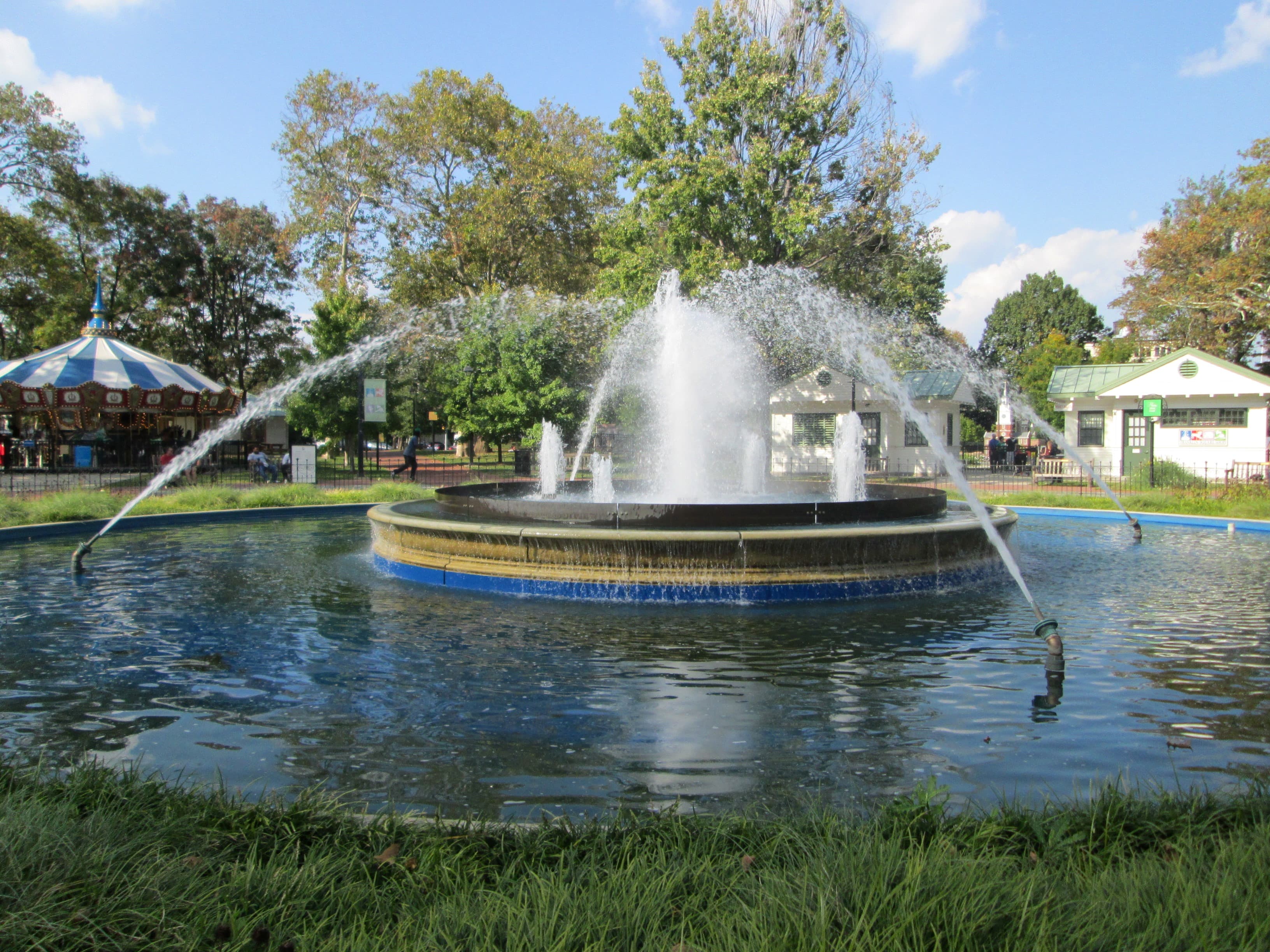
Built in 1838, the Franklin Square Fountain is a round stonework basin with forty jets, encircled by iron railing, and it is thought to be the oldest surviving fountain in William Penn's five historic squares. Its water came from the Schuylkill River, and its fence and stonework survive from the original layout. For much of the nineteenth century the fountain was the square's centerpiece and its pride; by the 1950s it was dry, broken, and abandoned along with the rest of the park.
The fountain's restoration was the emotional heart of the square's comeback. Historic Philadelphia repaired and restored the landmark basin as part of the 2006 renovation, and today it runs again as the centerpiece of the square, with benches around it and a choreographed water and light show in the evenings. Sit there at dusk and you are looking at the one feature of the square that has survived, in some form, since the 1830s.
Decline: bridge, highway, and skid row
Franklin Square's long decline began with the automobile. In the late nineteenth and early twentieth centuries the square sat at the center of a fashionable residential neighborhood, but beginning in the 1920s a series of events cut it off from the city around it. The construction of the Benjamin Franklin Bridge, from 1922 to 1926, leveled whole blocks of row homes, shops, and other structures at the square's eastern edge — the bridge begins at 6th Street, the square's eastern boundary. The steady flow of cars over the bridge turned the square's northern edge, Vine Street, into one of the city's busiest thoroughfares, effectively cutting off pedestrian access on two of the square's four sides.
The decline compounded. In the 1950s and 1960s the federal government's creation of Independence Mall demolished blocks of homes and other buildings around the square. The construction of the Vine Street Expressway in the late 1980s sealed the isolation. The Fairmount Park Commission had taken over management of the park in 1915, but by the end of the twentieth century the square was effectively abandoned: broken lights, trees in disarray, an eroded historic fountain, and benches that had become sleeping places for people experiencing homelessness. In 1961 the urbanist Jane Jacobs wrote in The Death and Life of Great American Cities that Franklin Square had become "the city's Skid Row park" — a description that fit for decades. It was the least-used of Penn's original five squares.
The square was listed on the National Register of Historic Places on September 14, 1981, as part of the Four Public Squares of Philadelphia, but the listing alone could not bring people back.
The 2006 restoration
The comeback began in 2003, when Historic Philadelphia, Inc. — the nonprofit that also stewards the Betsy Ross House and other historic sites — received the rights to renovate and manage Franklin Square. From 2003 to 2006 the organization carried out a $5.5 million refurbishment, funded primarily by a grant from the state of Pennsylvania, restoring the fountain, cleaning up the park, and rebuilding it as the fairground and family park it is today.
The square was reopened and rededicated on July 31, 2006, in Benjamin Franklin's tercentenary year — the 300th anniversary of his birth. The timing was deliberate: the square that bears his name came back to life in the year the city celebrated him. The restoration aimed to bring the park back to what William Penn had envisioned: a green respite in the middle of the city.
The change held. Redevelopment around the square — new housing, commercial space, and offices, including the conversion of the shuttered Metropolitan Hospital into condominiums — brought pedestrians back, and the square is now one of the busiest family parks in Center City. In 2025 the neighborhood gained another connection: the PATCO Speedline's Franklin Square Station, closed since 1979, reopened on April 3, 2025, after a $29.3 million renovation that preserved the station's original 1930s green-and-white tiles and added elevators, escalators, and ramps.
The carousel and mini golf today
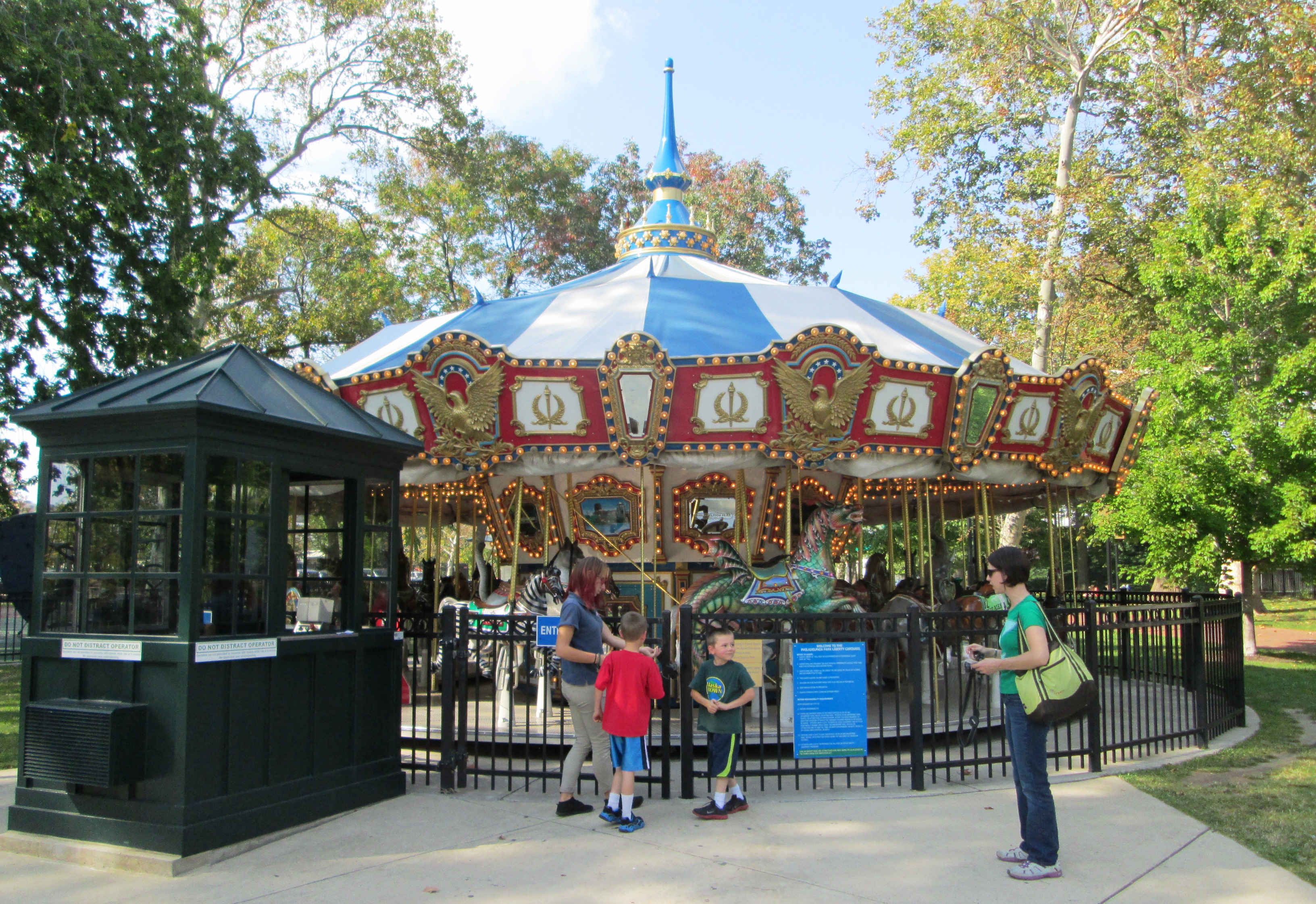
The restored square's most popular attractions sit just off the fountain. The Parx Liberty Carousel stands northwest of the fountain, a classic carousel whose handcrafted animals recall Philadelphia's heritage — including the city's famous racehorses, Smarty Jones and Afleet Alex, alongside a bald eagle, lions, zebras, and a dragon. It is a tribute to Philadelphia's great tradition of carousel-making, and on a warm afternoon it is the square's noisiest, happiest corner.
North of the fountain is Philly Mini Golf, the only miniature golf course in Center City. Its 18 holes are each modeled on one of the city's best-known sights — Elfreth's Alley, the Benjamin Franklin Bridge, the Liberty Bell among them — so a round of putt-putt doubles as a crash course in Philadelphia landmarks. Two playgrounds, one for younger children and one for older ones, sit in the park's southeast quadrant, and storytelling benches scattered through the square play tales of the square's past, a nod to the Once Upon a Nation storytellers who helped animate the park after the restoration. SquareBurger, a casual eatery near the fountain, serves the square's picnickers.
The square also hosts seasonal life: the Philadelphia Chinese Lantern Festival fills it with handcrafted lantern displays, and winter brings light shows and seasonal mini golf. Admission to the park itself is free; the carousel and mini golf are ticketed attractions, so check the official Historic Philadelphia site before visiting for current prices and schedules.
Its place among the other Penn squares
Franklin Square is the least formal and most family-oriented of Penn's five squares, and that is part of its charm. Rittenhouse Square, to the southwest, is the city's elegant living room. Logan Square, to the northwest, is dominated by the Swann Memorial Fountain and the sweep of the Benjamin Franklin Parkway. Washington Square, to the southeast, is the quiet, tree-shaded burial ground of Revolutionary War soldiers, attached to Independence Hall. Centre Square is gone as a square entirely — City Hall stands on it.
Franklin Square is the one that remembers the city's working life: the pasture, the market, the powder magazine, the burial ground, the bridge, the highway, and the long years when the city forgot it. It is also the one that has changed the most in living memory, from skid-row park to the square where Center City families spend a Saturday afternoon. Across 6th Street, at the base of the Benjamin Franklin Bridge, Isamu Noguchi's 101-foot stainless steel sculpture Bolt of Lightning... A Memorial to Benjamin Franklin (1984) marks the local legend that Franklin flew his famous kite experiment near here in 1752 — a legend the square's own history, with a cemetery in the way, makes unlikely, but which the city has chosen to remember anyway. Inside the square, the 1976 Living Flame Memorial by Reginald E. Beauchamp honors the city's fallen police officers and firefighters.
That layering — Penn's plan under a burial ground under a carousel — is what makes Franklin Square worth a slow visit. It is the square where Philadelphia's history is not displayed behind glass but worn into the ground itself.
Visiting today
Franklin Square sits at 200 North 6th Street, between North 6th and 7th Streets and Race Street and the Vine Street Expressway (I-676), on the northern edge of Old City and a short walk from Independence Hall and the Liberty Bell. The PATCO Franklin Square Station, reopened in April 2025, serves the square directly, and the Market-Frankford Line's 5th Street/Independence Hall station is a short walk south.
Come for the fountain first, then let the square set the pace: a lap of the paths, a ride on the carousel, a round of mini golf, and a bench by the fountain as the light show starts. Allow an hour or two for a relaxed visit, longer if you are playing mini golf or bringing children to the playgrounds. The square rewards the visitor who knows what lies underneath it — the pasture, the powder magazine, the 3,000 burials, the decades of neglect — because the park you see today is the result of a city deciding, after nearly a century of forgetting, to remember one of its oldest pieces of ground.
Key Facts
- Franklin Square is one of the five original open-space parks in William Penn's 1682 plan for Philadelphia, surveyed by Thomas Holme; it was originally called North East Publick Square and renamed for Benjamin Franklin in 1825.
- The square covers 7.5 acres between North 6th and 7th Streets and Race Street and the Vine Street Expressway (I-676), on the northern edge of Old City.
- In 1741 Thomas Penn leased part of the square to the First German Reformed Church (now Old First Reformed United Church of Christ) as a burial ground; more than 3,000 people were buried there between 1741 and about 1835, and the oldest identified gravestone is that of Elizabeth Messenger, dated December 14, 1742.
- The Pennsylvania Supreme Court ruled in 1836 that Penn's sons had no right to sell public land to the church; the gravestones were reused as curbing along the square's pathways and many were uncovered during the 2006 excavation.
- The square also served as a grazing pasture and horse and cattle market, held a powder magazine from 1776 to 1790, and was a drill and parade ground during the War of 1812.
- William Rush and Thomas Birch redesigned the park in the 1820s; the city made it a public park in 1837, and the Franklin Square Fountain was built in 1838 — the oldest surviving fountain in Penn's five historic squares, with forty jets and its original iron railing and stonework.
- The Benjamin Franklin Bridge (built 1922–1926) and the Vine Street Expressway (late 1980s) cut the square off from its neighborhood; Jane Jacobs called it "the city's Skid Row park" in 1961.
- The square was added to the National Register of Historic Places on September 14, 1981.
- Historic Philadelphia, Inc. restored the square in a $5.5 million project from 2003 to 2006; it was reopened and rededicated on July 31, 2006, in Franklin's tercentenary year.
- Today's attractions include the Parx Liberty Carousel northwest of the fountain, the 18-hole Philly Mini Golf course north of the fountain, two playgrounds in the southeast quadrant, storytelling benches, and SquareBurger near the fountain.
- The 1976 Living Flame Memorial by Reginald E. Beauchamp honors the city's fallen police officers and firefighters; across 6th Street stands Isamu Noguchi's 101-foot Bolt of Lightning... A Memorial to Benjamin Franklin (1984).
- The PATCO Franklin Square Station, closed since 1979, reopened on April 3, 2025, after a $29.3 million renovation.
- Coordinates: 39.9555, -75.1508.
Visitor Details
Address: 200 N 6th St (between N 6th and N 7th Streets, Race St and Vine St Expressway/I-676), Philadelphia, PA 19106.
Transit: PATCO Franklin Square Station serves the square directly (reopened April 3, 2025); SEPTA Market-Frankford Line to 5th Street/Independence Hall, then a short walk north. A short walk from Independence Hall and the Liberty Bell.
Hours/Admission: Admission to the park itself is free. The carousel and mini golf are ticketed attractions; no fixed price or opening hour is stated as fact in this article, since none was verified against an official source in this run. Check the official Historic Philadelphia site before visiting for current prices, hours, and seasonal schedules.
Best timing: Allow one to two hours. Start at the central fountain, walk the radiating paths, ride the carousel, play a round of Philly Mini Golf, and stay for the fountain's evening water and light show.
Franklin Square in Photographs