Land Donated by John D. Rockefeller Jr.
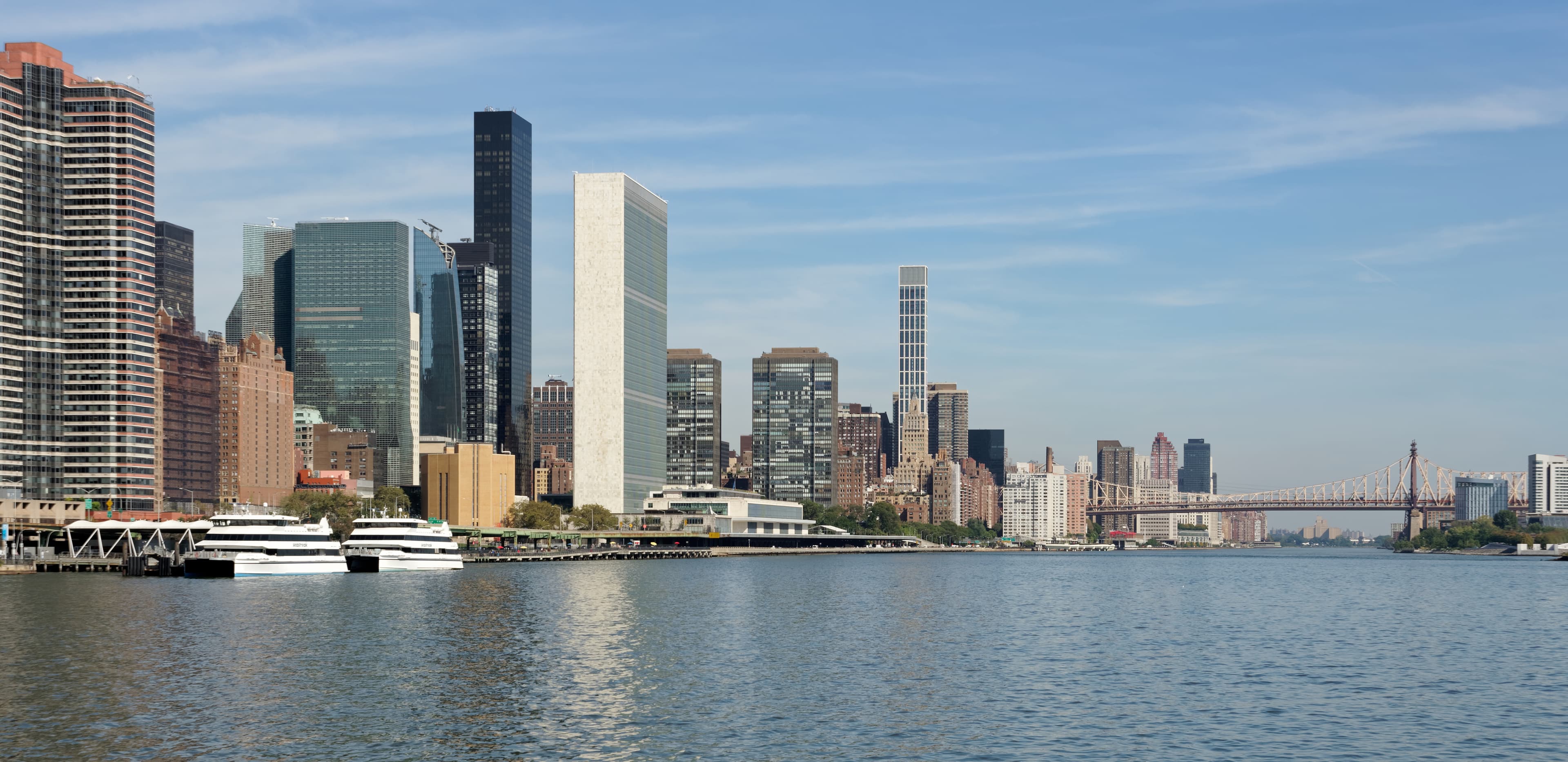
Following the founding of the United Nations in 1945, cities around the world vied to host the permanent headquarters. The decisive factor was an $8.5 million donation from John D. Rockefeller Jr. to purchase 18 acres of defunct slaughterhouses and industrial waterfront along Turtle Bay.
How New York Beat Philadelphia: The Deal Behind the Site
The headquarters was nearly built somewhere else. After the UN's founding in 1945 — and a shuffle through temporary homes in London, Lake Success, the Bronx, and Flushing Meadows — the organization needed a permanent home, and Philadelphia was the overwhelming favorite. The state legislature passed a unanimous resolution backing the bid, delegates were entertained at Philadelphia Orchestra concerts, and planners had earmarked a tract of condemned land near the University of Pennsylvania. Days before the December 1946 decision, Philadelphia's selection looked like a formality. What changed was a real-estate maneuver on the East River. Developer William Zeckendorf had assembled the Turtle Bay waterfront for a fantasy project called X City — a "city within a city" of four 40-story office blocks and two 57-story towers with a hotel, convention center, and concert hall, plus a marina and rooftop airport. Zeckendorf was too deep in debt to build it. On the evening of December 10, 1946, architect Wallace K. Harrison walked into Zeckendorf's 41st-birthday dinner and asked, "Would you sell it for $8.5 million?" The deal was struck on the spot. Harrison telephoned Nelson Rockefeller: John D. Rockefeller Jr. would fund the purchase and donate the land to the UN. The next morning, delegate Warren Austin announced the gift at Flushing Meadows; the city added $2.5 million for a tunnel beneath First Avenue and street improvements. Three days later, the General Assembly voted 46 to 7 to accept. Philadelphia had lost by a birthday dinner.
Inside the Compound: Chambers, Gifts, and the Chagall Window
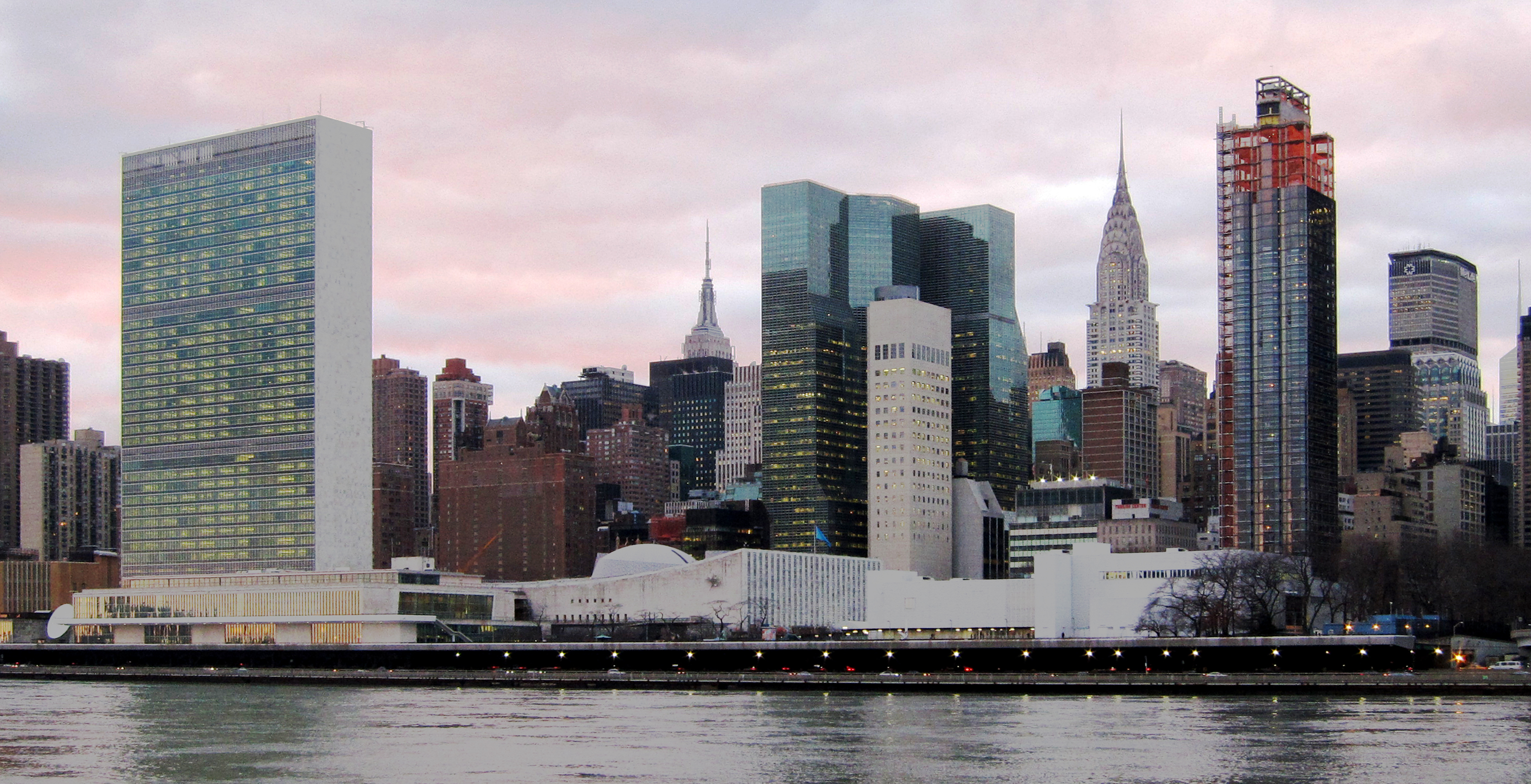
Rather than hold an international design competition, the UN handed the project to a ten-member Board of Design Consultants — architects nominated by member governments, directed by Harrison as Director of Planning. The roster was a roll call of mid-century masters: Le Corbusier for France, Oscar Niemeyer for Brazil, Sven Markelius for Sweden, Nikolai Bassov for the Soviet Union, alongside representatives from Belgium, Canada, China, Britain, Australia, and Uruguay. The board cut the estimated cost from nearly $85 million to about $65 million, largely by shrinking the Secretariat from 45 to 39 stories. Construction ran from the summer of 1948 to 1952. The result was New York's first green-glass curtain wall: the 39-story, 505-foot Secretariat slab, set north-south so it wouldn't shadow the site. But the compound's richest interiors are gifts from member states. The Security Council chamber came from Norway: architect Arnstein Arneberg designed the room around its horseshoe table, with a mural by Per Krohg depicting a phoenix rising from the ashes, and a blue-and-gold tapestry by Else Poulsson encoding the anchor of faith, the wheat of hope, and the heart of charity. The visitor's lobby reads like a museum of postwar diplomacy. The Netherlands gave a Foucault pendulum — a 200-pound gold-plated sphere on a 75-foot wire. France contributed a stained-glass window by Marc Chagall memorializing Secretary-General Dag Hammarskjöld, who died in a 1961 plane crash. Brazil's Cândido Portinari painted the twin War and Peace murals in Rio — denied a U.S. visa over his communist convictions, he never saw them installed. The Japanese Peace Bell rings at the opening of each General Assembly session, and a section of the Berlin Wall stands in the garden.
International Territory: Stamps, Security, and the Billion-Dollar Renovation
The headquarters is a country of its own, administratively speaking. The compound sits outside municipal jurisdiction, with its own security force, fire-response protocols, and postal administration. The United Nations Postal Administration began issuing stamps on October 24, 1951. The UNPA remains the only postal authority in the world issuing stamps in three currencies — dollars in New York, Swiss francs in Geneva, euros in Vienna — valid only at the respective headquarters. By the 2000s the buildings were failing: asbestos in the tiles and plumbing, and the Secretariat burning through more than $30 million a year in energy. In 2006 the General Assembly approved a $1.876 billion overhaul, the Capital Master Plan. Work ran from 2008 to 2014: while 5,000 staff decamped and asbestos came out, the Secretariat was reglazed with blast-resistant glass, the General Assembly dome's copper was replaced, and the campus earned LEED Gold — LEED Platinum for the Secretariat — targeting 50 percent energy savings. Getting inside today still feels like entering another jurisdiction. Security is airport-grade, tours run on fixed schedules, and the lobby alone — Chagall window, pendulum, Meditation Room — rewards arriving early. Just remember: the stamps you buy only work if you mail the letter before you leave the grounds.
Architecture & Jurisdiction
- The complex features the iconic 39-story green glass Secretariat Building and the sweeping General Assembly hall.
- The design was directed by Wallace K. Harrison alongside international masters including Le Corbusier, Oscar Niemeyer, and Sven Markelius.
- The headquarters is designated as an international zone with its own security force, fire response protocols, and postal administration.
Hero photo: Jakub Hałun, CC BY 4.0, via Wikimedia Commons.
Location Photography


Gallery photos: Neptuul (CC BY-SA 3.0), Horizon206 (CC0), qwesy qwesy (CC BY 3.0), Jdforrester (CC BY 4.0), Colin W (CC BY-SA 3.0) via Wikimedia Commons.