
A honeycomb in the middle of a new city
Walk west from Penn Station along 34th Street and the city changes character in a few blocks. The old brick and stone of Midtown gives way to glass — sheer, sheer towers rising over a platform built above the West Side Yard, the working rail yard where Long Island Rail Road trains are stored. This is Hudson Yards, the largest private real estate development in United States history, 28 acres of offices, apartments, shops, and a five-acre public square, all of it conjured out of air rights over train tracks. And in the middle of the square, where a development like this would normally put a fountain or a corporate plaza, stands something stranger: a 150-foot structure made of nothing but stairs.
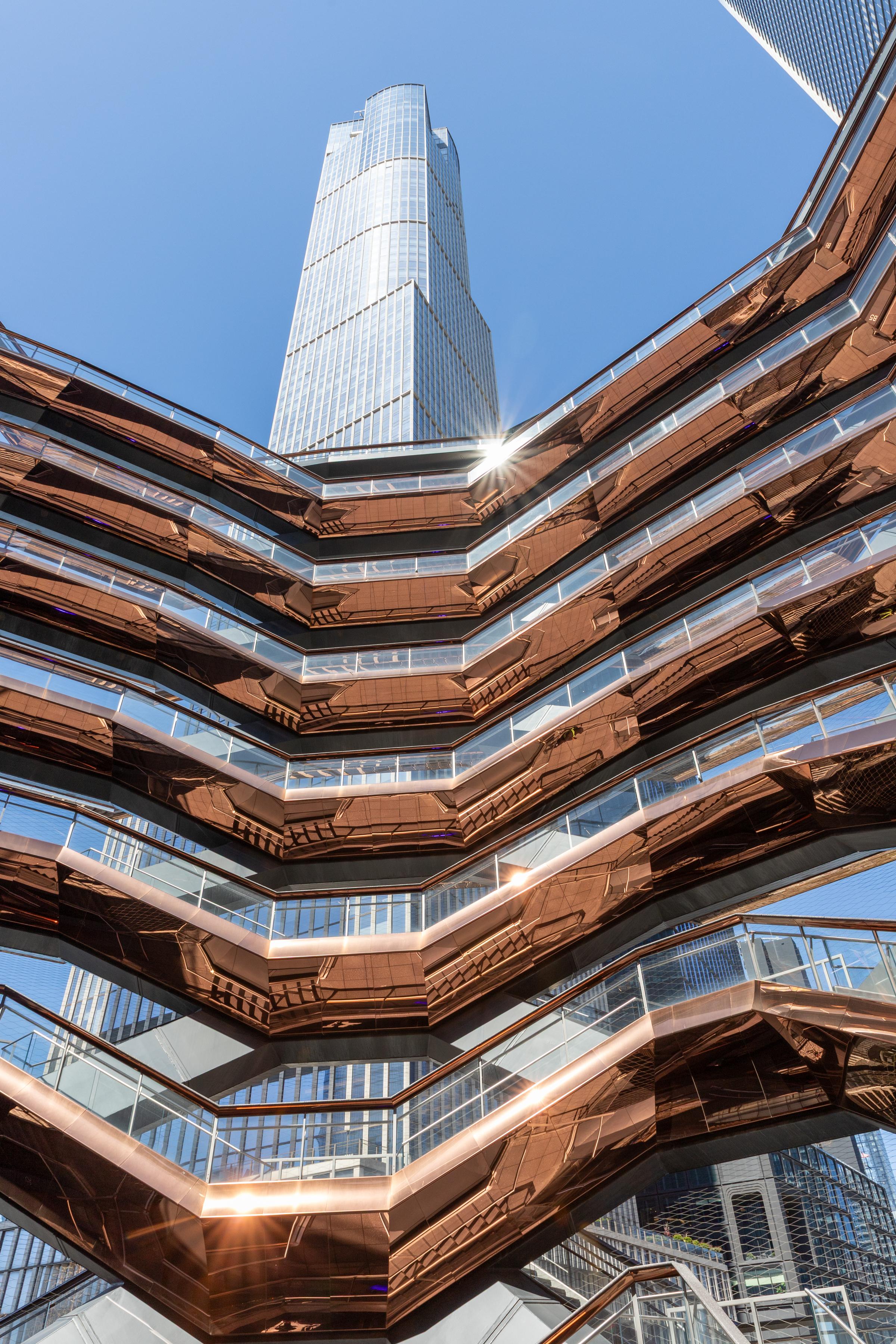
That is the Vessel. From the plaza it reads as a beehive, or a pinecone, or — as more than one New Yorker put it in its first week — a giant shawarma. It is 50 feet wide at its base and 150 feet wide at its top, an inverted cone of interlocking staircases that widens as it rises, so that the higher you climb, the further you lean out over the plaza below. There is no building inside it, no observation deck in the ordinary sense, no destination at the top except the view and the stairs themselves. It holds 1,000 people at a time, and its 154 flights of stairs, 2,500 steps, and 80 landings add up to more than a mile of climbable route packed into a footprint smaller than a city block. It is, in the words of its designer, a "social device" — a piece of public sculpture you are meant to use with your feet.
It opened on March 15, 2019, to enormous crowds and instant fame, and it has been one of the most argued-about structures in New York ever since: praised as Manhattan's answer to the Eiffel Tower, dismissed as gaudy and contrived, loved as a jungle gym, and mourned as a place where four people died. To climb it now is to climb a landmark that has been redesigned by tragedy — and to see, in the steel mesh that now lines its landings, how a city negotiates between a beautiful idea and the duty to keep people safe inside it.
Thomas Heatherwick and the stepwells of India
The Vessel was designed by the British designer Thomas Heatherwick and his London studio, Heatherwick Studio, for Related Companies, the developer of Hudson Yards. Related's chief executive, Stephen Ross, had told interviewers he wanted to commission "something transformational, monumental" as the centerpiece of the new district — a landmark that would give Hudson Yards, a place built from scratch, an instant identity. He looked at proposals from five unnamed artists, rejected them all, and was then introduced to Heatherwick by a colleague. Six weeks later, Ross accepted Heatherwick's proposal. Heatherwick's commission was reported in October 2013; the concept was presented to the public on September 14, 2016, at an event hosted by Anderson Cooper and attended by hundreds of people, including then-Mayor Bill de Blasio, with a performance by the Alvin Ailey American Dance Theater that evoked the interlocking staircases.
Heatherwick has said the design came from two sources. The first was a childhood memory: falling in love with an old, discarded flight of wooden stairs outside a local building site. The second was the stepwells of Gujarat and Rajasthan in India — the great subterranean staircases, some of them centuries old, that descend in geometric flights toward water, turning a functional descent into a piece of civic architecture. Heatherwick's idea was to take the stepwell and raise it above ground: a lattice of stairs and landings that visitors could climb, descend, and wander through, choosing their own route, meeting strangers on the landings, and looking out over the city from a different height at every turn. He described it as a piece of public space that cascades, and as a social device — a structure whose only function is to bring people together in motion.
The comparison that stuck, though, was visual rather than philosophical. Critics and visitors alike reached for the same images: a beehive, a honeycomb, a pinecone, an M. C. Escher drawing made real. Fortune's Shawn Tully called it "Manhattan's answer to the Eiffel Tower," a sentiment echoed by CNN. Elle Decor's Kelsey Kloss compared it to an Escher drawing. The New York Times architecture critic Michael Kimmelman was less admiring: he called the exterior "gaudy" and Hudson Yards more generally a "gated community" that lacked real public space. Blair Kamin of the Chicago Tribune called the Vessel "willful and contrived." The argument has never really been settled, which is part of why the structure remains interesting: it is a piece of public art that refuses to be background.
Building it: 75 pieces from Italy
The Vessel was originally slated to cost $75 million. By the time it was finished, projections had been revised to between $150 million and $200 million, and the final cost was estimated at $200 million. Heatherwick attributed the increase to the complexity of building the steel pieces — and the complexity was real. The structure is assembled from 75 large interlocking sections, each one geometrically distinct, fabricated by the Italian engineering firm Cimolai in Monfalcone, Italy, then shipped across the Atlantic, off-loaded via docks on the Hudson River, and lifted and welded into place like a three-dimensional jigsaw puzzle. Construction began on April 18, 2017, with the installation of the first ten pieces; the structure topped out in December 2017, when its highest piece was set in place.
The material is steel throughout, clad in a copper-toned finish, with polished copper-colored metal soffits — the undersides of the staircases — that reflect the people standing in the square below and the towers around it. The effect changes through the day: in bright sun the copper glints; in overcast weather it goes a deep, burnished bronze; at dusk the whole structure seems to hold the light a little longer than the glass around it. The structural engineering was by Thornton Tomasetti as engineer of record, with AKT II as design engineer, and the challenge they faced was considerable: a hollow, widening cone of stairs, open to the wind, holding a thousand moving people, had to be rigid enough to feel solid underfoot and light enough to read as sculpture.
The plaza it stands in is part of the design, not an afterthought. Hudson Yards Public Square, whose landscape design was carried out by Thomas Woltz of Nelson Byrd Woltz Landscape Architects, covers five acres and hosts some 28,000 plants and 225 trees, with a canopy of trees in the southern area of the plaza and a fountain at the southeast entrance. Across from the Vessel stands the entrance to the 34th Street–Hudson Yards station on the 7 line, and the plaza connects to the High Line, the elevated promenade whose northern terminus is here. The Shed, the arts center with its movable shell, stands beside the square. The Vessel was designed to anchor all of this — Ross said its unusual shape was intended to make it stand out like a "12-month Christmas tree" — and from almost anywhere in the district, it does.
One thing the Vessel never got was a permanent name. "Vessel" was planned as a temporary name during construction, with a formal name to be determined later. In January 2019, Hudson Yards asked the public to suggest one, creating a website for the purpose. No permanent name was ever adopted. The temporary name stuck, and the structure is still, officially and universally, the Vessel.
The climb: what it is actually like
The climb is the whole point, and it is unlike climbing anything else in New York. There is no single staircase to the top. Instead, flights branch and rejoin, landings open onto other flights, and at every level you choose: up again, across to another flight, or down a different way than you came. The geometry means that two visitors can climb for twenty minutes and barely see each other, then find themselves face to face on a landing sixteen stories up. Heatherwick intended visitors to explore it "as if it were a jungle gym," and that is a good description of the feeling — part playground, part maze, part viewing platform.
From the landings, the views change constantly. Low down, you look across the plaza and into the glass of the surrounding towers. Higher up, the Hudson River opens to the west, the Midtown skyline to the east, and the High Line threads away to the south. At the top — or, since the reopening, at the highest level you can now reach — you are 150 feet above the square, looking down through the hollow center of the structure at the plaza far below. The copper soffits catch the light from underneath, and the whole lattice seems to float. Photographs flatten it; the experience of being inside it, with stairs going in every direction at once, does not flatten at all.
That experience has changed since the reopening, and any honest account has to say so. The steel mesh that now lines the landings is fine and nearly invisible from the plaza, but from inside, climbing, it is right there between you and the view — photographs taken through it come out hazy, and the open, vertiginous feeling of the original design is muted. Some of the upper reaches and river-facing sections are closed off entirely, so the best old vantage points are no longer reachable. The climb is still worth doing — the geometry, the views, and the sheer strangeness of the place survive the mesh — but it is a different climb than the one visitors made in 2019, and it is better to arrive expecting that than to discover it on the stairs.
Practical advice follows from the design. Wear comfortable shoes and expect a workout: 2,500 steps is a serious climb, and the route is all stairs and landings, with an elevator serving only some levels. Go slowly on the landings, which are the places to stop and look — the flights themselves are narrow and are meant for moving. Morning light is kindest to the copper; late afternoon gives the best views west over the river, though sunset sessions are a separate ticketed offering. And give yourself time afterward for the plaza itself: the Vessel is best understood as the center of a square, and the square, with its plantings, its fountain, and the High Line stepping away south, is half the visit.
The controversies: photographs, access, and the price of a view
The Vessel arrived with arguments attached, and the first of them broke before it even opened. Hudson Yards' original terms and conditions for ticket holders claimed that by reserving a ticket, a visitor granted the company "the irrevocable, unrestricted, worldwide, perpetual, royalty-free, sublicensable, and transferable right and license" to use any photograph, recording, or footage they made of the Vessel, for any purpose, in any media, forever. The claim drew swift criticism — not least because the developers had received $4.5 billion in public money — and Hudson Yards quickly revised the terms. Visitors now retain ownership of their photographs, though the terms still allow Hudson Yards to repost and reuse images shared on social media. The episode set the tone for much of the Vessel's reception: a structure built as a gift to the public, on a site built with public support, that nonetheless arrived wrapped in private terms.
The second controversy was about access. The Vessel is, by its nature, a staircase, and at its opening only a single elevator connected some of its landings; as of 2019, only three of its 80 landings were accessible to wheelchair users. Disability-rights groups protested outside the structure, and the artist Finnegan Shannon staged a protest lounge that could only be reached by agreeing not to travel above the ground level. The United States Department of Justice filed a complaint alleging that most of the structure was not compliant with the Americans with Disabilities Act, except for the portions directly outside the elevator, and that elevator stops on the fifth and seventh stories were sometimes skipped because of overcrowding. In December 2019, Related Companies and the Vessel's operator reached an agreement with the Department of Justice to increase accessibility, adding wheelchair lifts and retaining elevator access to all levels. The elevator and lifts remain the only way to experience the upper levels without climbing, and visitors who need step-free access should check the current arrangements at vesselnyc.com before visiting, since only some landings are served.
The third argument is the one that has never gone away, and it is about money and public space. When the Vessel opened, climbing it was free — timed tickets, reserved in advance, but no charge. Since its reopening in 2024, climbing it is not free. That change, and the prices that came with it, are covered in the Visitor Details below, with the figures as they stood on the official site in this run. The shift from a free public landmark to a ticketed attraction is, for many New Yorkers, the Vessel's most consequential change after the mesh itself: the structure was presented as the public heart of Hudson Yards, and it now charges admission to climb it, while New York City residents climb free only on Thursdays. Whether that is a reasonable price for maintaining a complex structure, or a betrayal of the promise of a public square, is a question visitors will answer for themselves on the stairs.
The closures and the mesh: a difficult history
Any account of the Vessel has to include the part of its story that is hardest to write about, because it is the reason the structure looks the way it does today. Between February 2020 and July 2021, four people died by suicide at the Vessel: a 19-year-old man on February 1, 2020; a 24-year-old woman on December 22, 2020; a 21-year-old man on January 11, 2021; and a 14-year-old boy on July 29, 2021. After the third death, in January 2021, the structure was closed indefinitely while Related Companies consulted experts on how to prevent further deaths. Residents of the surrounding neighborhoods hired a suicide-prevention expert, who suggested adding netting or raising the barriers — but no changes were ultimately made to the barriers before the structure reopened at the end of May 2021, with visitors required to be accompanied by at least one other person and, after the first hour of each day, to pay $10 for a ticket, with the revenue intended to fund safety upgrades.
Two months later, after the fourth death, the Vessel was closed indefinitely again. Stephen Ross said he was considering closing the structure permanently. By August 2022, Hudson Yards officials were testing safety nets around the Vessel in preparation for a possible reopening. The solution that emerged, developed in coordination with Heatherwick Studio and with mental-health and suicide-prevention specialists, was floor-to-ceiling steel mesh — cut-resistant steel-mesh netting fitted to the balconies and landings, engineered to sit close to the original handrail geometry so that it reads as part of the structure rather than a retrofit. The mesh covers the walkable sections from the second level upward; sections without it are no longer accessible to the public. The top level could not be fitted with the same mesh without altering the silhouette of the piece, so it remains closed.
On October 21, 2024, the Vessel reopened — for the third time — after nearly three years closed. About 75 visitors lined up to climb it on the first morning. The reopening was reported by the Associated Press and widely covered, and the structure has been open, on a timed-ticket basis, ever since. The mesh is the visible price of that reopening, and the closed top level is its invisible one: the full ascent Heatherwick designed, all the way to the 150-foot apex, is no longer possible. That is worth knowing before you go, and it is worth remembering while you climb — the Vessel you climb today is a structure that has been changed, deliberately and visibly, so that it can stay open.
Hudson Yards around it
The Vessel does not stand alone, and a visit to it is best planned as a visit to Hudson Yards as a whole. The district rewards a full afternoon. Start at the Vessel and the Public Square, then walk south onto the High Line, which begins — or ends, depending on your direction — here, and runs down through Chelsea to the Meatpacking District. The Shed, beside the square, hosts performances and exhibitions in a building whose outer shell telescopes open; check its program before you go, since it changes constantly. The Shops & Restaurants at Hudson Yards, at 20 Hudson Yards, hold more than 100 shops and restaurants, and the Edge observation deck, in 30 Hudson Yards, is the glass-floored platform that juts out over the West Side — a natural pairing with the Vessel, and one the official site now sells as a combined ticket.
The setting is also the Vessel's context as a piece of urban history. Hudson Yards was built on a platform over the West Side Yard, one of the largest remaining open rail yards in Manhattan, and it is the largest private real estate development in United States history. Everything about it — the towers, the square, the Vessel itself — was built at once, from a master plan, on land that had never held a neighborhood. That is why the Vessel matters beyond its own geometry: it was the attempt to give an instant district an instant landmark, a place with no history of its own, a history to gather around. Whether it succeeded is still being argued, on the landings and in the press, seven years after it opened. But nobody walks through Hudson Yards without looking at it, and nobody who has climbed it forgets what it felt like to be inside a staircase the size of a building.
If you visit in the holiday season, there is one more reason to go. Starting in 2025, the Vessel has been illuminated at night during the winter holidays, and Hudson Yards' 2026 holiday program, "Shine Bright at Hudson Yards," kicks off with the Vessel's second annual Holiday Lighting Ceremony on November 16, 2026 — free and open to the public, with doors at 5 p.m. and the ceremony at 6 p.m. — followed by a ticketed first look inside at the Vessel's new interior holiday display, including an 18-foot-tall mistletoe installation. A light show plays along the Vessel's exterior daily through January 7, 2027. It is, by all accounts, the most photographed the structure has been since its opening week — which is to say, the Vessel has found a second life as a seasonal spectacle, and the plaza in December is worth the trip on its own.
How to visit
The Vessel is at 20 Hudson Yards, in the Hudson Yards Public Square, at 10th Avenue and West 33rd Street, on Manhattan's West Side. The simplest way there is the 7 train to 34th Street–Hudson Yards, whose station entrance stands across the plaza from the Vessel; the A, C, and E trains to 34th Street–Penn Station are a ten-minute walk east. Enter the Public Square from 10th Avenue or 33rd Street and the Vessel is impossible to miss — it is the copper structure in the middle of the square.
Climbing the Vessel requires a timed-entry ticket, booked in advance at vesselnyc.com — walk-up availability is limited, and tickets are released monthly, on the last Friday of each month at 9 a.m. for the following month, so popular dates sell out. As of this run (November 8, 2026), the official site listed General Admission from $14 and Flex Admission, which allows arrival at any time on the chosen date, from $20, with a Sunset & Bubbles option from $24 and a Vessel & Edge bundle from $84; children five and under are free but still need a ticket, and New York City residents can reserve free tickets on Thursdays with proof of residency. Those figures are starting prices that vary by date and time slot — check vesselnyc.com for the price of the slot you want before booking. Hours also vary by day of week and season; the official site's summer listing gave 11 a.m. to 7 p.m. daily, and other published guides give different hours for other seasons, so check vesselnyc.com on the day you plan to go rather than relying on any single published schedule. The Vessel can close in bad weather.
Allow at least an hour for the climb itself, and more if you like to linger on the landings. Bring water in warm weather — there is no shade inside the lattice, and the copper reflects the sun. If you use a wheelchair or have limited mobility, check the current elevator and lift arrangements at vesselnyc.com before visiting, since only some landings are step-free. And if you are a New Yorker who has not been back since 2019, go on a Thursday: the free residents' tickets are the closest thing to the Vessel's original promise, and the climb, mesh and all, is still the strangest and most memorable staircase in the city.
Key Facts
- The Vessel is at 20 Hudson Yards, in the Hudson Yards Public Square, at 10th Avenue and West 33rd Street, Manhattan, New York, NY 10001. Coordinates: 40.7538, -74.0022 (Wikipedia infobox: 40°45′14″N 74°00′08″W).
- The Vessel is a 16-story, 150-foot-tall (46 m) structure of connected staircases, designed by Thomas Heatherwick of Heatherwick Studio for Hudson Yards developer Related Companies. It consists of 154 flights of stairs, 2,500 steps, and 80 landings, with the total length of its stairs exceeding one mile (1.6 km). It is 50 feet (15 m) wide at its base, expanding to 150 feet (46 m) at its apex, and can hold 1,000 people at a time.
- The concept was publicly presented on September 14, 2016. Construction began on April 18, 2017; the structure topped out in December 2017; it opened to the public on March 15, 2019. The structure was fabricated in Italy by Cimolai, in 75 large interlocking sections assembled in Monfalcone and shipped to New York. Structural engineering was by Thornton Tomasetti (engineer of record) and AKT II (design engineer).
- The design was inspired by the stepwells of Gujarat and Rajasthan, India, and by a discarded flight of wooden stairs Heatherwick remembered from childhood. Heatherwick described the Vessel as a "social device" and a piece of public space that cascades. Developer Stephen Ross said its shape was intended to make it stand out like a "12-month Christmas tree."
- The cost was originally projected at $75 million and later revised to between $150 million and $200 million; the final cost was estimated at $200 million. Hudson Yards, the 28-acre development the Vessel anchors, is the largest private real estate development in United States history, built on a platform over the West Side Yard rail yard.
- "Vessel" was intended as a temporary name during construction, with a permanent name to be chosen later; the public was asked for suggestions in January 2019, but no permanent name was adopted.
- The Hudson Yards Public Square, designed by Thomas Woltz of Nelson Byrd Woltz Landscape Architects, covers five acres and hosts some 28,000 plants and 225 trees. The plaza connects to the High Line and to the 34th Street–Hudson Yards station on the 7 line.
- Four people died by suicide at the Vessel between February 2020 and July 2021 (February 1, 2020; December 22, 2020; January 11, 2021; July 29, 2021). The structure closed indefinitely in January 2021, reopened at the end of May 2021 with a companion requirement and a $10 ticket after the first hour of each day, and closed indefinitely again on July 29, 2021.
- After nearly three years closed, the Vessel reopened on October 21, 2024, with floor-to-ceiling cut-resistant steel-mesh barriers fitted to the walkable sections from the second level upward, developed with Heatherwick Studio and suicide-prevention specialists. The top level remains closed because the mesh cannot be fitted there without altering the structure's silhouette. Only sections fitted with the mesh are accessible to the public.
- At its opening, Hudson Yards claimed ownership of any photograph taken of the Vessel by ticket holders; after public criticism, the terms were revised so visitors retain ownership of their photographs.
- Accessibility: the structure has ramps and an elevator, but as of 2019 only three of its 80 landings were ADA-accessible. In December 2019, Related Companies and the Vessel's operator reached an agreement with the U.S. Department of Justice to add wheelchair lifts and retain elevator access to all levels.
- Reception has been divided: Fortune called it "Manhattan's answer to the Eiffel Tower" and Elle Decor compared it to an M. C. Escher drawing, while the New York Times' Michael Kimmelman called its exterior "gaudy" and the Chicago Tribune's Blair Kamin called it "willful and contrived." It has also been nicknamed the beehive, the honeycomb, the pinecone, and the Giant Shawarma.
- Since 2025 the Vessel has been illuminated at night during the winter holiday season. Hudson Yards' 2026 "Shine Bright" program opens with the Vessel's second annual Holiday Lighting Ceremony on November 16, 2026, and a light show plays on the Vessel's exterior daily through January 7, 2027.
Location Photography