
The fortress on the corner
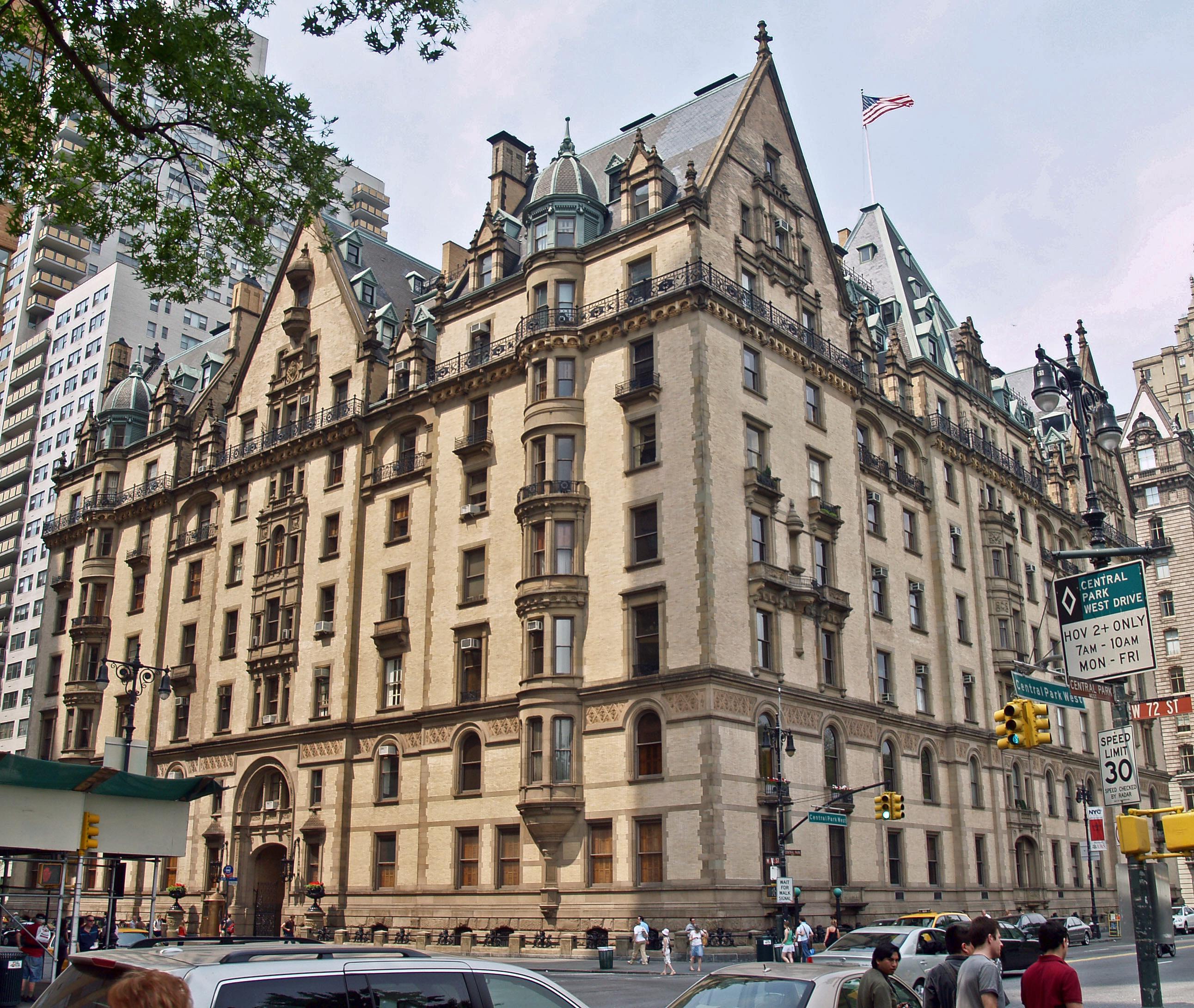
The Dakota fills its entire block — the northwest corner of 72nd Street and Central Park West, between 72nd and 73rd Streets, facing Central Park across the avenue. It is nine stories of pale brick and brownstone trim, steep slate roofs, gables, dormers, balconies, and turrets, built around a central courtyard you can glimpse only through the great archway on 72nd Street. It looks less like an apartment building than like a small fortified town, or a palace that wandered in from northern Europe and settled down facing the park. Nothing else on Central Park West looks quite like it, and nothing else in New York carries quite its weight of history: it is the oldest remaining luxury apartment building in the city, a National Historic Landmark, and the address most associated with a single night in the city's history.
The building's full address is 1 West 72nd Street. It was completed in October 1884, and it has been occupied, famous, and almost entirely closed to the public ever since. That is the first thing to understand about the Dakota, and the thing that shapes any visit: it is a private home. There is no lobby to tour, no ticket to buy, no door to knock on. What there is, and what has drawn people to this corner for decades, is the building itself — its facade, its archway, and the silence of the park across the street.
Edward Clark and the building that was too far away
The Dakota was the project of Edward Cabot Clark, a lawyer who had made his fortune as the business partner of Isaac Merritt Singer, of the Singer sewing machine company. In December 1877 Clark bought the block on the Upper West Side, then a sparsely settled stretch of Manhattan where goats reportedly still grazed and the streets were barely paved, and commissioned the architect Henry Janeway Hardenbergh to design a luxurious apartment house. Construction began on October 25, 1880. Clark died in 1882, two years before the building was finished, and the Dakota opened on October 27, 1884, with all 65 of its apartments — each one different, ranging from four to twenty rooms — already rented.
The building was a gamble, and the gamble was the point. In 1880, wealthy New Yorkers lived in private houses or in hotels; the apartment, associated in the public mind with the tenement, was not a respectable way for a rich family to live. Clark and Hardenbergh set out to change that by building something that felt less like a block of flats and more like a private mansion shared among sixty-five families: a square building arranged around a central courtyard, with its own power plant, its own dining rooms and kitchens that sent meals up to the apartments, croquet lawns and tennis courts in the courtyard, a children's playroom, and passenger elevators operated by uniformed attendants. The apartments had ceilings as high as fourteen feet in some rooms, and fireplaces, and servants' quarters. It was, by design, a building that made apartment living look not merely acceptable but desirable — and within a generation, the grand apartment houses of Central Park West and Fifth Avenue had followed its lead.
The name is the building's most repeated story, and it is worth telling carefully. According to the popular legend, the Upper West Side of 1880 was so far from inhabited Manhattan — so remote — that Clark's friends joked it was as far away as the Dakota Territory, and Clark, who had a sense of humor about the gamble, named the building for the joke. The story is charming, and it is told everywhere, but the architectural historian Andrew Alpern, who has written the most thorough history of the building, found no documentary evidence for it: the building was not even given its name until mid-1882, and the tale appears to have been invented years later by a property manager. What is certain is that the name stuck, and that it suited the building's air of splendid isolation — a palace raised on what was, for a few more years, nearly open country at the edge of the city.
A German Renaissance palace built around a courtyard
Hardenbergh designed the Dakota in the German Renaissance style — sometimes described as North German Renaissance — a romantic, almost storybook idiom of steep gables, oriel windows, balconies, carved stonework, and a high slate roof broken by dormers and chimneys. The exterior is the part of the building the public knows, and it is deliberately theatrical: the pale brickwork, the brownstone trim, the wrought-iron balconies, and the great arched entrance on 72nd Street, flanked by lanterns, that leads through a vaulted passage into the courtyard within. The interior, by contrast, was planned in the French manner then fashionable in New York, with apartments arranged around the courtyard so that every room had light and air — a luxury in itself in 1884.
The courtyard is the heart of the building and the part almost nobody sees. It was originally laid out with gardens, a fountain, and lawns for croquet and tennis, and it is still a private garden for residents. The archway that leads to it is the Dakota's most famous feature, and its most somber: it is the passage through which residents came and went, and through which the building's history turned, in a single night, from architectural to tragic.
The building's importance was recognized early. The New York City Landmarks Preservation Commission designated the Dakota a New York City Landmark on February 11, 1969. It was added to the National Register of Historic Places on April 26, 1972, and designated a National Historic Landmark on December 8, 1976 — a date that would, four years later, acquire a second meaning at this address.
The famous residents
From the beginning, the Dakota attracted the artistic and the celebrated, and over a century and a half it has accumulated a roster of residents that no other building in New York can match. Boris Karloff, the first actor to move in, arrived in the 1930s. Lillian Gish, Judy Garland, Rosemary Clooney, Judy Holliday, José Ferrer, Jason Robards, Jack Palance, Gwen Verdon, and Rudolf Nureyev all lived there. So did the composer and conductor Leonard Bernstein, whose piano stood in his Dakota apartment; the singer Roberta Flack, who lived there for four decades until her death in 2025; the playwright William Inge; the CBS News broadcaster Edward R. Murrow; the dancer Rudolf Nureyev; the feminist writer Betty Friedan; and the comedian Gilda Radner.
No resident stayed longer, or became more identified with the building, than Lauren Bacall. She moved into the Dakota in 1961 and lived there for more than half a century, in a sprawling apartment overlooking Central Park, until her death in 2014; the apartment was sold the following year for a reported $21 million. Bacall was, in the building's later decades, its most visible resident — the one neighbors and passersby were most likely to recognize — and her long tenure is part of what the Dakota means to New Yorkers: not a crash pad for the famous, but a home where the famous stayed.
Fame, however, has never been a ticket in. The Dakota became a cooperative in 1961, when the residents bought the building from the Clark family, and its co-op board has been famous for a century for saying no. Madonna, Cher, Billy Joel, Carly Simon, Antonio Banderas and Melanie Griffith, and Alex Rodriguez are among the prominent applicants reportedly turned down over the years — in some cases, the board's reasoning was that the applicant's fame was not the point, and that the building wanted residents who would live there quietly, not people who would make the address a spectacle. The rejections have become part of the building's legend, and part of its character: the Dakota is exclusive in the old sense, guarding its privacy rather than advertising it.
Rosemary's Baby and the Bramford
For many people who have never been to New York, the first sight of the Dakota came at the movies. Roman Polanski's 1968 psychological horror film Rosemary's Baby, adapted from Ira Levin's 1967 novel, used the Dakota's exteriors as the fictional Bramford apartment building — the sinister old pile where Mia Farrow's Rosemary and John Cassavetes's Guy move in, and where the film's dread slowly gathers. Polanski called the building the real star of the picture, and the film opens and closes with aerial views of it, looming over the park.
Only the exteriors were shot on site. The Dakota's interiors were off-limits to the filmmakers, so the production designer Richard Sylbert recreated them, room by room, on sound stages at Paramount Studios in Hollywood — a faithful copy of a place the camera was never allowed inside. Levin himself had modeled the Bramford on buildings like the Dakota, and in the novel one character even urges the young couple to move into "the Dakota" by name. The film gave the building a dark facet it has never quite shaken: a reputation for the eerie and the haunted, whispered about in ghost stories and tour guides, that sits oddly beside its actual history as a quiet home for musicians and actors. It also made the Dakota's silhouette — the gables, the roofline, the great block of it against the sky — recognizable around the world, twelve years before the night that made it unforgettable.
December 8, 1980
John Lennon and Yoko Ono moved into the Dakota in 1973, during Lennon's break from the music business, and made it their New York home. Their apartment was on the seventh floor. Lennon, who had spent the 1970s living mostly out of the public eye, was by 1980 working again: Double Fantasy, his first album of new music in five years, had been released three weeks earlier, and on December 8 he spent the day at the Record Plant studio, working on a new single for Ono.
That evening, as Lennon and Ono returned home, a man who had been waiting near the entrance most of the day stepped forward. Earlier that afternoon, Lennon had signed the man's copy of Double Fantasy outside the building — a photograph of the autograph, taken by a fan, is one of the most reproduced images of Lennon's last day. At about 10:50 p.m., in the archway of the Dakota, Mark David Chapman shot Lennon four times in the back at close range. Lennon staggered a few steps into the building's entrance vestibule and collapsed. He was rushed by police car to Roosevelt Hospital, a few blocks away, and pronounced dead on arrival, shortly after 11 p.m. He was forty years old.
The next day, Lennon was cremated at Ferncliff Cemetery in Hartsdale, New York, and Ono scattered his ashes in Central Park. Chapman pleaded guilty to second-degree murder on June 22, 1981, and was sentenced on August 24, 1981, to twenty years to life in prison; he has been repeatedly denied parole since. Every year on December 8, Ono places a lit candle in the window of Lennon's room in the Dakota, and fans gather across the street in Strawberry Fields for an all-day vigil, musicians playing Lennon's songs while the crowd sings along. Ono continued to live in the Dakota for more than four decades after Lennon's death, until 2023.
It is worth saying plainly, because the building's fame invites it: the archway is not a shrine, and the Dakota is not a memorial. It is a home, and people live there, and the residents — then as now — have asked for nothing more than to be left alone. The grief belongs to the park across the street, where the city made a place for it. That is where visitors go, and where they should go.
Strawberry Fields: the memorial across the street
In 1985, New York City dedicated a section of Central Park directly across from the Dakota as Strawberry Fields, a living memorial to John Lennon named for the Beatles song "Strawberry Fields Forever." Ono worked with the Central Park Conservancy to create it, and it was dedicated on October 9, 1985, what would have been Lennon's forty-fifth birthday. Countries from around the world donated trees and plants for the landscape, and the city of Naples, Italy, donated the memorial's centerpiece: a black-and-white mosaic set into the path, bearing a single word — "Imagine."
The mosaic has become one of the most visited spots in Central Park. On any given day you will find flowers laid on it, a guitarist playing nearby, and visitors from a dozen countries standing quietly around the circle. On Lennon's birthday, October 9, and on the anniversary of his death, December 8, the crowds grow, and the vigil stretches through the day. It is a modest memorial — a garden, a path, a mosaic — and its modesty is the point. Lennon, who wrote a song about imagining a world without possessions and without borders, is remembered not with a statue but with a place to sit, a tree to stand under, and a word set in stone.
Strawberry Fields is also the practical answer to the question of how to visit the Dakota. The building itself can only be seen from the sidewalk. The memorial is the place to linger: it is public, it is open, it is the part of this story that belongs to everyone, and it is, fittingly, the view Lennon himself had from his windows — the park he walked in, across the street from the home he loved.
The co-op years
After Edward Clark's death, the Dakota remained in the hands of his descendants for nearly eighty years. In 1961, the Glickman Corporation bought the building, and the tenants — fearing the new owner might demolish it — bought it themselves and formed a cooperative, The Dakota, Inc., which owns the building to this day. The conversion saved the building and set its modern character: a self-governing community of shareholders, famously selective, famously private, and famously determined to keep the Dakota as it is.
The decades since have been a slow, expensive act of preservation. In 1974 the co-op voted to repair much of the building, including the elevators, at a cost then of about $500,000. Twenty years later, the board approved a renovation of the facade and the repair of some 2,000 windows, at a cost of roughly $5 million. The building that stands on the corner today is, in its bones, the building of 1884 — the same brick, the same gables, the same archway — kept standing by the people who live inside it, and by the landmark laws that now protect it.
That continuity is the Dakota's quiet achievement. New York has a habit of turning its institutions into memories and its memories into plaques. The Dakota is still a working home, still occupied, still guarded, still serving the purpose Edward Clark imagined for it in 1880: a place where people who could live anywhere choose to live together, behind a wall of pale brick, facing the park. It is a landmark you cannot enter — and, on a clear morning, standing on 72nd Street with the gables against the sky and the park at your back, a landmark you do not need to enter to understand.
How to visit
The Dakota is at 1 West 72nd Street, on the northwest corner of 72nd Street and Central Park West on the Upper West Side — reach it by subway on the B/C to 72nd Street (Central Park West) or the 1/2/3 to 72nd Street (Broadway). The Dakota is a private residential building: do not enter the archway, do not approach the gate, and do not ring for entry — residents live here, and the building is not open to visitors. View the facade and the 72nd Street archway from the public sidewalk, then cross Central Park West to Strawberry Fields in Central Park, where the Imagine mosaic sits a short walk inside the park at West 72nd Street. The mosaic is the place to pause, leave flowers, and remember Lennon. Expect other visitors at the mosaic at all hours, and larger crowds on October 9 and December 8. No admission fee or hours apply to viewing the building from the street; Central Park is public land, so check the Central Park Conservancy's site before visiting for current park information.
Key Facts
- The Dakota is a cooperative apartment building at 1 West 72nd Street, on the northwest corner of 72nd Street and Central Park West on the Upper West Side of Manhattan. Coordinates: 40.7765, -73.9762.
- Built between October 25, 1880 and October 27, 1884, in the German Renaissance style, designed by architect Henry Janeway Hardenbergh for businessman Edward Cabot Clark, who made his fortune as Isaac Merritt Singer's partner in the Singer sewing machine company. Clark died in 1882, before the building was completed. It is the oldest remaining luxury apartment building in New York City, and the first luxury apartment house in the city.
- The building was a square block arranged around a central courtyard, with 65 apartments when it opened — each one different, from four to twenty rooms — all rented before the doors opened. It had its own power plant, dining rooms and kitchens that sent meals to the apartments, a children's playroom, and passenger elevators operated by uniformed attendants.
- The popular story that the building was named because the Upper West Side was as remote as the Dakota Territory has no documentary basis, according to historian Andrew Alpern: the building was not given its name until mid-1882, and the tale appears to have been invented later by a property manager.
- The Dakota was designated a New York City Landmark on February 11, 1969, added to the National Register of Historic Places on April 26, 1972, and designated a National Historic Landmark on December 8, 1976.
- Notable residents have included Boris Karloff, Lillian Gish, Judy Garland, Rosemary Clooney, Judy Holliday, José Ferrer, Jason Robards, Jack Palance, Gwen Verdon, Rudolf Nureyev, Leonard Bernstein, Roberta Flack, William Inge, Edward R. Murrow, Betty Friedan, and Gilda Radner. Lauren Bacall lived there from 1961 until her death in 2014, more than half a century, and her apartment sold the following year for a reported $21 million.
- The Dakota became a cooperative in 1961, when the residents bought the building from the Clark family after the Glickman Corporation purchased it, forming The Dakota, Inc. Its co-op board is famously selective and has reportedly rejected prominent applicants including Madonna, Cher, Billy Joel, Carly Simon, Antonio Banderas and Melanie Griffith, and Alex Rodriguez.
- The Dakota's exteriors served as the fictional Bramford building in Roman Polanski's 1968 film Rosemary's Baby; the interiors were recreated on sound stages in Hollywood because the building's interiors were off-limits to the filmmakers.
- John Lennon and Yoko Ono moved into the Dakota in 1973 and lived on the seventh floor. On the night of December 8, 1980, at about 10:50 p.m., Mark David Chapman shot Lennon four times in the back in the building's archway as Lennon and Ono returned from a recording session at the Record Plant. Lennon was taken to Roosevelt Hospital and pronounced dead on arrival, shortly after 11 p.m., aged forty.
- Lennon was cremated the next day at Ferncliff Cemetery in Hartsdale, New York, and Ono scattered his ashes in Central Park. Chapman pleaded guilty to second-degree murder on June 22, 1981, and was sentenced on August 24, 1981, to twenty years to life in prison. Ono places a lit candle in the window of Lennon's room every year on December 8; Ono continued to live in the Dakota until 2023.
- Strawberry Fields, the memorial to Lennon in Central Park directly across from the Dakota, was dedicated on October 9, 1985 — what would have been Lennon's forty-fifth birthday. Ono worked with the Central Park Conservancy to create it; countries around the world donated trees and plants, and the city of Naples donated the black-and-white Imagine mosaic that is its centerpiece.
- The Dakota is a private residential building and is not open to the public. Visitors should view it from the sidewalk and visit Strawberry Fields across the street.
Visitor Details
Address: The Dakota, 1 West 72nd Street (northwest corner of 72nd Street and Central Park West), Upper West Side, New York, NY 10023.
Transit: Subway to 72nd Street — B/C trains at Central Park West, or 1/2/3 trains at Broadway. Strawberry Fields is inside Central Park at West 72nd Street, directly across Central Park West from the Dakota.
Hours / Admission: The Dakota is a private residential building and is not open to visitors — view the facade and the 72nd Street archway from the public sidewalk only; do not enter the archway or approach the gate. No admission fee applies to viewing the building from the street. Strawberry Fields is in Central Park, which is public land; no fixed park hours are stated in this article, since none was verified against the Central Park Conservancy's official site — check centralparknyc.org before visiting for current park information.
Best timing: Visit on a clear morning for the best light on the Central Park West facade. Expect other visitors at the Imagine mosaic at all hours, and larger crowds on October 9 (Lennon's birthday) and December 8 (the anniversary of his death), when fans hold an all-day vigil at Strawberry Fields.
The Dakota in Photographs