
A few blocks from the noise of Lincoln Road, a bronze arm forty-two feet tall rises out of a lily pond, and a hundred and thirty figures cling to it, climbing toward a hand that will never quite reach them. The Holocaust Memorial Miami Beach was built by the people who survived what it remembers, on a street whose address is itself a date. It is the most serious place in Miami Beach, and one of the most powerful memorials in America.
The hand rising over Miami Beach
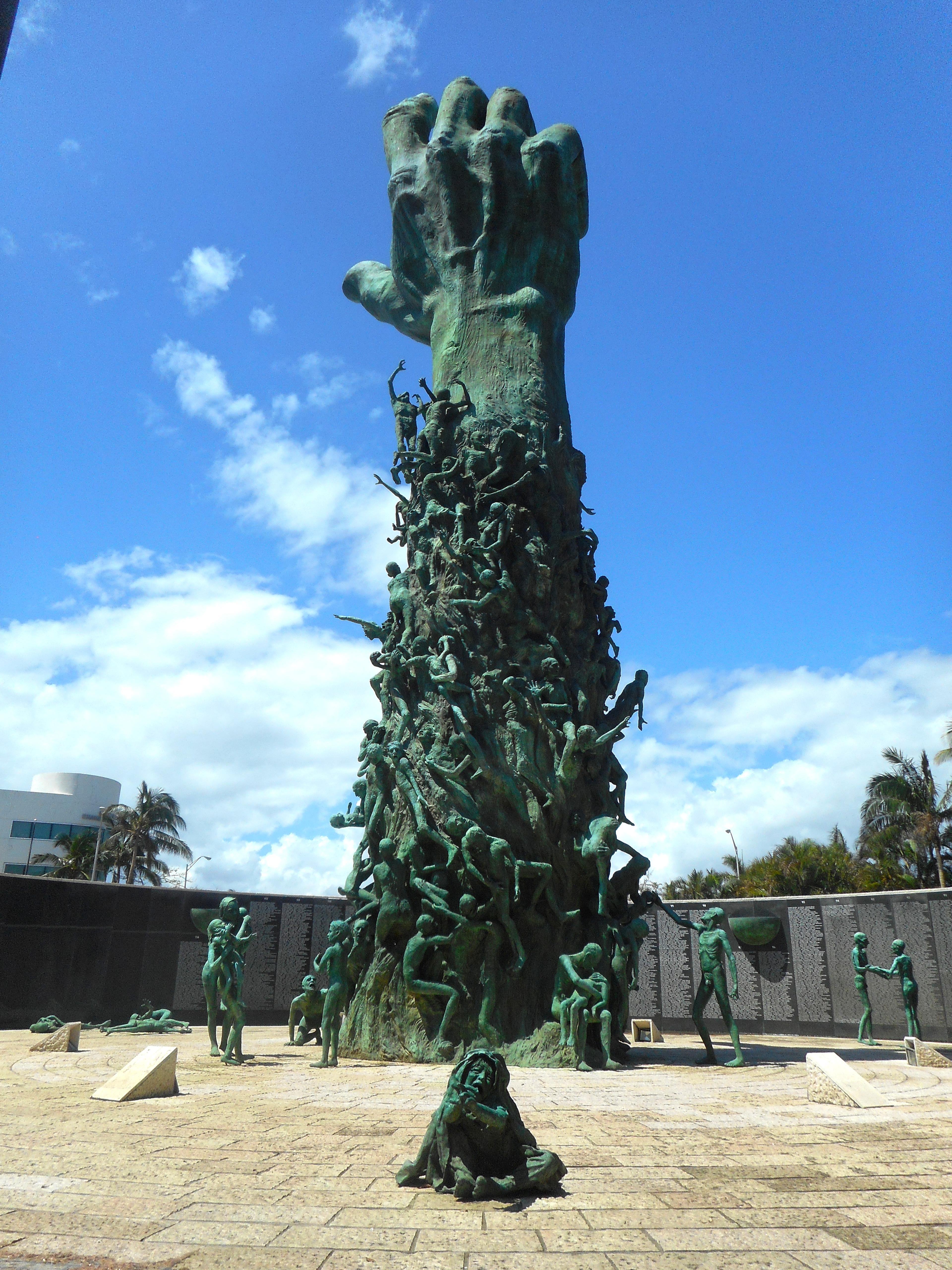
The first thing you see is the hand. It rises above the palm trees at the corner of Meridian Avenue and Dade Boulevard, an outstretched bronze arm forty-two feet tall, its fingers open to a sky that in Miami is almost always blue. The arm is tattooed with a prisoner number from Auschwitz. Clinging to it, climbing it, falling from it, are a hundred and thirty life-size human figures — mothers holding babies out toward the hand, fathers lifting sons, brothers reaching for brothers, bodies tangled together in a single desperate ascent. The sculptor Kenneth Treister called the work the Sculpture of Love and Anguish, and he called it, more bluntly, "a scene from hell, frozen in bronze."
The sculpture stands in the middle of a broad, round reflecting pool planted with water lilies, ringed by a low wall of pale Jerusalem stone. Around it, on pink-hued Jerusalem stone paving, stand more figures — a mother and her children, a man alone, a body lying flat on the ground — and behind them a curving black granite wall covered in thousands of names. The whole place is an outdoor room, open to the sky, and it is free, and it is open every day of the year. More than a hundred thousand people walk through it annually, many of them by accident: they are on their way to the Convention Center, or to Lincoln Road, or to the beach, and they come around a corner and stop.
That is the point of the place, and it was the point from the beginning. The memorial was not commissioned by a city or a government. It was conceived by the people who had survived the thing it remembers, and who had come to live, improbably, in a beach town built for pleasure. They wanted a memorial that a stranger could not walk past without understanding something — and they wanted it here, in Miami Beach, because this was where they had ended up, and because they believed the living had an obligation to the dead that did not expire with distance or time.
Why Miami Beach
To understand why one of America's most powerful Holocaust memorials stands in a resort town, you have to understand who lived in Miami Beach in the second half of the twentieth century. After the war, South Florida became home to one of the largest communities of Holocaust survivors in the United States. They came for the warmth, for the cheap apartments, for the other survivors already there, for the synagogues and the delicatessens and the familiar sound of Yiddish on a bench on Ocean Drive. Miami Beach in the 1960s and 1970s was, in a real sense, a retirement community of people who had survived the worst of the century — and they raised children and grandchildren there, in the shadow of a past they rarely spoke about at the dinner table.
By the early 1980s, that generation was aging, and a question was pressing on them: when we are gone, who will remember? In the fall of 1984, a small group of survivors began meeting to talk about building a permanent memorial. The moving force was David Schaecter, a survivor and local businessman, and among the group was Andrew C. Hall, a Miami attorney who had himself survived the Holocaust as a child and who would serve as the memorial's chairman. They formed the Holocaust Memorial Committee in 1985 as a private nonprofit organization, funded by donations, and they went to the City of Miami Beach Commission with a request for land.
The city gave them a site at Meridian Avenue and Dade Boulevard, a full block in the heart of South Beach, a few steps from the Convention Center. It was not an empty lot. It had been the home of William and Florrie Loeb, Holocaust survivors who had emigrated from Rotterdam after the bombing and occupation of the Netherlands, bought the house in the 1940s, and raised their son Robert there. Florrie Loeb sold the property to the city in the early 1970s, and the city had planned to turn it into a parking lot. The trees the Loebs planted in the 1920s and 1930s still stand at the back of the memorial grounds — living things that predate the memorial, the war, and the family that planted them.
An address that is a date
The memorial's address is 1933–1945 Meridian Avenue. That is not a range of street numbers. It is a date: 1933, the year Hitler came to power in Germany, to 1945, the year Nazi Germany was defeated. The address was chosen deliberately, so that every letter, every map, every taxi ride to the memorial carries the span of the Holocaust with it. It is the first thing the memorial tells you, before you have even arrived, and it is characteristic of the whole design: nothing here is decorative, and nothing is accidental.
The site itself is arranged as a journey. Treister described the memorial as "a large environmental sculpture… a series of outdoor spaces in which the visitor is led through a procession of visual, historical and emotional experiences." There are eleven dedicated areas, and they are meant to be walked in order, from the street to the central sculpture and out again — from history, through horror, to a kind of exhausted, quiet remembrance. The path is not long. It takes perhaps half an hour to walk slowly. It stays with people for much longer than that.
The survivors' committee
The committee's work took more than five years, and it was not easy. The survivors who conceived the memorial were not architects or fundraisers; they were people in their sixties and seventies who had decided, late in life, to build something permanent out of the worst experience of their lives. They raised the money in donations, large and small, from the South Florida Jewish community and beyond. They worked with the city on the site. And they chose an artist.
Kenneth Treister was a Miami Beach architect — born and raised in the city, the son of a local builder — who had also trained as a sculptor. The committee entrusted him with the whole thing: not just a statue, but the entire environment, the architecture and the sculpture together. Treister spent years on research, including time in Jerusalem, studying how memory is built into stone. He wanted the memorial to be, in his words, both the anguish of the dying and the love that persisted even then — mothers holding their babies, brothers helping their brothers, sisters helping their mother — because, as he put it, "there must have been a tremendous love going on during the Holocaust."
The work took five years of his life. He began with a foundry in Taiwan, where he worked with a sculptor in a small village for two weeks before the economics of the project fell apart — the Taiwanese dollar doubled against the American dollar, and he came home without a place to build. A friend's connection led him to Mexico, one of the few places in the world that still did monumental sculpture at that scale, and he and his wife Halyne moved to Cuernavaca and spent three or four years there, designing and building the memorial day and night. The central sculpture was cast in Mexico City by Fundición Artística. Treister has said those five years were his whole life for that stretch — he did nothing else.
The Sculpture of Love and Anguish
The central sculpture is forty-two feet of bronze, and it is unlike any other Holocaust memorial in America because it does not abstract the horror. It shows it. The arm rises from a round platform in the reflecting pool, and the forearm is modeled from the bodies of a hundred and thirty figures — men, women, and children, emaciated, naked, clinging to one another and to the arm itself, some reaching upward, some falling, some already still. They are grouped into small family vignettes, little plays, as Treister called them: a mother holding a baby out, a father holding a son, two brothers trying to touch each other. At the top, the hand opens — fingers spread, reaching for a sky it cannot touch.
The number tattooed on the forearm was chosen with care. It is an Auschwitz prisoner number that was never actually issued at the camp — a number that belongs to no one, so that it stands for everyone. The figures themselves are not portraits of individuals. Treister did not assign them identities. He designed them as a crowd, a mass of people in their final moments, and then broke the crowd into families, because families were what the Holocaust destroyed, one household at a time.
Around the base of the arm, on the Jerusalem stone plaza, stand more figures, life-size and separate from the central mass: a woman crouching, a man reaching, a mother with two children, a body lying flat on the paving as if it had simply given up. These are the figures visitors walk among, and they are the ones that make the scale of the central sculpture human. You can stand next to one of them. You can see that it is your height.
Walking the memorial: the Arbor of History
The approach to the central sculpture runs through the Arbor of History, a tunnel-like colonnade of Jerusalem stone columns, roofed with a wooden trellis overgrown with bougainvillea. Along one side of the tunnel runs a long wall of black granite, and on the granite are etched photographs and words: a short history of the Holocaust from 1933 through 1945, told in the first panels, followed by a chronological pictorial record of what happened — the ghettos, the deportations, the camps, the liberation — accompanied by maps and text written with the historian Helen N. Fagin. The photographs are the documentary record: Jewish women after arrival at Auschwitz, the gates of the camps, the faces of people who did not survive the war.
The tunnel is deliberately dark and close. The granite is polished to a mirror shine, so that as you read the panels you see your own reflection in the stone, standing among the photographs. That is not an accident either. The memorial is designed so that the visitor is never only a spectator. You are in the picture.
Emerging from the Arbor, the space opens suddenly into the plaza and the reflecting pool, and the sculpture is there, forty-two feet tall, with the sky behind it. The contrast is the point: confinement, then openness; darkness, then light; history, then the thing itself.
The wall of names and the Dome of Contemplation
Ringing the plaza is the Memorial Wall, a curving wall of black granite panels covered in thousands of names — the names of victims, submitted by their families, etched into the stone. The wall is low enough to read at eye level and long enough that reading it takes time. Visitors run their fingers along the names. Some of them find a relative. Many of them simply read, panel after panel, until the scale of the loss becomes something felt rather than something counted.
Beyond the plaza, the memorial has quieter spaces. The Garden of Meditation is a planted area for sitting and thinking, shaded by the trees the Loebs planted decades ago. The Lonely Path is a narrow walkway, a solitary stretch of the journey. And the Dome of Contemplation is a bare, domed space of Jerusalem stone — empty on purpose, a room with nothing in it but light and silence, for the moment after the rest of the memorial has done its work.
The journey ends, as it began, with a family. The final sculpture in the sequence shows the same mother and two children who appear at the start of the walk — now dead, lying still — framed by the words of Anne Frank. It is the memorial's last statement, and its bleakest: the people you met at the beginning do not survive to the end.
A place of education
The memorial was dedicated on Sunday, February 4, 1990, with Elie Wiesel, the Nobel laureate and survivor, as the guest speaker at the dedication ceremonies. Wiesel's presence was a kind of blessing on the project — the most famous survivor of the century standing before a memorial built by survivors who were not famous, in a beach town that the world associated with pleasure, and saying that this, too, was a place where memory belonged.
In the years since, the memorial has become what its founders hoped it would be: not only a monument but a classroom. It is a committee of the Greater Miami Jewish Federation, and it runs lectures, teacher seminars, and school tours, and organizes programs to commemorate Kristallnacht, Holocaust Education Week, Yom HaShoah — Holocaust Remembrance Day — and other dates on the Jewish calendar. More than a hundred thousand people visit each year. There is a free mobile app, produced by the memorial, with survivor testimony, slideshows, interactive maps, and audio and video about the sculpture and the history it tells — worth downloading before you go, or listening to as you walk.
The memorial has also become a civic place for Miami Beach, in a way its founders could not have fully foreseen. It is a Florida Heritage site. It is where the city gathers on remembrance days. And it is where visitors who came to Miami for the beach and the nightlife find themselves, sometimes without planning to, standing quietly in front of a wall of names, thinking about something else entirely. That is the memorial working as designed.
What a visit feels like
A visit to the Holocaust Memorial Miami Beach is not like a visit to the other landmarks in this journal. There is no ticket, no tour, no gift shop, no view to photograph for its own sake — although people do photograph the sculpture, and the photographs are extraordinary, because the sculpture is extraordinary. What there is, instead, is a sequence of spaces that ask something of you: read this, look at this, stand here, be quiet for a minute.
Give it time. The walk itself takes less than an hour, but the memorial rewards slowness — reading the panels in the Arbor of History rather than hurrying through them, sitting for a while in the Garden of Meditation, standing at the Memorial Wall long enough to read a few dozen names and understand that there are thousands more. Come in the morning, when the light is low and the plaza is quiet, or late in the afternoon, when the sun drops behind the palm trees and the bronze goes dark. Bring children old enough to understand what they are seeing, and be ready to talk with them afterward. The memorial is designed to be understood by anyone willing to pay attention, and it is designed to be unforgettable.
And then, when you leave, you walk back out onto Meridian Avenue, and Miami Beach is still there — the traffic, the cafes, the sun, the ordinary business of a beach town. The memorial does not ask you to stay in its world. It asks you to carry something of it back into yours.
How to visit
The Holocaust Memorial Miami Beach stands at 1933–1945 Meridian Avenue, Miami Beach, FL 33139, at the corner of Meridian Avenue and Dade Boulevard, a few blocks north of Lincoln Road and a short walk from the Miami Beach Convention Center. Admission is free — there is no charge to enter, and no ticket is required. The memorial's official site states it is open 365 days a year, from 10:00 am to sunset; note that some other sources list slightly different hours (the Greater Miami Jewish Federation lists 9 a.m. to sundown), so check holocaustmemorialmiamibeach.org before visiting for current hours, especially around holidays and remembrance events. Allow forty-five minutes to an hour for a slow walk through all eleven areas, longer if you want to read the Arbor of History panels in full or sit in the Garden of Meditation. The memorial is outdoors and self-guided; the free official app (Holocaust Memorial Miami Beach, for iPhone and Android) adds survivor testimony, audio, and maps. Donations are accepted and appreciated, and help maintain the memorial and its education programs. No fixed prices or fees are stated in this article beyond the verified fact that admission is free.
The memorial in photographs