
The corner of Tremont and School
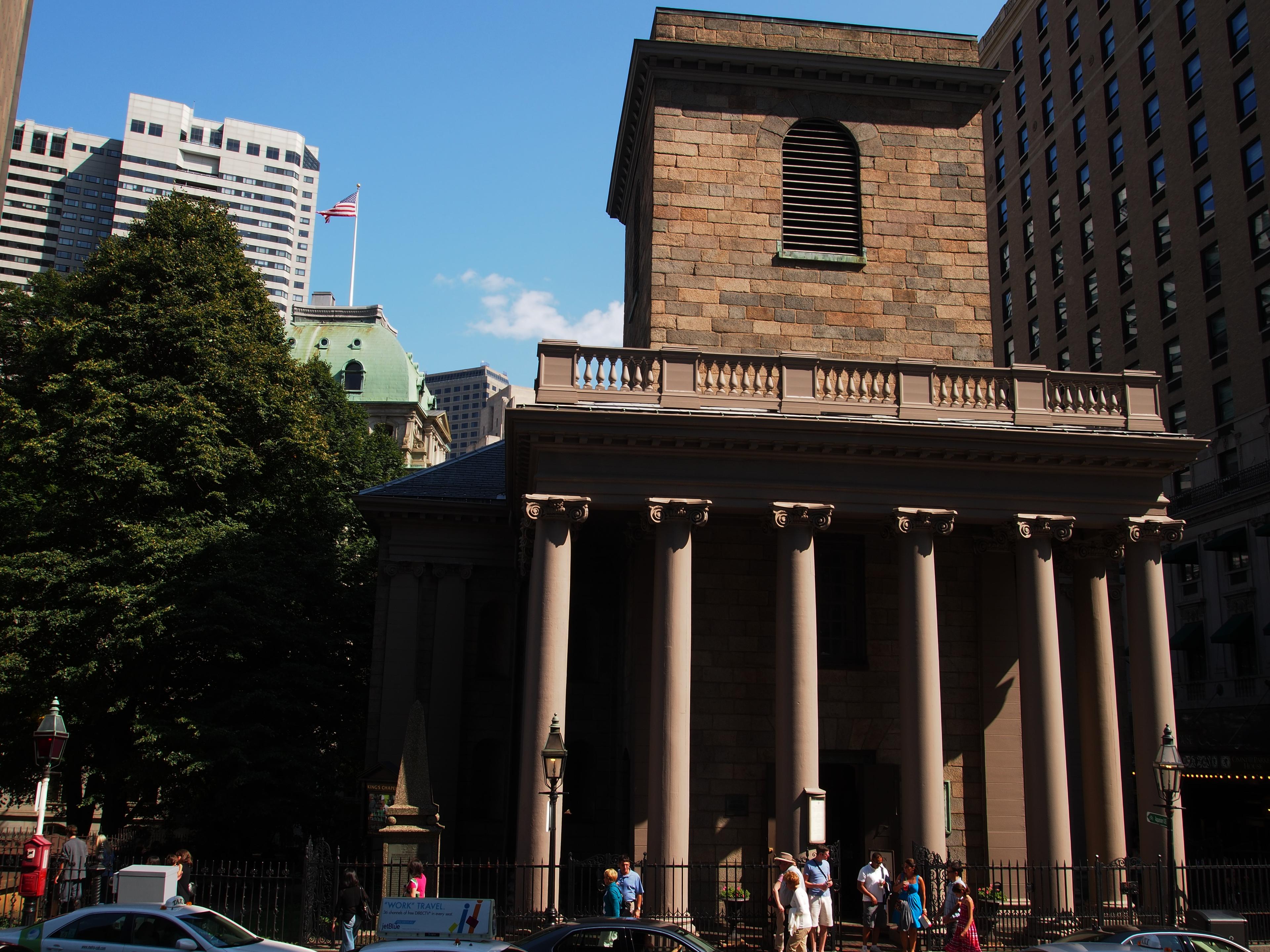
King's Chapel stands at 58 Tremont Street, at the corner of Tremont and School Streets in downtown Boston, and it is the kind of building that stops you even before you know what it is. The walls are Quincy granite, laid in rough, honey-colored courses. The front is a portico of tall Ionic columns, added after the main building was finished, and above it rises a square stone tower with no steeple — the steeple was designed but never built, because the money ran out. To the left of the church, behind a low iron fence, is a sloping yard of tilted slate headstones: King's Chapel Burying Ground, Boston's oldest graveyard, older than the church itself by more than half a century.
The chapel is the fifth stop on the Freedom Trail, and it earns the place. It was founded in 1686, when Boston was still a Puritan town that had no use for the Church of England. It survived the Revolution, when its congregation scattered and its pews were seized. It became, in 1785, the first Unitarian church in America while keeping the Anglican prayer book it had always used. George Washington sat in its Governor's Pew. Paul Revere cast its bell. And it is still, today, an active congregation — an independent Christian Unitarian church affiliated with the Unitarian Universalist Association — holding Sunday services in the same box pews where eighteenth-century Bostonians sat.
King's Chapel is not a ruin or a museum that happens to look like a church. It is a working church that happens to be one of the oldest buildings in Boston, and that is what makes it worth a slow visit: the history is not behind glass. It is the room you are standing in.
A king's church in a Puritan city
Boston was founded by Puritans in 1630, and for the first half-century of its life it had exactly one kind of church: the Congregational church of the town's own choosing. The Church of England — the king's church — was not welcome, and for decades it did not exist in Boston at all. That changed in 1686, when King James II sent Sir Edmund Andros to govern the newly created Dominion of New England. Andros was a royal governor with a royal church, and he needed a place for it to worship.
The congregation was organized at a meeting in Boston's Town House on June 15, 1686. It was the first Anglican congregation in colonial New England, and its very existence was a provocation: the Puritan town had to be compelled to give it land, and the land it got was a corner of the town's burying ground, at Tremont and School Streets. The first King's Chapel was a wooden church, built in 1688 on that corner, on ground that had already been burying Bostonians for more than fifty years.
The chapel's early years were precarious. It was the church of the royal governors and the British officers stationed in Boston, a small Anglican island in an overwhelmingly Puritan city. But it grew. In 1710 the town voted to grant the church more land to enlarge its building, and the enlarged wooden church held the first organ heard in New England — a gift from the Puritan merchant Thomas Brattle, bequeathed to the congregation in 1713, in a gesture that says something about how Boston was already changing. Music would remain central to King's Chapel for the next three centuries.
Building the stone chapel
By the 1740s the wooden church was too small, and the congregation resolved to build in stone. They hired Peter Harrison of Newport, Rhode Island — the architect now often called America's first architect — who modeled the design on the London churches of James Gibbs, above all St. Martin-in-the-Fields. Construction began in 1749; the cornerstone was laid on August 11 of that year. The stone was Quincy granite, cut from the quarries south of Boston, and King's Chapel was the first large building in Boston to be built of stone — Boston's first granite structure.
The building went up around the wooden church it was replacing, so that worship could continue during construction. When the stone chapel was finished and opened in 1754, the old wooden church was taken apart piece by piece, carried out through the windows of the new building, and shipped to Lunenburg, Nova Scotia, where its timbers were used to build St. John's Anglican Church. It is one of the great images in Boston's architectural history: a church dismantled and carried out through its own replacement's windows.
The new building was, and remains, a superb piece of Georgian architecture — symmetrical, plain, and monumental, with the classical restraint that Harrison had learned from Gibbs. The one thing it lacked was its steeple. Harrison's design called for one, but the funds were exhausted, and the tower was left flat-topped. It has stayed that way for 270 years: the square granite tower, with its louvered arched openings, is the building's most recognizable feature precisely because it ends where a steeple should begin. The Ionic portico across the front came later, softening the granite facade with a row of tall columns.
In 1960 the building was designated a National Historic Landmark for its architectural significance — one of the finest designs of the noted colonial architect, in the words of the designation.
The Revere bell
The bell in the tower has its own history, and it is the part of King's Chapel that most visitors ask about first. The original bell was cast in England and hung in the tower in 1772. In 1814, during an evening service, it cracked. The congregation turned to the most famous bellfounder in Boston: Paul Revere and Sons.
Revere recast the bell, and it was rehung on February 23, 1816. It is the largest bell the Revere foundry ever cast, and the last one cast during Paul Revere's lifetime. Revere is quoted as saying it was "the sweetest bell I ever made." It still rings today, rung by hand to summon the congregation to Sunday services, just as it has for more than two centuries. Visitors on the chapel's Bells and Bones tour can climb to the tower and see it up close — a great bronze bell, green with age, hanging in the stone tower that has held it since 1816.
Revolution and reinvention
The Revolution nearly ended King's Chapel. Its congregation was, by definition, the king's people: royal officials, British officers, and the Loyalist families who worshipped under the Crown's flag. When the British evacuated Boston in 1776, most of those families left with them — for Nova Scotia and England — and the church was closed. Services were suspended, and the building stood empty through the war years.
Those who remained reopened the church in 1782. But the congregation that came back was not the congregation that had left. In 1782 the church invited a young lay reader named James Freeman to serve for a time. Freeman had preached a few times but had never been ordained, and he stayed: his ministry would last fifty-two years. Over the next three years he became increasingly convinced that the congregation's views had moved away from Anglican doctrine, above all on the Trinity. In 1785 the congregation voted to revise the 1662 English Book of Common Prayer along Unitarian lines, removing the references to the Trinity, and published the revised prayer book that same year.
The break was decisive and strange at once. Freeman still considered King's Chapel to be Episcopalian, and he sought ordination from the Episcopal Church's first bishop, Samuel Seabury, who refused him. The church kept its Anglican form — the liturgy, the prayer book, the pews, the music — and changed its theology. King's Chapel became the first Unitarian church in the United States, and it has worshipped according to a Unitarian version of the Book of Common Prayer ever since, now in its ninth edition. The congregation describes itself today as an independent Christian Unitarian congregation affiliated with the Unitarian Universalist Association, and the hybrid liturgy Freeman created in 1785 is still in use at its services — a living artifact of the moment when an English church became an American one.
Inside the chapel
Step inside and the first thing you notice is the light: tall arched windows on both sides, and a room that is wider than it is long, built for a congregation to see and hear one another. The interior is carried by wooden columns with Corinthian capitals, hand-carved by William Burbeck and his apprentices in 1758. The box pews are original — high-backed, close-fitted wooden pews that families once owned and furnished, with doors that close, and the names of their eighteenth-century owners still attached to some of them.
Pew No. 30 is the Governor's Pew, originally reserved for the royal governor — Jonathan Belcher held it in the colonial period — and on October 27, 1789, it was occupied by George Washington, who attended a service at King's Chapel during his tour of New England in his first year as president. Paul Revere sat in the pews too, and so did Oliver Wendell Holmes. The pulpit, at the front of the room, is the oldest American pulpit still in continuous use.
The chapel's music has been famous since the beginning. The first organ, Brattle's gift of 1713, was the first organ heard in New England. The organs that followed were built by Richard Bridge — the 1756 Bridge organ, which tradition says was selected and played upon by Handel — and later by Hook & Hastings and Simmons & Willcox. The fifth organ was a large 1909 E. M. Skinner, a gift from Frank E. Peabody in memory of his son Everett. The present organ, the sixth installed in the chapel, was built by C. B. Fisk in 1964 and is decorated with pipes and carvings from the 1756 Bridge organ. For forty-two years, from 1958, the eminent American composer Daniel Pinkham was the chapel's organist and music director.
Look around the walls and you will find the monuments of the congregation's long life, including a monument to Samuel Vassall, brother of the colonist William Vassall, an early deputy of the Massachusetts Bay Colony. The chapel's archives, housed in the Parish House, hold more than three centuries of records — the paper trail of a congregation that has kept its own history since 1686.
The burying ground
The graveyard beside the chapel predates it by fifty-six years, and it is not, despite its name, the chapel's property at all. King's Chapel Burying Ground was founded in 1630, the year Boston was settled, and it was the town's only burial site for thirty years, until Copp's Hill (1659) and the Granary (1660) followed. It has always been owned and operated by the City of Boston, and the city still manages it today as part of its Historic Burying Grounds Initiative.
Tradition holds that the first person buried here was Isaac Johnson, the early settler who owned the land — he died in September 1630 and was buried at the southwest corner of his own lot, and the other colonists began using the ground after him. A 1985 survey counted 586 surviving grave markers; the city believes well over a thousand people were buried in the small plot. The oldest marker still standing is dated 1658, for William Paddy.
The names on the stones are the first generation of Massachusetts. John Winthrop, the first governor of the Massachusetts Bay Colony, died in 1649 and lies in the Winthrop family tomb beside Tremont Street. Mary Chilton, a Mayflower passenger who is believed to have been the first woman to step off the Mayflower, died around 1679 and is buried in the Winslow tomb. The Reverend John Cotton, the most powerful religious leader of seventeenth-century Boston, is here, as is Hezekiah Usher, the colonies' first printer and publisher. A marker stands for William Dawes, who rode with Paul Revere on the midnight ride to Lexington in 1775 — though the city notes that his remains were moved to Forest Hills Cemetery in the nineteenth century, so the stone is a memorial rather than a grave. Free and enslaved Black Bostonians were buried here too, in ground that served the whole town, not just its governors.
The burying ground is small — less than half an acre — and it rewards a slow walk. The slate markers, carved with winged skulls and cherubs and the spare epitaphs of the seventeenth century, lean at every angle, and the chapel's granite wall rises behind them. It is the oldest graveyard in Boston, and one of the three historic burying grounds on the Freedom Trail.
The Freedom Trail and the chapel today
King's Chapel and its burying ground are the fifth stop on the Freedom Trail, between the Old South Meeting House and the Old State House, and they sit at the hinge of the trail: the point where the story turns from the town's founding to its revolution. The chapel is easy to find and hard to miss — the granite tower is visible from the Common, and the portico faces Tremont Street where the trail's red line runs past.
The chapel today is both a historic site and a working church. Sunday services are held in the sanctuary, following the prayer book Freeman revised in 1785. The chapel offers guided tours of the building, including an Art & Architecture tour, and its signature Bells and Bones tour, which takes visitors into the eighteenth-century crypt beneath the chapel and up to the tower to see the Revere bell. The chapel is also a concert venue: its music program, which began with Brattle's organ in 1713, continues with regular concerts in the sanctuary.
That continuity is the point. King's Chapel has been rebuilt, emptied, reopened, and re-theologized, and it has never stopped being used. The box pews still hold a congregation. The bell still rings on Sunday mornings. The prayer book is in its ninth edition, and the words in it were first printed in 1785. A building that has survived three centuries by changing just enough, and no more, is a rare thing in a city that rebuilds itself constantly — and it is why the chapel, the bell, and the graveyard beside it are still worth standing in front of, slowly, on a walk down Tremont Street.
How to visit
King's Chapel is at 58 Tremont Street, at the corner of Tremont and School Streets in downtown Boston — a short walk from Boston Common and the Park Street T station (Red and Green lines), and the fifth stop on the Freedom Trail. Enter through the portico on Tremont Street; the burying ground, which is city-owned and entered separately from Tremont Street, lies immediately beside the church. Allow time for both: the sanctuary, with its box pews, carved columns, and pulpit, and the burying ground, where the Winthrop tomb, the Chilton marker, and the Dawes memorial stand among the oldest stones in the city. Ask about the guided tours, including the Art & Architecture tour and the Bells and Bones tour of the crypt and the Revere bell. No fixed prices, tour times, or opening hours are stated in this article, since none was verified against the chapel's official site in this run: check kings-chapel.org before visiting for current hours, tour times, and any admission or tour fees.
King's Chapel in Photographs


Key Facts
- King's Chapel is an independent Christian Unitarian congregation, affiliated with the Unitarian Universalist Association, at 58 Tremont Street, at the corner of Tremont and School Streets in downtown Boston. Coordinates: 42.3583, -71.0597.
- The congregation was founded by Royal Governor Sir Edmund Andros on June 15, 1686, as the first Anglican church in colonial New England, during the reign of King James II. The original King's Chapel was a wooden church built in 1688 on the corner of Tremont and School Streets, on land taken from the town's burying ground.
- In 1710 the town granted the church more land to enlarge its building; the enlarged wooden church held the first organ heard in New England, bequeathed by the Puritan merchant Thomas Brattle in 1713.
- The present stone church was designed by Peter Harrison of Newport, Rhode Island — often called America's first architect — modeled on the London churches of James Gibbs, above all St. Martin-in-the-Fields. Construction began in 1749 (cornerstone laid August 11, 1749) and the building opened in 1754. It was built of Quincy granite, the first large stone building in Boston, and was constructed around the wooden church so worship could continue; when the stone church was finished, the wooden church was dismantled, carried out through the new building's windows, and shipped to Lunenburg, Nova Scotia, where its timbers built St. John's Anglican Church.
- The steeple in Harrison's design was never built for lack of funds; the square granite tower remains flat-topped. The Ionic portico across the front was added later. The building was designated a National Historic Landmark in 1960 for its architectural significance.
- The chapel's bell was cast in England and hung in the tower in 1772. It cracked during an evening service in 1814, was recast by Paul Revere and Sons, and was rehung on February 23, 1816. It is the largest bell the Revere foundry ever cast and the last cast during Paul Revere's lifetime; Revere called it "the sweetest bell I ever made." It is still rung by hand for Sunday services.
- During the Revolution, the church's Loyalist congregation largely left Boston with the British evacuation in 1776 and the church was closed. Those who remained reopened it in 1782. James Freeman, invited as lay reader in 1782, served a fifty-two-year ministry; in 1785 the congregation voted to revise the 1662 Book of Common Prayer along Unitarian lines, removing references to the Trinity, making King's Chapel the first Unitarian church in the United States. Freeman sought ordination from Bishop Samuel Seabury, who refused him. The congregation still worships according to its own Anglican-style Unitarian prayer book, now in its ninth edition.
- Inside, the chapel is characterized by wooden columns with Corinthian capitals hand-carved by William Burbeck and his apprentices in 1758, original box pews, and the oldest American pulpit still in continuous use. Pew No. 30, the Governor's Pew, was occupied by George Washington on October 27, 1789. A monument to Samuel Vassall stands within the chapel.
- Music has been central since the first organ in 1713. Later organs were built by Richard Bridge (1756; tradition says it was selected and played upon by Handel), Hook & Hastings, and Simmons & Willcox; the fifth was a 1909 E. M. Skinner, a gift from Frank E. Peabody in memory of his son Everett; the present organ, the sixth, was built by C. B. Fisk in 1964 and is decorated with pipes and carvings from the 1756 Bridge organ. The composer Daniel Pinkham was organist and music director for forty-two years from 1958.
- King's Chapel Burying Ground, beside the church, was founded in 1630, the year Boston was settled, and is the city's oldest graveyard and a Freedom Trail site. It was Boston's only burial site for thirty years (1630–1660). It is owned and operated by the City of Boston, not by the chapel. Tradition holds the first interment was Isaac Johnson, the land's owner, in 1630; a 1985 survey counted 586 surviving markers, and the city believes well over a thousand people were buried there. Notable burials include John Winthrop (died 1649), first governor of the Massachusetts Bay Colony; Mary Chilton (died c. 1679), a Mayflower passenger believed to be the first woman to step off the Mayflower; the Reverend John Cotton; Hezekiah Usher, the colonies' first printer and publisher; and a memorial marker for William Dawes, whose remains were moved to Forest Hills Cemetery in the nineteenth century.
- King's Chapel and its burying ground are the fifth stop on Boston's Freedom Trail. The chapel offers guided tours, including an Art & Architecture tour and the Bells and Bones tour of the eighteenth-century crypt beneath the chapel and the Revere bell in the tower.
Visitor Details
Address: King's Chapel, 58 Tremont Street (corner of Tremont and School Streets), Downtown Boston, Boston, MA 02108. Transit: Park Street station (Red and Green lines) is a short walk away, across Boston Common; the chapel is the fifth stop on the Freedom Trail. Hours/Admission: No fixed prices, tour times, or opening hours are stated in this article, since none was verified against the chapel's official site in this run. Check kings-chapel.org before visiting for current hours, tour times, and any admission or tour fees. Best timing: Allow an hour or more to see both the sanctuary and the burying ground. Inside, look for the box pews, the Governor's Pew (No. 30), the carved Corinthian columns, the pulpit, and the Fisk organ; outside, walk the burying ground to the Winthrop tomb and the Chilton and Dawes markers. Ask about the Bells and Bones tour for the crypt and the Revere bell.