A neighborhood becomes a holiday stage
The most revealing thing about Dyker Heights at Christmas is the boundary between the spectacle and the ordinary street. Behind the lights are homes, driveways, front steps, and people carrying on with winter evenings. That tension gives the displays their character: private houses become something thousands of strangers can enjoy from the sidewalk. Arrive looking for a single attraction and you miss the larger story of a neighborhood making itself visible.
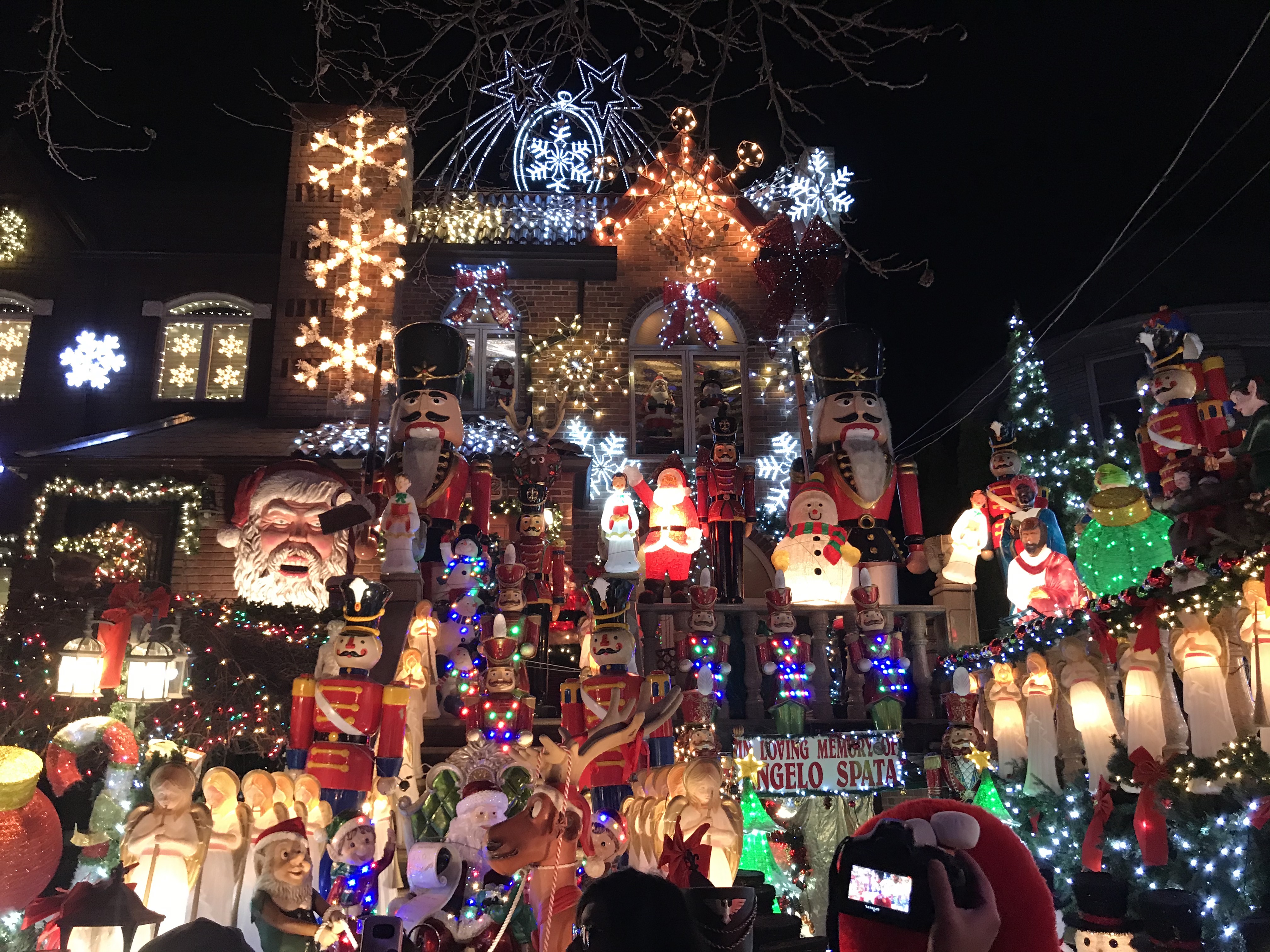
Lucy Spata’s house on 84th Street is among the best-known landmarks of the tradition. The resident-run tour company Dyker Heights Christmas Lights identifies her as a pioneer, while acknowledging that accounts of the custom’s beginnings differ. It is more accurate to describe her as a leading figure in its growth than to assign every decorated house a single founding date. The lights are a collection of individual decisions, renewed each winter.
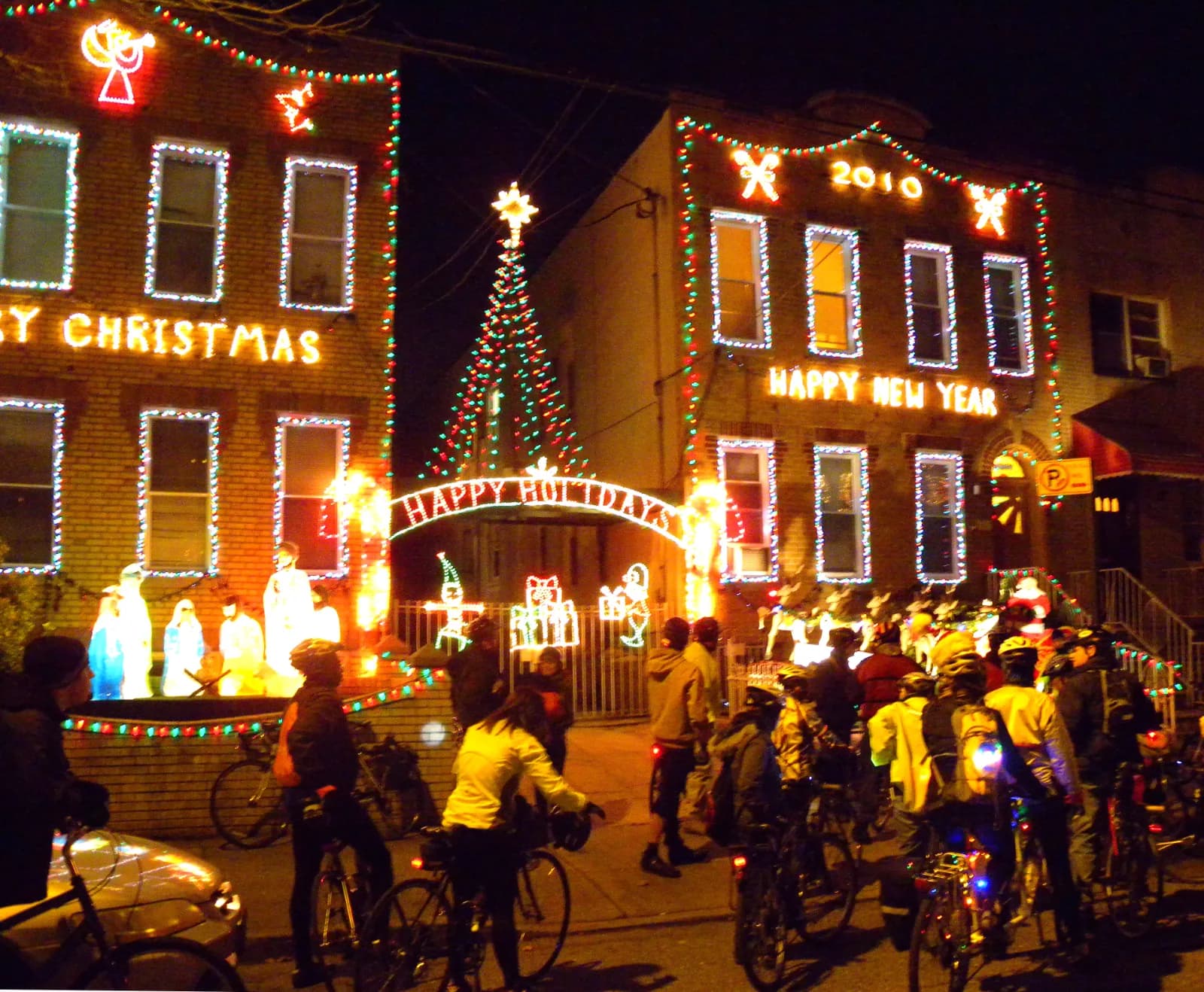
That distinction matters when planning a visit. A photograph records what one homeowner chose in one season. It cannot promise that the same figures, colors, or installations will appear in December 2026. Our featured photograph was taken in 2009 and is clearly dated; it documents the tradition’s earlier life rather than advertising this year’s displays.
The history beneath the decorations
Long before the neighborhood became a winter destination, this part of southwestern Brooklyn belonged to the town of New Utrecht. Brooklyn Public Library’s Dyker Heights primary-source collection follows its development through maps, advertisements, photographs, and newspaper reports. Detached homes and the commercial corridor along 13th Avenue are part of that story, as are the ambitions of developer Walter L. Johnson.
One particularly useful document is a January 1923 Brooklyn Daily Eagle report about the Dyker Heights clubhouse at 13th Avenue and 86th Street. It describes a building erected by Johnson in 1898 that was purchased by the Italian Country Club of Brooklyn. The record offers a concrete glimpse of neighborhood institutions changing hands and communities establishing themselves. It is a richer historical clue than the idea that Dyker Heights appeared fully formed as a Christmas attraction.
Look at the homes as well as the ornaments. Front yards give decorations a setting, while setbacks allow visitors to see a whole composition from the street. As an editorial way of reading the scene, think of each property as an individual stage: the architecture determines where a figure can stand, where a string of lights can turn, and how much can be seen without stepping onto private land.
1986: the year one house started a rivalry
The custom is commonly traced to 1986, when Lucy Spata began decorating her home on 84th Street. Sources agree on the year but split on her motive — one telling says she was honoring her late mother's love of holiday decorating. Spata started modestly, with glowing angel figurines in her front yard, and the display grew larger each year. She became known around town as "Mrs. Claus," and she and her husband Angelo still decorate everything themselves: his 2010 gift of 16-foot nutcrackers arrived on a flatbed truck, and the display now tops 30,000 lights. Her neighbors followed suit, and the results turned competitive. The Polizzotto house's "Toyland" display features 25-foot toy soldiers flanking a two-story Santa that speaks — a commission by the late Alfred Polizzotto, who hired Lou Nasti, a Brooklyn window-figure maker nicknamed "Geppetto," to create it. Many homeowners now hire professional decorators, some spending as much as $20,000 on a single season. The crowds followed the lights: Tony Muia of A Slice of Brooklyn started running bus tours to the neighborhood in 2006, and more than 100,000 people now come to see the displays each holiday season — a volume that longtime residents have found harder to love.
Visitor Notes
- Displays are privately arranged and vary by house and season; no single neighborhood opening or closing date is guaranteed.
- Use public sidewalks only; keep driveways and entrances clear and follow local crossing guidance.
- Residential streets get heavily congested; arriving on foot from the subway is recommended.
What to look for on a winter walk
Use the area around 83rd through 86th Streets, between 11th and 13th Avenues, as a starting area rather than a guaranteed checklist. Displays and participation vary. A shorter walk with time to notice details can be more rewarding than racing through every block to reproduce a video itinerary.
Begin by looking at one house from a little distance. Notice how the entrance, windows, roofline, and garden work together. Then move closer along the public sidewalk to see smaller details. Compare the effect with a neighboring property: a simple arrangement may be just as memorable as a crowded one. Keep moving when a viewing spot becomes congested and return only if the pavement clears.
For photographs, avoid making other visitors wait while you take repeated shots. Keep equipment close, leave room for people to pass, and avoid photographing residents through windows. A wide street view often tells the story better than a tightly framed decoration because it records the relationship between the house and its neighborhood.
Planning a considerate visit
There is no single opening time for a neighborhood of private homes. Treat December evenings as a general planning window and confirm current conditions before traveling; do not rely on fixed start and end dates or a universal nightly switch-off time. An early-evening visit is a sensible preference, but it is not a reservation or a guarantee that every display will be illuminated.
Viewing from public sidewalks does not require buying a tour. Commercial tours may provide transportation and commentary; they do not turn lawns or driveways into public viewing areas. Plan for winter weather, comfortable shoes, and the return journey before setting out. Check current transit service and station accessibility with the MTA, especially if step-free travel is essential.
Brooklyn Community Board Ten’s guidance asks viewers to respect properties, avoid littering, keep driveways clear, and hecross local streets carefully. Apply that advice throughout the visit. Crowded sidewalks, curb crossings, and changing winter conditions can affect wheelchair and stroller travel; do not interpret the outdoor setting as a promise of an unobstructed accessible route.
For another Brooklyn story, continue reading our Coney Island Cyclone guide or Brooklyn Army Terminal feature. Both offer a different perspective on how the borough became a destination. Plan those as separate stops with travel time between them, rather than describing them as sights just around the corner.
Coney Island Cyclone: https://plain-sight-jade.vercel.app/new-york/coney-island-cyclone
Brooklyn Army Terminal: https://plain-sight-jade.vercel.app/new-york/brooklyn-army-terminal
Sources and further reading
Brooklyn Public Library, Dyker Heights Primary Source Packet: https://static.bklynlibrary.org/prod/public/documents/brooklyn-collection/connections/Dyker%20Heights%20PP.pdf
Brooklyn Community Board Ten, visitor guidance published by NYC: https://www.nyc.gov/assets/cecm/downloads/pdf/dos-and-donts-dyker-heights.pdf
Dyker Heights Christmas Lights, resident-run commercial tour operator, historical account and community message: https://dykerheightschristmaslights.com/visitors.php
Photograph provenance and CC0 license: https://commons.wikimedia.org/wiki/File:Lights_in_Heights_2009_jeh.jpg
For current transit information: https://www.mta.info/
Location Photography




Gallery photos: Rhododendrites (CC BY-SA 4.0), Rhododendrites (CC BY-SA 4.0), Rachel L'Heureux (CC BY-SA 4.0), HeatherMarieKosur (CC BY-SA 4.0), HeatherMarieKosur (CC BY-SA 4.0) via Wikimedia Commons.