The landmark that moves
Most landmarks ask you to stand still and look. The Cyclone asks you to climb aboard. At Surf Avenue and West 10th Street, the difference between an old structure and a living piece of city culture is immediately clear: this is an attraction designed to work, with each train following the same tightly folded course through the air.
Even if you never ride, spend a moment reading the shape of the track from a public viewing position. Follow the climb toward the first drop, then try to trace where the route disappears into the structure. The pleasure is partly architectural. A coaster puts a sequence of movements on display, turning a compact piece of land into a much longer journey.
The Cyclone opened on June 26, 1927. That date is confirmed by its current operator, Luna Park, and its survival makes it a direct connection with an earlier generation of oceanfront amusements. A visit can be a thrill ride, an encounter with engineering, or a chance to consider what a city chooses to keep.
Competition, design, and recognition
Luna Park’s historical timeline places the Cyclone in a competitive amusement landscape. The success of the original Thunderbolt encouraged Jack and Irving Rosenthal to develop a coaster of their own. They hired designer Vernon Keenan; the Historic Districts Council identifies Harry C. Baker as the builder. The opening fare was twenty-five cents, according to the operator’s history.
The Cyclone’s story belongs to a district with several generations of parks and attractions. The original Luna Park opened in 1903; the present park using that name opened in 2010. Keeping those dates distinct helps avoid a common confusion: a historic coaster operating within today’s Luna Park does not mean the current park has operated continuously since the early twentieth century.
The Historic Districts Council records the Cyclone’s designation as an individual New York City landmark on July 12, 1988. Luna Park also identifies its 1991 listing in the National Register of Historic Places. Those recognitions describe its historical importance, but the most persuasive evidence remains the thing itself: an amusement structure that visitors can still recognize, study, and, when operating, experience.
Ride Statistics
- Operates as part of Luna Park Coney Island.
Details behind the first drop
The Historic Districts Council describes the Cyclone as a twister-type coaster. A mechanical lift brings the train to its first plunge; momentum then carries it through the circuit. Watch the course with that sequence in mind. The lift is only the beginning of the story, and the following changes of height and direction are the design’s central drama.
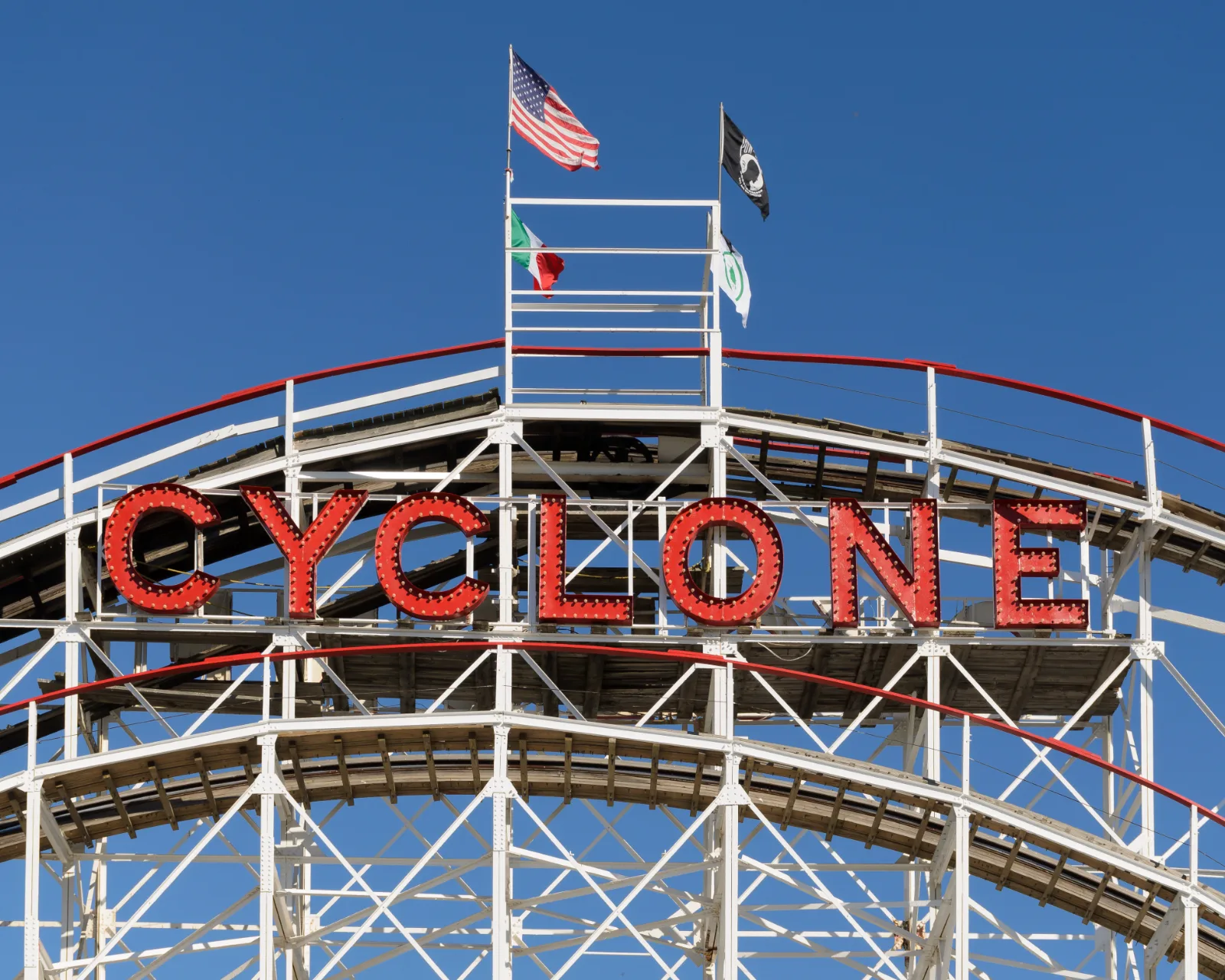
The operator gives an 85-foot drop, a maximum speed of 60 miles per hour, and 2,640 feet of track. These figures are useful for understanding scale, but they do not explain the whole appeal. The route is folded rather than simply stretched out, and looking through the structure reveals overlapping paths that a quick photograph can flatten.
Our featured photograph shows the actual Cyclone in September 2016. It is a record of the coaster at that time, not a historical construction image. Notice how the sign and structural framework work together: one announces the attraction to the street, while the other reveals the mechanism that makes the name meaningful.
Planning a visit today
Find the Cyclone at 834 Surf Avenue in Coney Island, Brooklyn. Check Luna Park's current calendar before traveling specifically to ride. Seasonal schedules, weather, and operational changes make a fixed year-round opening time unreliable. The official planning page also links to current prices, directions, accessibility information, and frequently asked questions.
A paid ride and an exterior look are different experiences. Confirm the current admission product and any exclusions before purchasing; do not assume every park package includes every attraction. The Cyclone's official ride page currently lists a 54-inch minimum height for riding alone. Read the operator's full restrictions and ask staff about individual accessibility needs rather than treating a height requirement as the complete eligibility policy.
Allow time to observe the attraction before joining a queue. Keep cameras and belongings secured according to staff instructions, and take exterior photographs from public areas without obstructing people. A working landmark is still an operating ride, so barriers and staff directions matter.
For more Brooklyn history in our archive, read the Brooklyn Bridge guide or the Dyker Heights Christmas Lights feature. These are separate journeys, not neighboring stops on the same short walk.
Brooklyn Bridge: https://plain-sight-jade.vercel.app/places/united-states/new-york/brooklyn-bridge
Dyker Heights: https://plain-sight-jade.vercel.app/places/united-states/new-york/dyker-heights-christmas-lights
Sources and photograph credit
Historic Districts Council: https://hdc.org/buildings/the-cyclone/
Luna Park ride information: https://lunaparknyc.com/rides/coney-island-cyclone/
Luna Park historical timeline: https://lunaparknyc.com/about/
Current planning information: https://lunaparknyc.com/plan/
Photograph: King of Hearts, September 24, 2016, CC BY-SA 4.0. Resized and converted to WebP; image remains under the same license. Source: https://commons.wikimedia.org/wiki/File:Coney_Island_Cyclone_New_York_September_2016_001.jpg
Saved from the wrecking ball
By the late 1960s the Cyclone was in trouble. Coney Island's attendance had been sliding for years, and the coaster — which had thrilled riders through four decades — was deteriorating. In 1971, New York City bought the ride for $1 million, and the plan was not preservation: the city intended to demolish it, with talk of expanding the neighboring aquarium onto the site. The Cyclone was written off as an eyesore. The backlash was immediate. Coaster enthusiasts and locals organized a "Save the Cyclone" campaign, and city officials soon concluded that tearing down the Island's most famous ride would be, in their own assessment, potentially disastrous to Coney Island's economy. In April 1975 the city invited sealed bids to lease the coaster to a private operator. The winners were Dewey and Jerome Albert, owners of the adjacent Astroland amusement park, who bid $57,000 a year. The Alberts put carpenters and ironworkers to work, spent $60,000 on the refurbishment, and reopened the Cyclone on July 3, 1975. It has been running more or less ever since — through Astroland's closure in 2008, through a stint as a standalone operation, and into the hands of the new Luna Park, which took over management in 2011.
Lore of the ride
The Cyclone's reputation has always run ahead of its statistics. At the 1988 public hearing for its landmark designation, supporters entered into the record the opinion of Charles Lindbergh, who had ridden the coaster about two years after his solo flight across the Atlantic. "A ride on Cyclone is a greater thrill than flying an airplane at top speed," Lindbergh had said. It was the kind of endorsement money couldn't buy, and it helped make the case that the coaster was a cultural artifact, not just a ride. Astroland had its own ways of keeping the legend fresh. In the early 1980s, as part of the park's reopening celebrations, the Cyclone ran backwards on weekdays — the same track, the same drops, in reverse, under the name "Back-Fire." Employees also passed down older stories, like the 1948 tale of Emilio Franco, a mute coal miner who reportedly screamed "I feel sick" on the ride and fainted after hearing his own voice for the first time. The design underneath the lore is a triple out-and-back layout: a 75-foot lift hill feeds an 85-foot first drop at a 58.1-degree angle, pulling 3.75 G's, with the whole two-and-a-half minutes folded into a plot once occupied by the Switchback Railway — America's first roller coaster, which opened in 1884. In 2016, Luna Park finished a multi-year refurbishment of the track with Great Coasters International. Enthusiasts worried the work would smooth away the roughness that defines the ride. It didn't. The Cyclone survived Hurricane Sandy's flooding in 2012, sat out the 2020 season for the pandemic, and reopened in 2021 — still rough, still fast, and still the landmark that moves.
Location Photography


Gallery photos: Leonard J. DeFrancisci (CC BY-SA 3.0), Kidfly182 (CC BY-SA 4.0), King of Hearts (CC BY-SA 4.0), King of Hearts (CC BY-SA 4.0) via Wikimedia Commons.